May 23, 2026
 7 Min
 No Comment
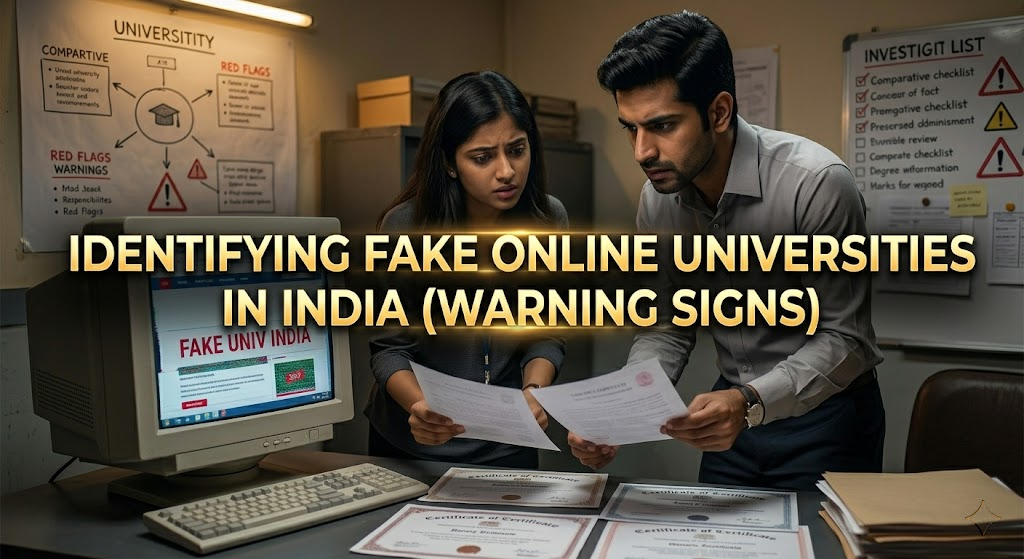
Online education in India has grown rapidly over the past few years. Flexible learning, affordable fees, and remote access have made digital education attractive for students and working professionals alike. However, this growth has also created a dangerous rise in fake online universities india students unknowingly fall victim to every year.
Many fraudulent institutions promise quick degrees, guaranteed placements, and unrealistic career opportunities. Some even use fake accreditation logos and misleading advertisements to appear legitimate. Unfortunately, students often realize the truth only after spending significant money and valuable time.
The consequences can be serious. Fake degrees may become invalid for jobs, higher education, or government applications. In some cases, students lose lakhs of rupees to fraudulent institutions that disappear entirely.
According to official higher education advisories from University Grants Commission (UGC) India, students should always verify university recognition carefully before taking admission.
Students researching safe education choices and career planning can also explore guidance through OneGrasp Education Insights.
Why Fake Online Universities Are Increasing
The demand for online education has expanded rapidly across India.
As more students seek:
- Flexible degrees
- Affordable learning
- Career-focused programs
- Remote education
fraudulent institutions are exploiting this demand aggressively.
Fake universities often target:
- Rural students
- Working professionals
- Competitive exam aspirants
- International students
- People unfamiliar with UGC regulations
Many scams operate through aggressive social media advertising and fake admission counselors.
What Makes an Online University Fake?
A fake online university is typically an institution that:
- Lacks official recognition
- Offers invalid degrees
- Uses fake accreditation claims
- Operates without regulatory approval
- Misleads students through false promises
In India, legitimate online universities usually require recognition from:
- UGC
- UGC-DEB
- AICTE (for technical programs in some cases)
Without proper approval, degrees may have limited or zero official validity.
Always Verify UGC-DEB Approval
The most important step is verifying whether the university is approved by the Distance Education Bureau (DEB) under UGC.
Students should never trust advertisements alone.
Official verification can be checked directly through:
UGC-DEB Official Portal
Key Things to Verify
| Verification Area | Why It Matters |
|---|---|
| UGC Recognition | Degree validity |
| DEB Approval | Online program legitimacy |
| NAAC Accreditation | Quality standards |
| Official Website | Authentic communication |
If a university is missing from official approval lists, students should avoid it completely.
Unrealistic Promises Are a Major Red Flag
Fake institutions often attract students using unrealistic claims.
Common Scam Promises
- Guaranteed government jobs
- Degrees without exams
- Instant graduation
- 100% placement guarantee
- Extremely low fees with “lifetime validity”
Legitimate universities never guarantee jobs or instant qualifications.
Education still requires:
- Attendance
- Assessments
- Exams
- Academic performance
If something sounds too easy, it usually deserves careful scrutiny.
Check the Website Carefully
Fraudulent universities often have poorly maintained websites.
Warning signs include:
- Grammar mistakes
- Fake testimonials
- Broken links
- Missing contact details
- No physical address
- Generic accreditation logos
Students should also verify:
- Official domain authenticity
- Faculty information
- Transparent fee structure
- Real admission process
Professional-looking websites alone do not guarantee legitimacy.
Beware of Fake Accreditation Claims
Some fake institutions misuse logos from:
- UGC
- AICTE
- NAAC
- International accreditation agencies
Always verify claims directly through official regulatory websites.
According to education quality discussions published by National Assessment and Accreditation Council (NAAC), accreditation status should always be independently verified.
Extremely Cheap Degrees Can Be Suspicious
Affordable education is possible, but unrealistically cheap degree offers can signal fraud.
Example
| Genuine Program | Suspicious Offer |
|---|---|
| Structured semester fees | “One-time payment for lifetime degree” |
| Exams and assignments | “No exams required” |
| UGC-approved curriculum | “Fast-track guaranteed certification” |
Students should compare fee structures across multiple universities before applying.
Search for Real Student Reviews
One of the smartest ways to identify fake universities is researching authentic student experiences.
Look for:
- Independent review platforms
- LinkedIn alumni profiles
- Reddit discussions
- YouTube student reviews
- Google reviews carefully
However, students should also be cautious because fake positive reviews are common.
Authentic reviews usually contain balanced experiences instead of exaggerated praise.
Professionals exploring future-ready education and safe learning opportunities can also stay updated through OneGrasp Career Resources.
Avoid Admission Pressure Tactics
Fraudulent institutions often create urgency artificially.
Common tactics include:
- “Last seat remaining”
- “Admission closing today”
- “Limited scholarship offer”
- Constant phone pressure
Legitimate universities provide clear timelines and transparent processes instead of aggressive emotional pressure.
Expert Insight / Analysis
One of the biggest problems in India’s online education space is that many students prioritize convenience over verification.
Experts increasingly warn learners against focusing only on:
- Cheap fees
- Fast admissions
- Influencer promotions
- Social media advertisements
Instead, students should evaluate:
- Official recognition
- Long-term degree validity
- Industry reputation
- Alumni outcomes
- Placement transparency
Another major trend is that employers are becoming more aware of fake institutions. As a result, background verification processes are becoming stricter across both private and government sectors.
This means choosing a legitimate university is more important than ever.
Common Mistakes Students Make
Many students unintentionally fall into online education scams due to avoidable mistakes.
Common issues include:
- Not verifying UGC approval
- Trusting WhatsApp admission agents
- Choosing based only on low fees
- Ignoring official websites
- Skipping review research
- Falling for guaranteed job promises
Another major mistake is assuming all online degrees are automatically valid.
Recognition matters significantly.
Latest Trends / Updates
UGC is increasingly publishing warning lists about fake universities and unapproved online programs in India.

AI-powered verification and digital credential systems are improving education transparency.

Students are becoming more aware of online education scams through social media discussions and review platforms.

Many employers now conduct stricter degree verification checks during recruitment.

Hybrid learning and officially approved online degree programs are gaining stronger acceptance across industries.

Government regulations around online education platforms are becoming stricter to reduce fraud and improve accountability.
Real-Life Example / Mini Case Study
Consider the example of Amit, a working professional from Delhi.
He found an online MBA advertisement promising “guaranteed placement” and “degree completion in one year without exams.” The fees appeared extremely affordable, and admission counselors pressured him to pay immediately for a “limited scholarship.”
Before making payment, Amit checked the UGC-DEB portal and discovered the university was not approved for online education.
Instead of risking his money and career future, he later enrolled in a verified UGC-approved program.
His experience highlights why proper verification is essential before online admissions.
Pros and Cons of Online Universities in India
| Pros | Cons |
|---|---|
| Flexible learning opportunities | Fake institutions exist |
| Affordable education options | Verification confusion |
| Career-focused programs | Aggressive marketing scams |
| Growing employer acceptance | Variable quality standards |
| Accessible from anywhere | Hidden fee risks |
Beginner vs Expert Verification Approach
| Beginner Thinking | Expert Thinking |
|---|---|
| Trusts advertisements blindly | Verifies official approvals |
| Focuses only on low fees | Evaluates long-term validity |
| Believes guaranteed job claims | Studies realistic outcomes |
| Applies quickly under pressure | Researches carefully |
| Ignores accreditation details | Verifies through official portals |
How to Verify an Online University Safely
Students can follow these practical steps before admission:
- Verify UGC-DEB approval.
- Check official accreditation status.
- Research independent reviews.
- Compare fee structures carefully.
- Avoid pressure-based admissions.
- Verify placement claims realistically.
- Apply only through official websites.
Careful research can prevent major financial and career mistakes.
Quick Checklist
- Verify UGC recognition
- Check DEB approval
- Research student reviews
- Avoid unrealistic promises
- Compare fees carefully
- Use official university websites only
- Never rush admissions
Conclusion
Identifying fake online universities in India has become essential as digital education continues expanding rapidly. While online learning offers excellent opportunities, students must approach admissions carefully and prioritize verification over marketing promises.
The smartest approach is to research thoroughly, verify official approvals, compare institutions carefully, and avoid pressure-based admissions. A valid degree is not just about affordability — it is about long-term credibility, career value, and professional security.
Whether you are a student, working professional, or parent, investing time in proper verification can prevent major financial and educational mistakes. Platforms like OneGrasp can also help learners stay informed about safe education choices, career planning, and future-ready opportunities in India.
FAQs
Students should verify UGC-DEB approval through official government portals before applying.
No. Only degrees from officially recognized universities are considered valid.
Many fake institutions make false placement claims without real employer partnerships.
Not always. Government universities may offer affordable programs legitimately. However, unrealistically cheap degrees require caution.
Fake degrees may become invalid for jobs, promotions, higher studies, and government applications.