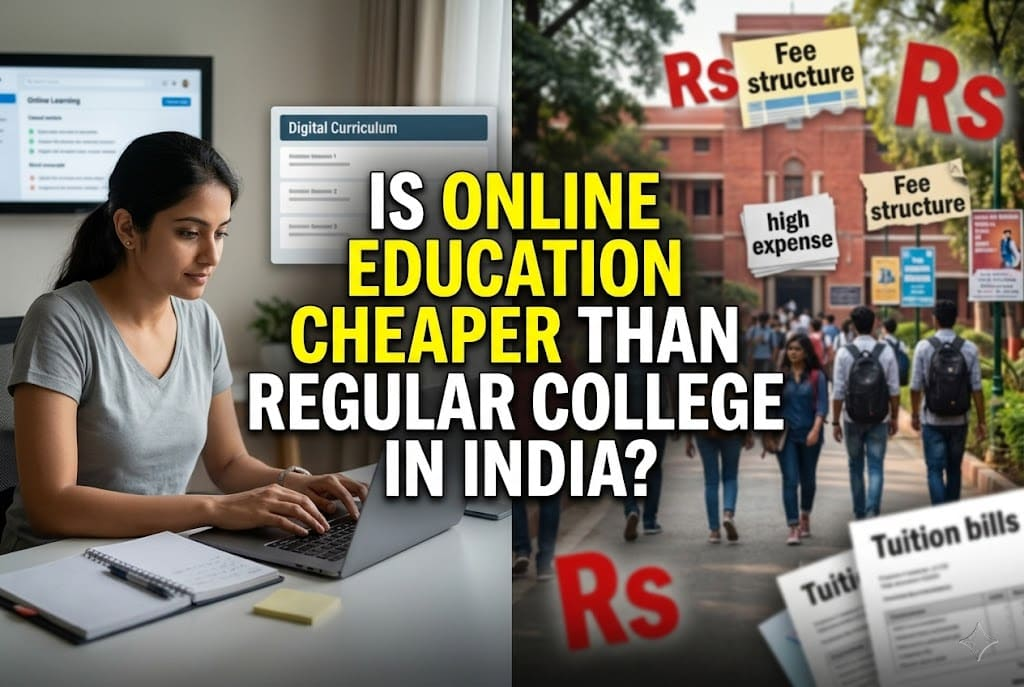
Education costs in India have increased significantly over the past decade. Rising tuition fees, hostel expenses, transportation, coaching costs, and city living expenses have made higher education financially challenging for many families. As a result, more students are now exploring whether online education cheaper india learners increasingly choose can provide a more affordable alternative to traditional college education.
The answer in most cases is yes.
Online education is usually significantly cheaper than regular college education in India when considering both direct and indirect expenses. However, affordability alone should not be the only factor when choosing between online and offline learning.
Students must also evaluate:
Career goals
Learning style
Degree credibility
Industry requirements
Practical exposure
Online learning has become especially popular among working professionals, students from smaller cities, and budget-conscious learners seeking flexible education pathways.
According to digital education insights from University Grants Commission (UGC) India, online education is becoming an increasingly important part of India’s higher education ecosystem.
Students exploring affordable career-focused education can also discover resources through OneGrasp Education Insights.
Despite cost advantages, online education may not suit every career path equally.
Fields requiring heavy practical training may still benefit more from offline learning.
Examples
Better for Online Learning
Better for Offline Learning
Digital marketing
Medical training
Business management
Laboratory-intensive sciences
Data analytics
Clinical education
Software development
Hands-on engineering labs
Students should align education mode with career requirements carefully.
Expert Insight / Analysis
One of the biggest shifts in India’s education system is that affordability is becoming a major competitive advantage.
Experts increasingly believe online education will continue expanding because rising traditional education costs are becoming unsustainable for many families.
Another important trend is “blended employability.”
Employers are increasingly focusing on:
Skills
Practical ability
Communication
Adaptability
instead of judging candidates solely by learning format.
However, experts also caution students against choosing online education only because it is cheaper.
The best education choice depends on balancing:
Cost
Career goals
Learning effectiveness
Industry acceptance
Common Mistakes Students Make
Many students make financial and educational mistakes while comparing online and offline learning.
Common issues include:
Choosing courses only based on low fees
Ignoring university credibility
Underestimating self-discipline needs
Not researching industry requirements
Falling for fake universities
Ignoring networking opportunities
Another major mistake is assuming all online degrees are equally valuable.
Recognition and practical learning matter greatly.
Latest Trends / Updates
UGC-approved online degree programs are expanding rapidly across India.

AI-powered digital learning platforms are improving affordability and personalized education experiences.

Working professionals are increasingly choosing online education for promotions and career transitions.

Hybrid education models combining online flexibility with practical exposure are becoming more popular.

Companies are focusing more on skill-based hiring instead of judging candidates only by education mode.

Affordable internet access and smartphone learning continue driving online education growth across smaller Indian cities.
Real-Life Example / Mini Case Study
Consider the example of Sneha, a student from Vijayawada.
Her family could not afford relocating her to Bengaluru for a private BBA program due to hostel and living costs. Instead, she enrolled in a UGC-approved online business degree while learning digital marketing through certifications.
Because she studied from home, her family saved substantial living expenses. Meanwhile, she also completed freelance projects during her studies.
By graduation, she had both a degree and practical work experience.
Her experience highlights how online education can provide strong financial and career advantages when used strategically.
Pros and Cons of Online Education vs Regular College
Pros
Cons
Lower overall costs
Requires strong self-discipline
Flexible schedules
Limited campus experience
Learn from anywhere
Networking may require extra effort
Suitable for working professionals
Practical exposure varies
Affordable career growth
Some industries still prefer offline learning
Beginner vs Expert Education Decision Approach
Beginner Thinking
Expert Thinking
Chooses only based on fees
Evaluates ROI carefully
Ignores accreditation
Verifies official approval
Focuses only on degrees
Builds practical skills too
Follows trends blindly
Studies industry demand
Avoids research
Compares long-term value
When Online Education Makes the Most Sense
Online learning may be ideal for:
Budget-conscious students
Working professionals
Career switchers
Students in smaller cities
Learners needing flexible schedules
However, students seeking strong campus exposure and practical labs may still benefit more from traditional education.
What to Do Next (Actionable Steps)
If you are comparing online and regular college education, follow these practical steps:
Online education is generally much cheaper than regular college education in India, especially when considering tuition, living expenses, transportation, and flexibility benefits. For many students and working professionals, it provides an affordable pathway toward career growth and skill development.
However, affordability alone should not drive educational decisions. The real value depends on university credibility, career alignment, practical learning, and long-term employability.
In today’s rapidly evolving economy, both online and offline education can succeed when combined with strong skills, adaptability, and continuous learning. Platforms like OneGrasp can also help learners stay informed about affordable education options, career planning, and future-ready opportunities in India.
FAQs
Yes. Online education usually costs significantly less due to lower tuition and reduced living expenses.
Yes, if they are offered by UGC-approved universities.
Yes. Employers increasingly value practical skills and recognized qualifications alongside experience.
Hostel fees, transportation, relocation, food, and campus expenses often increase total education costs significantly.
Yes. Flexible schedules make online learning especially useful for employees and career switchers.

 May 23, 2026
 7 Min
 No Comment