May 25, 2026
 7 Min
 No Comment
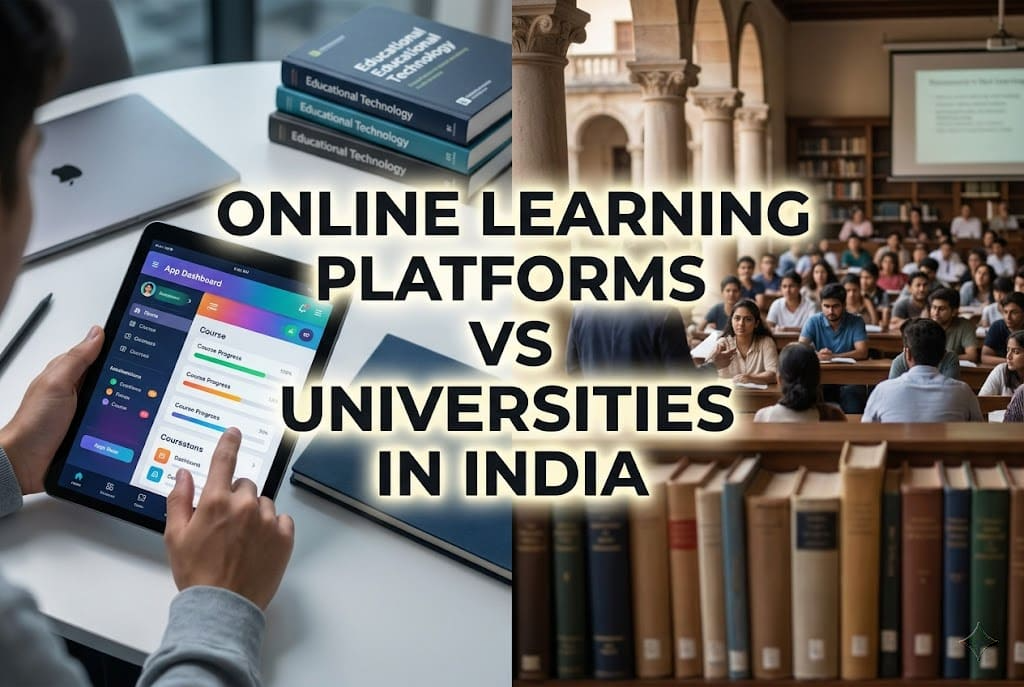
India’s education system is experiencing a major digital shift. A few years ago, students mainly relied on schools, colleges, and universities for career growth. Today, however, digital learning platforms are competing directly with traditional institutions by offering affordable, flexible, and industry-focused education.
This transformation has created an important debate around online learning platforms universities and which option delivers better career outcomes in modern India.
Should students pursue university degrees for long-term academic credibility? Or should they focus on skill-based platforms that teach practical industry tools faster?
The answer is no longer simple.
Online learning platforms now offer certifications in AI, coding, digital marketing, business analytics, and finance from global instructors. Meanwhile, universities continue providing structured education, formal qualifications, research exposure, and government-recognized degrees.
As industries evolve rapidly through AI, automation, and digital transformation, learners must understand the strengths and limitations of both pathways before making educational decisions.
Choosing correctly can impact employability, career flexibility, salary growth, and long-term professional opportunities.
What Are Online Learning Platforms?
Online learning platforms are digital education systems designed primarily for flexible and skill-oriented learning.
Popular examples include:
These platforms usually focus on:
- Practical skills
- Short-term certifications
- Career-focused learning
- Industry-relevant tools
- Self-paced education
Students can also explore educational guidance and digital learning resources through OneGrasp Education Resources for better academic and career planning.
What Are Online Universities?
Online universities are accredited higher education institutions that deliver formal academic degree programs digitally.
Programs commonly include:
- Online BA
- Online BCom
- Online BBA
- Online MBA
- Online MCA
According to the University Grants Commission, recognized online universities in India must comply with regulatory guidelines for online education delivery.
Unlike skill platforms, universities usually provide:
- Degree qualifications
- Structured academic curriculum
- Semester systems
- Formal examinations
- Long-term academic progression
Online Learning Platforms Universities: Key Differences
Understanding the practical differences is essential before choosing either option.
| Online Learning Platforms | Online Universities |
|---|---|
| Skill-focused learning | Academic degree programs |
| Short-term certifications | Long-term structured education |
| Flexible self-paced model | Semester-based system |
| Faster industry updates | More regulated curriculum |
| Practical execution focus | Academic foundation focus |
| Usually lower cost | Higher academic commitment |
Both models serve different educational and career objectives.
Who Should Choose Online Learning Platforms?
Online learning platforms are ideal for learners who want:
- Quick skill development
- Freelancing opportunities
- Career switching
- Industry-specific expertise
- Flexible self-paced learning
These platforms are especially valuable in fields such as:
- Digital marketing
- Coding
- Data analytics
- Graphic design
- AI tools
- Content creation
In many digital industries today, practical portfolios matter more than academic qualifications alone.
Who Should Choose Online Universities?
Online universities are better suited for students who need:
- Formal academic qualifications
- Government job eligibility
- Higher education pathways
- Long-term academic recognition
- Structured educational systems
Online degrees remain important for:
- Competitive examinations
- Corporate eligibility
- Postgraduate admissions
- Public sector jobs
Students planning traditional career paths often benefit more from recognized degree programs.
Cost Comparison: Platforms vs Universities
One major factor influencing students is affordability.
| Learning Type | Approximate Cost Range |
|---|---|
| Skill Platforms | Low to Moderate |
| Online Degrees | Moderate to High |
| Premium Certifications | Varies by institution |
| Professional Degrees | Long-term investment |
Skill platforms often provide affordable entry-level learning. Meanwhile, universities usually involve longer-term academic commitments.
However, cost alone should never determine educational decisions.
Career Value in Modern Industries
Modern employers increasingly value both practical skills and academic credibility.
Where Skill Platforms Excel
Skill platforms perform strongly in industries like:
- Technology
- Marketing
- Design
- Freelancing
- Startup ecosystems
Employers in these industries often prioritize:
- Portfolio quality
- Problem-solving ability
- Technical execution
- Real-world projects
Where Universities Still Matter
Universities remain highly important for:
- Government recruitment
- Traditional corporate hiring
- Regulated professions
- Higher academic studies
Degrees still provide formal credibility and broader educational foundations.
According to World Economic Forum Future of Jobs Report, continuous reskilling and digital adaptability are becoming essential in future employment markets.
Expert Insight: Why Hybrid Learning Is Becoming the Future
The modern education ecosystem is increasingly moving toward blended learning models.
Experts believe the strongest career strategy combines:
- Academic qualifications
- Industry certifications
- Practical project work
- Continuous upskilling
For example:
- A BCom student learns financial analytics online
- An MBA graduate studies AI tools
- A software developer learns cybersecurity certifications
This hybrid approach improves adaptability in rapidly evolving industries.
Moreover, AI and automation are changing skill requirements so quickly that continuous learning is becoming necessary even after formal graduation.
Common Mistakes Students Should Avoid
Many learners make emotional or trend-driven educational decisions.
| Mistake | Consequence |
|---|---|
| Choosing only based on low cost | Poor long-term value |
| Ignoring accreditation | Degree validity issues |
| Relying only on certificates | Weak academic foundation |
| Ignoring practical skills | Reduced employability |
| Following social media hype | Career misalignment |
Students should evaluate long-term goals carefully before selecting learning pathways.
Latest Trends and Updates
Artificial intelligence and adaptive learning technologies are rapidly transforming both universities and online learning platforms across India.

Several universities are now integrating industry certifications, AI-powered learning dashboards, and practical project modules into academic degree programs.

Meanwhile, online learning platforms are expanding professional certifications in areas such as AI, cybersecurity, data analytics, fintech, and digital business operations.

Hybrid education models combining formal university education with industry-oriented skill certifications are becoming increasingly popular among students and working professionals.

Employers are also gradually adopting skills-first hiring approaches while still valuing recognized academic qualifications for many structured career roles.
Real-Life Example: Combining Both Learning Models
Consider the example of Arjun, a BBA student from Andhra Pradesh.
While pursuing his online degree, he simultaneously completed digital marketing and analytics certifications through online learning platforms.
During college, he built freelance experience managing social media campaigns for local businesses. After graduation, his combination of formal education and practical skills helped him secure a stronger job role than many traditional graduates.
His experience reflects an increasingly common learning strategy among modern students.
Beginner vs Expert Educational Strategy
| Beginner Approach | Expert Approach |
|---|---|
| Chooses only one path | Combines both strategically |
| Focuses only on certificates | Builds practical portfolio |
| Ignores long-term planning | Aligns learning with career goals |
| Learns inconsistently | Maintains continuous upskilling |
| Follows trends blindly | Studies industry demand carefully |
Experienced professionals understand that education today is continuous rather than fixed.
Pros and Cons of Online Learning Platforms
| Pros | Cons |
|---|---|
| Flexible learning | No formal degree qualification |
| Affordable education | Quality varies widely |
| Fast skill acquisition | Requires self-discipline |
| Industry-oriented topics | High competition |
| Self-paced convenience | Limited academic depth |
Pros and Cons of Online Universities
| Pros | Cons |
|---|---|
| Recognized academic qualification | Longer duration |
| Useful for government jobs | More structured schedules |
| Strong educational foundation | Slower curriculum updates sometimes |
| Higher education eligibility | Higher overall commitment |
| Formal credibility | Practical exposure may vary |
What Students Should Do Next
Students should make educational decisions based on long-term career alignment rather than temporary trends.
Practical next steps include:
- Define career goals clearly
- Research industry demand
- Verify university accreditation
- Compare course outcomes carefully
- Build practical skills continuously
- Create real-world projects
- Combine academic and technical learning
Students should also verify university recognition through official bodies like National Assessment and Accreditation Council (NAAC) before enrolling in degree programs.
Quick Checklist
- Define career objectives
- Compare learning pathways
- Verify accreditation status
- Build practical portfolio
- Learn continuously
- Track industry trends
- Combine theory with execution
Conclusion
The debate around online learning platforms universities is no longer about which option is universally better. Instead, the real question is which learning model aligns best with individual career goals, industries, and long-term aspirations.
Online learning platforms offer speed, flexibility, affordability, and practical skill development for rapidly changing digital industries. Meanwhile, universities continue providing academic credibility, structured education, and eligibility for many traditional career pathways.
As India’s digital economy continues evolving, the most successful learners will likely be those who combine both approaches strategically.
In the modern workforce, degrees provide foundations, but continuous skill development creates long-term adaptability and career resilience.
The future of education in India is not purely traditional or purely digital. It is increasingly hybrid, flexible, and centered around lifelong learning.
FAQs
It depends on career goals. Platforms focus on practical skills, while universities provide formal academic qualifications.
In some digital industries, certifications and portfolios may matter more, but many careers still require formal degrees.
Yes, UGC-approved online universities are generally valid for many educational and employment purposes.
Technology, digital marketing, design, freelancing, and startup sectors highly value practical skills and certifications.
Yes, many students now combine academic degrees with industry certifications to improve employability and career flexibility.