April 24, 2026
 4 Min
 No Comment
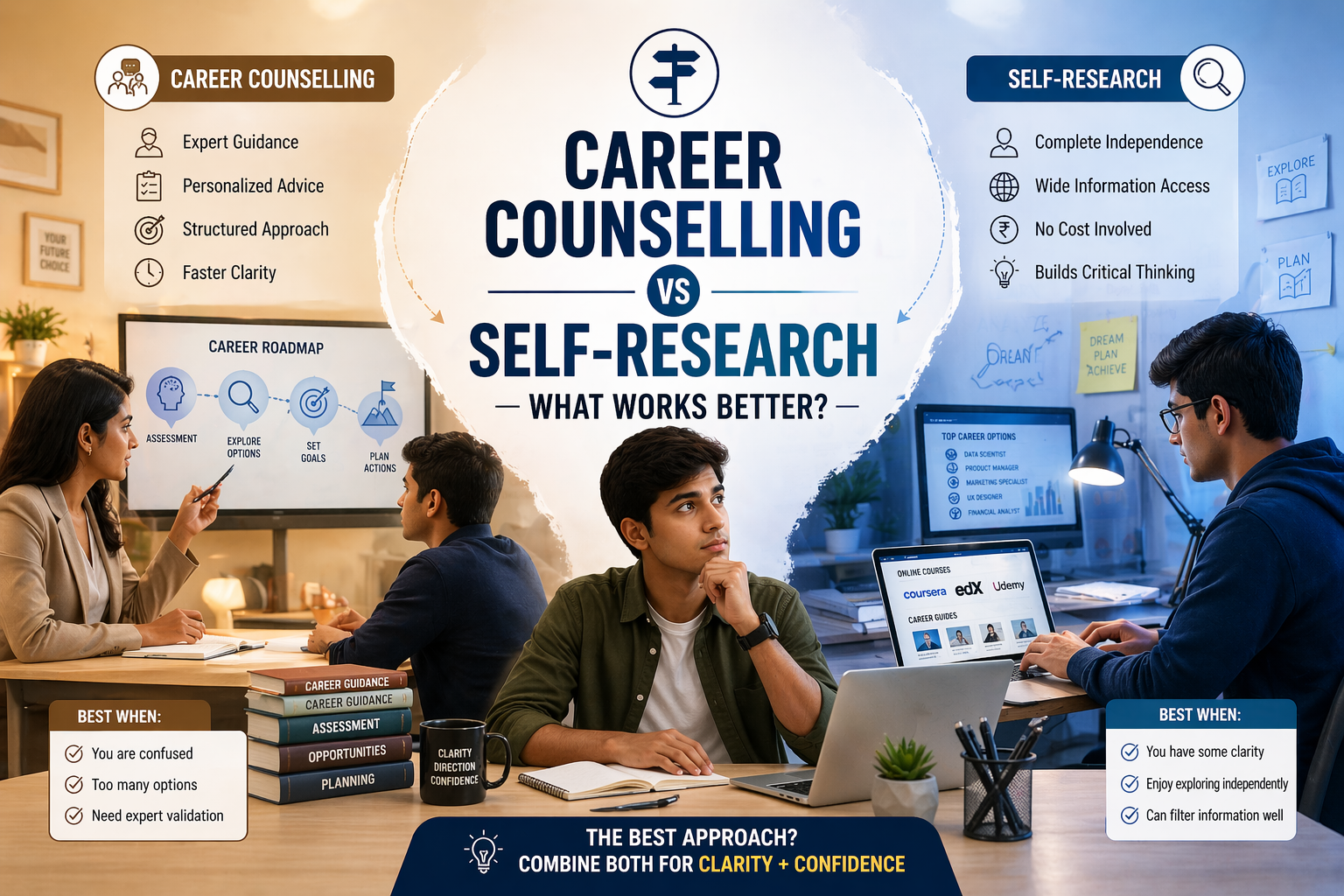
When Indian students weigh career counselling vs self research, understanding the strengths of each method can guide them toward clearer decisions.
Why career counselling vs self research matters for Indian students
If you ask students how they choose their career, most answers fall into two categories.
Some rely on career counselling.
Others prefer to figure things out on their own through research.
Both approaches are valid. But they are not equally effective in every situation.
The real question is not which one is better overall, but which one works better for you.
What Is Career Counselling?
Career counselling involves working with a trained professional who helps you:
- Understand your strengths and interests
- Explore suitable career options
- Plan your academic and professional path
Counsellors often use structured tools like assessments, discussions, and industry insights to guide you.
What Is Self-Research?
Self-research means taking responsibility for your own career decisions.
This includes:
- Searching online resources
- Watching career-related content
- Reading about industries and roles
- Talking to professionals
It is a more independent approach where you gather information and make decisions on your own.
Career Counselling: Pros and Limitations
Advantages
Career counselling provides:
- Structured guidance
- Expert insights
- Personalized recommendations
- Faster clarity
A good counsellor can help you avoid common mistakes and narrow down options quickly.
Limitations
However, there are some challenges:
- Quality varies between counsellors
- It can be expensive
- Some advice may feel generic
- Over-reliance can reduce independent thinking
Not all counselling services provide deep or practical insights.
Self-Research: Pros and Limitations
Advantages
Self-research offers:
- Complete control over decisions
- Access to unlimited information
- No cost involved
- Development of independent thinking
Students who actively research tend to understand their choices better.
Limitations
But it also has drawbacks:
- Information overload
- Difficulty verifying sources
- Lack of structured direction
- Slower decision-making
Many students spend months researching without reaching clarity.
Which One Works Better?
There is no one-size-fits-all answer.
Career counselling works better when:
- You are confused and need direction
- You have too many options
- You want expert validation
Self-research works better when:
- You already have some clarity
- You enjoy exploring independently
- You can filter information effectively
The Real Answer: Use Both Together
The most effective approach is not choosing one over the other.
It is combining both.
A practical strategy looks like this:
- Start with self-research to explore options
- Use career counselling to validate decisions
- Continue researching to deepen understanding
This approach gives you both clarity and confidence.
Common Mistakes Students Make
Many students go wrong by:
- Depending completely on counsellors
- Avoiding guidance altogether
- Following trends instead of interests
- Making decisions without enough information
Both extremes can lead to poor career choices.
Why This Matters for Indian Students
In India, career decisions are often influenced by:
- Family expectations
- Limited exposure to options
- Pressure to choose early
This makes it even more important to balance guidance and independent thinking.
Students who combine both approaches tend to make more informed decisions.
Practical Example
Consider a student choosing between engineering and business.
- Self-research helps them understand both fields
- Career counselling helps identify which suits their strengths
Together, they make a more confident decision.
FAQs
Is career counselling necessary?
Not always, but it can help if you are confused.
Can I choose a career through self-research alone?
Yes, but it may take more time and effort.
Which is more reliable?
Both are reliable when used correctly.
Should I trust online information?
Only from credible sources.
When should I consider counselling?
When you feel stuck or uncertain.
How to Get Started
If you are unsure where to begin:
- • Start with basic research about careers
- • Shortlist a few options
- • Seek guidance if needed
- 👉 You can also explore structured guidance here: https://onegrasp.edumilestones.com/
This helps you move from confusion to clarity more efficiently.
Final Thoughts
Career decisions are important, but they don’t need to be complicated.
Career counselling and self-research are not opposites.
They are tools.
Using only one can limit your perspective.
Using both can give you a clearer and more balanced view.
The goal is simple:
Make informed decisions based on both knowledge and guidance.
Frequently Asked Questions
Is career counselling necessary for Indian students?
It isn’t mandatory, but professional guidance can speed up clarity when students feel confused or overwhelmed.
Can I rely solely on self-research to choose a career?
Yes, but it may take longer and requires disciplined filtering of information to avoid overload.
What are the main drawbacks of self-research?
Students may face information overload, difficulty verifying sources, and slower decision‑making without structured direction.
How does career counselling complement self-research?
Counselling validates self‑gathered insights, offers expert feedback, and helps narrow options more efficiently.
When should I consider professional career counselling?
When you feel stuck, have too many options, or need expert validation to confirm your self‑research findings.
Related Posts: