Discover 500+ International Scientific Conferences
Browse events

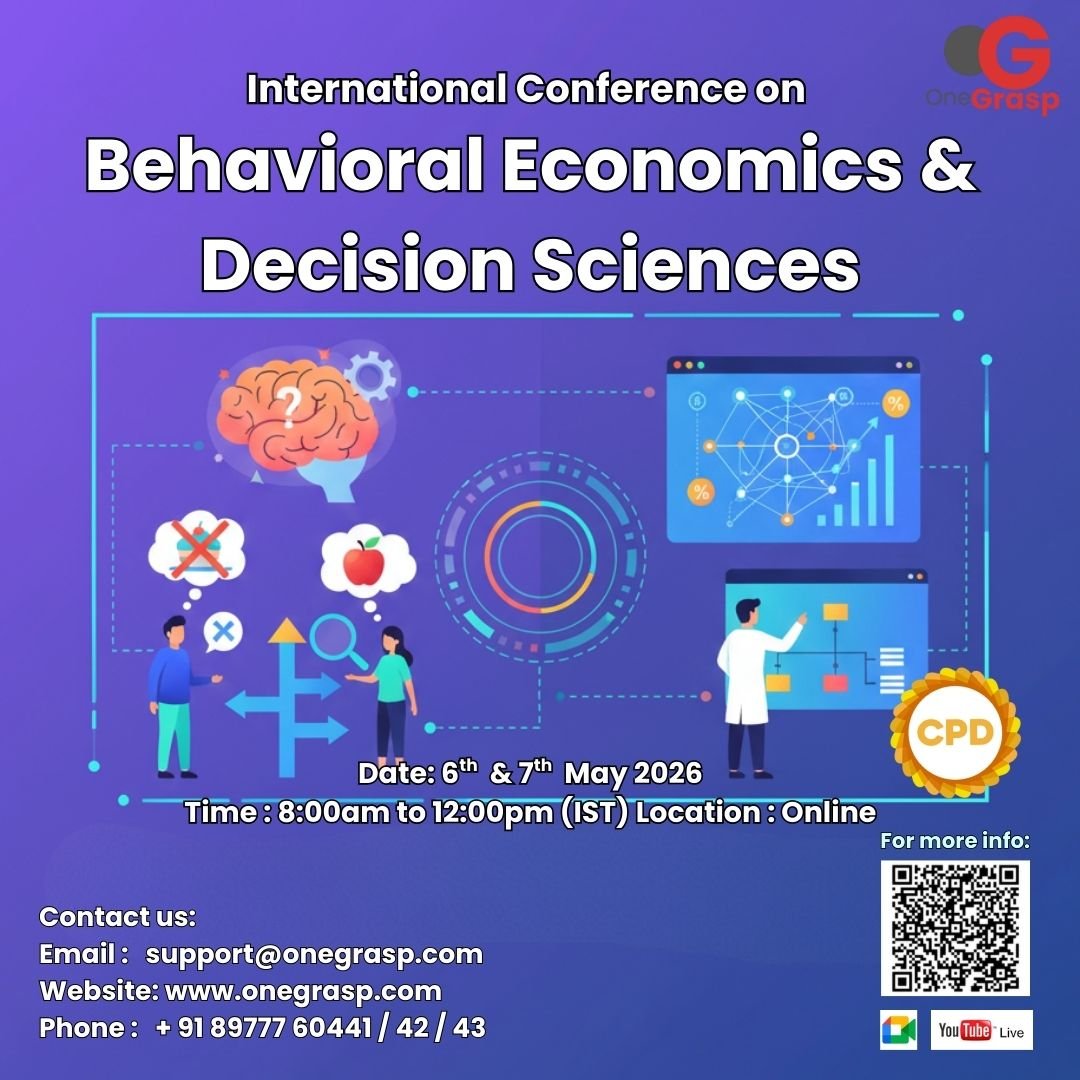
Date: 6th & 7th May 2026 | Time: 8.00 am – 12:00 pm (IST) | Location: Online
Overview:
This conference brings together economists, psychologists, neuroscientists, business leaders, policy makers, and researchers to explore the intersections of behavioral economics and decision sciences. It examines cognitive biases, heuristics, choice architecture, social incentives, and the psychological mechanisms underlying economic and organizational decision-making. Sessions highlight traditional and experimental research, use of behavioral insights for policy and business, and applications for healthcare, finance, development, and public welfare.
Structure and Sessions (Who Does What):
Participate and Contribute (Who Benefits):
Benefits:
Abstract Topics / CFP (Call for Papers) Tracks:
Detailed Program Grid (2 Half Days – 8 AM to 12 PM IST)
| Time | Day 1 | Day 2 |
| 08:00–08:15 | Opening Ceremony & Welcome Address | Recap of Day 1 & Opening Keynote |
| 08:15–09:00 | Keynote I: Heuristics, Biases & Decision Theory | Keynote III: Behavioral Insights for Policy & Market Design |
| 09:00–09:45 | Technical I: Choice Architecture & Incentives | Technical III: Behavioral Modeling & Data Science |
| 09:45–10:00 | Q&A and Networking Break | Q&A and Networking Break |
| 10:00–10:45 | Technical II: Social Influence & Peer Effects | Panel: Behavioral Finance & Development Economics |
| 10:45–11:30 | Abstract Presentations & Case Studies | Technical IV: Experimental Methods & Real-World Applications |
| 11:30–12:00 | Participant Feedback & Closing Remarks | Closing Ceremony & Certificate Distribution |
Submit Abstract & Registration
| Conference Dates | Conference Title | Timing (IST) | Abstract Submission Deadline | Registration Deadline |
| 6th, 7th May 2026 | IVC on Behavioral Economics & Decision Sciences | 8:00 AM – 12:00 PM | 27th April 2026 | 29th April 2026 |
Abstract Guidelines:
Conclusion:
The International Virtual Conference on Behavioral Economics & Decision Sciences provides an interdisciplinary platform for sharing, learning, and advancing research and practice in human decision-making. It inspires both academic innovation and real-world behavioral change.