June 4, 2026
 7 Min
 No Comment
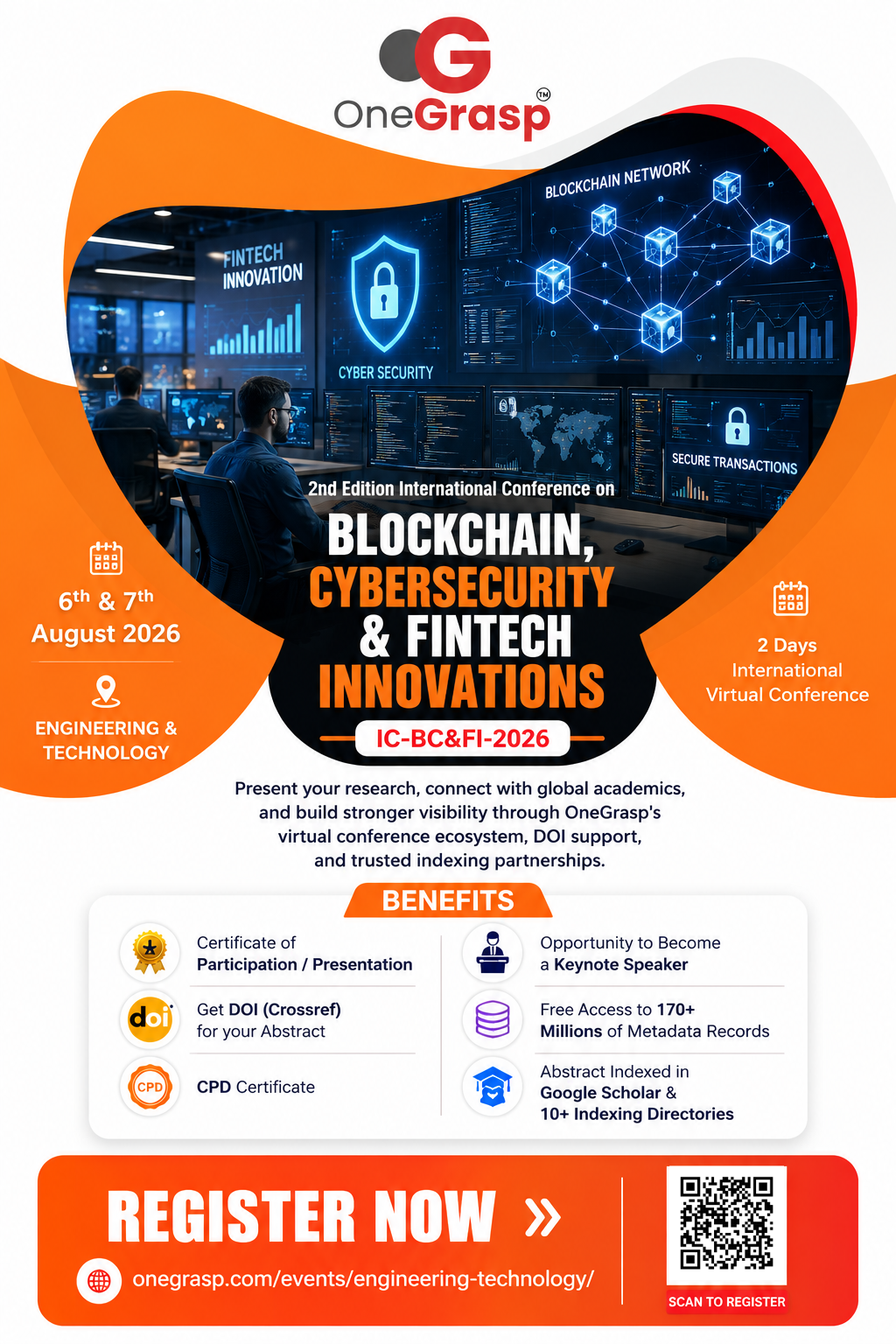
The financial world is undergoing one of its most radical transformations in history, driven by blockchain technology, advanced cybersecurity systems, and rapidly evolving fintech ecosystems. As digital transactions scale globally, ensuring trust, transparency, and security has become a critical priority for governments, enterprises, and financial institutions. This is where Blockchain Cybersecurity Fintech innovation plays a central role in shaping the future of global finance.
The 2nd Edition International Conference on Blockchain, Cybersecurity & Fintech Innovations (IC-BC&FI-2026) brings together researchers, developers, industry leaders, cybersecurity experts, fintech innovators, and policymakers to explore how emerging technologies are reshaping financial systems, digital trust frameworks, and decentralized ecosystems.
Conference Registration:
https://onegrasp.com/events/engineering-technology/1st-edition-international-conference-on-blockchain-cybersecurity-fintech-innovations-ic-bcfi/
This conference acts as a bridge between academic research and real-world financial applications, focusing on secure digital transformation in banking, investments, payments, and decentralized systems.
What the Conference Is About
Featured Snippet Answer
IC-BC&FI-2026 is an international conference focused on blockchain technology, cybersecurity frameworks, and fintech innovation to enhance secure digital financial systems and decentralized economic models.
Modern financial systems rely heavily on digital infrastructure. With the rapid rise of cryptocurrencies, digital banking, AI-driven trading systems, and decentralized finance (DeFi), security and trust have become critical concerns.
According to global financial research, cybersecurity threats in financial systems continue to increase as digital adoption expands, making blockchain-based security frameworks and zero-trust architectures essential for resilience.
This conference explores how blockchain can improve transparency, how cybersecurity can protect financial ecosystems, and how fintech innovation can deliver faster, safer, and more inclusive financial services.
Why Blockchain Cybersecurity Fintech Matters Today
Featured Snippet Answer
Blockchain cybersecurity fintech matters because it ensures secure financial transactions, prevents cyber fraud, improves transparency, and supports decentralized digital economies.
Financial systems are among the most targeted sectors for cyberattacks due to the high value of sensitive data and transactions. Traditional security models are no longer sufficient against sophisticated threats like ransomware, phishing, and insider attacks.
Blockchain introduces tamper-resistant ledgers that enhance trust in financial transactions, while cybersecurity frameworks protect digital assets from unauthorized access. Fintech innovations further improve efficiency through automation, AI-driven analytics, and digital payment systems.
Global institutions such as the World Economic Forum emphasize the importance of digital trust and cybersecurity resilience in modern financial systems, especially as economies transition toward cashless ecosystems.
Blockchain Cybersecurity Fintech and Digital Finance Evolution
Featured Snippet Answer
Blockchain cybersecurity fintech is transforming digital finance by enabling secure transactions, decentralized systems, fraud prevention, and intelligent financial services.
The convergence of blockchain, cybersecurity, and fintech is creating a new financial paradigm:
- Blockchain ensures immutable transaction records
- Cybersecurity protects sensitive financial data
- Fintech enables automation and digital financial services
This integration supports innovations such as smart contracts, decentralized finance (DeFi), digital wallets, and tokenized assets.
Recent research highlights blockchain-based zero-trust security models that strengthen fintech ecosystems against cyber threats while maintaining operational efficiency.
Conference Themes and Research Areas
Featured Snippet Answer
IC-BC&FI-2026 covers blockchain technology, cybersecurity frameworks, fintech innovation, digital banking, decentralized finance, and AI-driven financial systems.
Key topics include:
- Blockchain architecture and protocols
- Cybersecurity in financial systems
- Fintech innovation and digital banking
- Smart contracts and decentralized applications
- Cryptocurrency security and regulation
- AI in financial fraud detection
- Risk management and compliance systems
- Tokenization and digital assets
- Zero-trust security frameworks
- RegTech and financial governance
These areas reflect the growing need for secure, transparent, and scalable financial technologies in global markets.
Emerging Trends in Blockchain Cybersecurity Fintech
Featured Snippet Answer
Key trends include decentralized finance (DeFi), AI-driven fraud detection, blockchain security frameworks, digital identity systems, and tokenized financial ecosystems.
Financial technology is rapidly evolving beyond traditional banking systems. Institutions are increasingly adopting:
- AI-powered cybersecurity monitoring
- Blockchain-based identity verification
- Cross-border digital payment systems
- Smart contract automation
- Tokenized real-world assets
Industry reports show that smart fintech systems are transforming banking, lending, insurance, and payment ecosystems through advanced data analytics and AI integration.
Latest Trends & Updates
Blockchain adoption in financial services is expanding from experimental use cases to enterprise-level integration. Banks and fintech companies are actively deploying blockchain for cross-border payments, fraud detection, and compliance automation.
Cybersecurity in financial ecosystems is shifting toward zero-trust architectures, where every access request is continuously verified. This model significantly reduces insider threats and unauthorized access risks.
Fintech innovation is increasingly driven by AI and machine learning, enabling predictive analytics for credit scoring, fraud detection, and investment forecasting. These technologies are improving efficiency and decision-making in financial institutions.
Regulatory technology (RegTech) is emerging as a key trend, helping organizations comply with complex financial regulations through automation and real-time monitoring systems.
Future research directions include quantum-resistant blockchain security, AI-driven decentralized finance systems, interoperable blockchain networks, and privacy-preserving financial technologies.
Expert Insight: Long-Term Impact on Financial Systems
The integration of blockchain, cybersecurity, and fintech is expected to redefine global financial infrastructure over the next decade. Financial systems will become more decentralized, automated, and intelligent.
Key long-term impacts include:
- Reduction in financial fraud through blockchain verification
- Increased adoption of decentralized financial ecosystems
- Enhanced transparency in global transactions
- Stronger cybersecurity frameworks for digital banking
- Greater financial inclusion through fintech solutions
However, challenges remain in scalability, regulation, interoperability, and ethical AI deployment in financial systems. Conferences like IC-BC&FI-2026 play a critical role in addressing these issues through interdisciplinary collaboration.
Real-Life Example: Blockchain in Fintech Security
A fintech startup developing a digital payment platform faced repeated fraud attempts and unauthorized access issues. Traditional security systems were unable to fully prevent these attacks.
After adopting blockchain-based authentication and zero-trust security principles, the platform introduced immutable transaction tracking and multi-layer verification systems.
As a result, fraud incidents significantly decreased, and user trust increased, allowing the startup to expand into international markets. This demonstrates how blockchain cybersecurity fintech solutions can directly improve financial system resilience.
Beginner vs Expert Comparison
| Beginners | Experts |
|---|---|
| Learn blockchain basics | Design secure financial ecosystems |
| Understand cybersecurity concepts | Build zero-trust architectures |
| Study fintech tools | Develop decentralized finance systems |
| Focus on theory | Implement scalable systems |
| Individual learning | Industry transformation strategies |
Pros and Cons of Participating
| Pros | Cons |
|---|---|
| Global networking opportunities | Time commitment |
| Exposure to advanced research | Competitive participation |
| Industry collaboration | Technical complexity for beginners |
| Publication opportunities | Preparation required |
| Career advancement | Fast-evolving subject matter |
Common Mistakes to Avoid
Ignoring Security Aspects
Many researchers focus only on blockchain innovation without addressing cybersecurity risks. This limits real-world applicability.
Overlooking Regulatory Challenges
Fintech solutions must comply with evolving financial regulations across regions.
Weak Integration of Technologies
Blockchain, AI, and cybersecurity must be studied together, not in isolation.
Poor Research Methodology
Unstructured research reduces impact in academic and industry discussions.
What To Do Next
- Review conference themes in detail
- Identify relevant research problems
- Study blockchain and cybersecurity frameworks
- Prepare a strong abstract or paper
- Register early for participation
- Explore fintech case studies
- Follow current digital finance trends
- Build interdisciplinary understanding
Quick Checklist
✔ Select blockchain-fintech research topic
✔ Understand cybersecurity frameworks
✔ Prepare abstract or paper
✔ Review submission guidelines
✔ Register for conference
✔ Study real-world fintech use cases
✔ Follow AI and blockchain trends
✔ Prepare presentation materials
✔ Connect with researchers
✔ Plan post-conference application
Conclusion
The 2nd Edition International Conference on Blockchain, Cybersecurity & Fintech Innovations (IC-BC&FI-2026) represents a critical platform for shaping the future of secure digital finance. As financial systems become increasingly digital and decentralized, the integration of blockchain, cybersecurity, and fintech innovations is essential for building trust, transparency, and resilience.
This conference provides valuable opportunities for researchers, professionals, and students to explore cutting-edge developments, collaborate with global experts, and contribute to the evolution of next-generation financial systems.
From decentralized finance to AI-powered cybersecurity and blockchain-based digital trust systems, the discussions at IC-BC&FI-2026 will help define the future of global financial innovation.
Frequently Asked Questions
Researchers, fintech professionals, blockchain developers, cybersecurity experts, students, and policymakers.
Yes, students and early-stage researchers are welcome to learn and engage.
No, attendees can also participate without submitting research papers.
Blockchain, cybersecurity, fintech systems, smart contracts, DeFi, and digital finance security.
It improves networking, research exposure, industry collaboration, and job opportunities in fintech and cybersecurity fields.