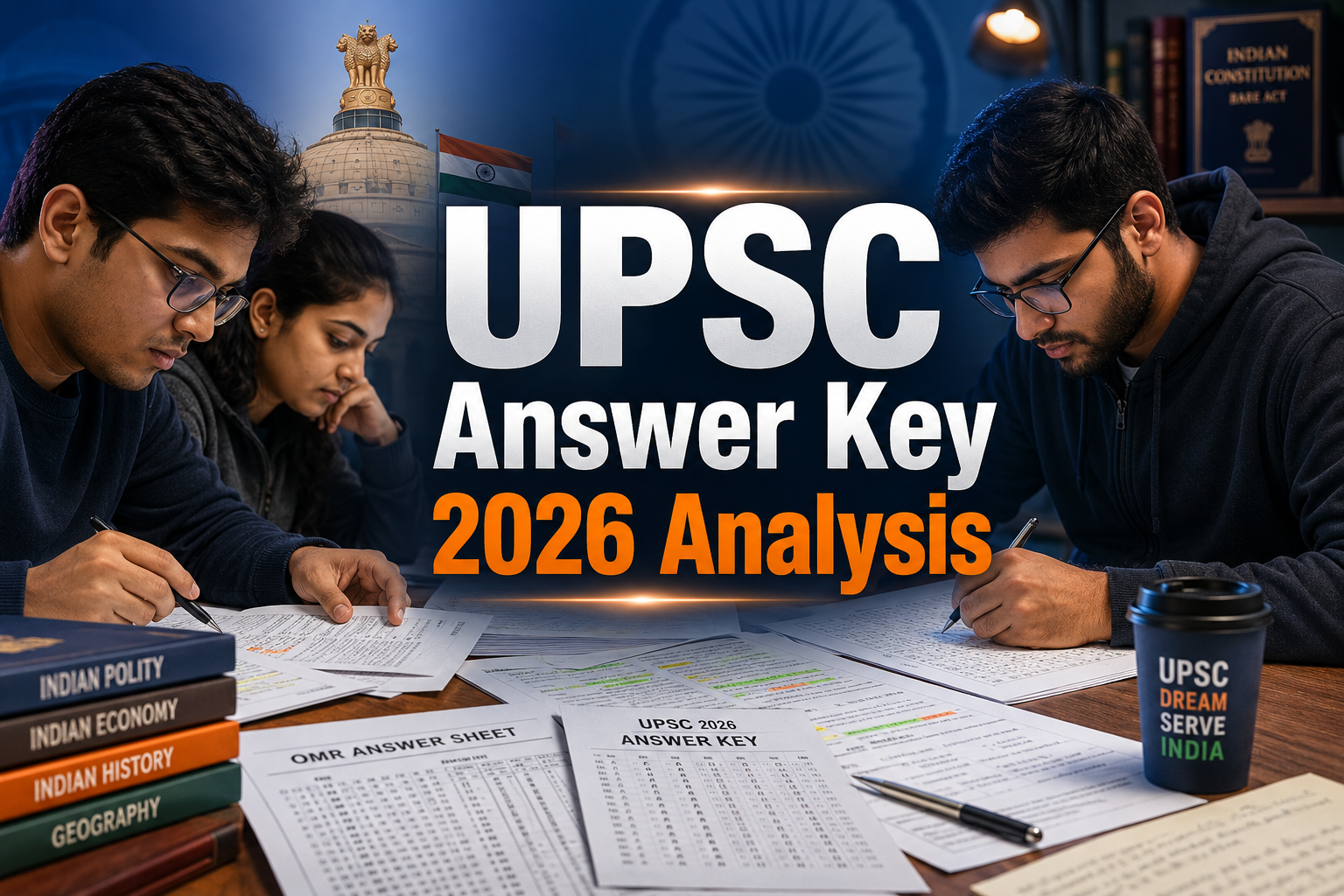
The UPSC answer key analysis for 2026 breaks down cutoff expectations, difficult sections, and strategic moves aspirants need right now.
Every year, the UPSC Civil Services Preliminary Examination creates a wave of anxiety, debate, and intense analysis across India. However, the 2026 attempt has sparked unusually high discussion among aspirants, educators, and coaching institutes alike. From unexpectedly tricky polity questions to conceptual current affairs, the exam challenged both beginners and repeat candidates in unique ways.
The biggest conversation today revolves around one topic — UPSC Answer Key Analysis. Aspirants are desperately calculating scores, estimating cutoffs, and trying to understand where they truly stand after one of the most unpredictable prelims papers in recent years.
Meanwhile, social media platforms, Telegram groups, and coaching communities are flooded with conflicting answer keys. This makes expert interpretation even more important. A single wrong assumption can dramatically alter an aspirant’s confidence and preparation strategy for the Mains examination.
In this detailed analysis, we will break down the expected cutoff trends, paper difficulty, expert observations, common mistakes, and what serious candidates should do next.
The 2026 prelims paper reflected a major strategic shift from UPSC. Instead of rewarding rote memorization, the exam focused heavily on analytical thinking and interdisciplinary understanding.
For example, many current affairs questions were indirectly linked to static subjects. Aspirants who depended only on monthly compilations struggled to eliminate options confidently.
According to insights shared by several top coaching institutes and discussions on the official UPSC website, the paper showed increasing emphasis on conceptual clarity rather than factual recall.
Another notable trend was the rise of statement-based questions. Experts estimate nearly 60% of the General Studies paper involved analytical elimination techniques rather than direct answers.
As a result, even high-performing candidates found accuracy difficult to maintain.
UPSC Answer Key Analysis: Expected Cutoff Range
One of the biggest questions after every prelims exam is simple: “What will the cutoff be?”
Based on early expert reviews and student feedback, the expected cutoff for UPSC Prelims 2026 may remain moderate compared to previous years.
Category
Expected Cutoff Range
General
84–90
OBC
80–86
EWS
82–88
SC
72–78
ST
68–74
These estimates are based on:
Overall paper difficulty
Number of ambiguous questions
Negative marking impact
Candidate performance trends
However, aspirants should remember that unofficial answer keys can vary significantly. Therefore, relying on multiple trusted sources is crucial before calculating a final score.
According to exam trend studies published by Statista and educational market analyses, competitive exams across India are increasingly moving toward application-based assessment models. UPSC appears to be accelerating that shift.
Toughest Sections in the UPSC 2026 Paper
A direct answer for most aspirants: Environment, Economy, and Ancient History proved particularly difficult.
The Environment section included several unfamiliar species and convention-based questions. Meanwhile, Economy questions demanded conceptual understanding instead of straightforward definitions.
Ancient History also surprised candidates with highly specific cultural references rarely emphasized in conventional preparation materials.
Interestingly, Polity remained relatively balanced. Candidates with strong NCERT foundations and repeated revision performed better in this area.
This pattern reveals an important lesson: UPSC is rewarding depth over excessive resource collection.
Expert Insight: What the Paper Indicates About Future UPSC Trends
The larger implication of the 2026 paper is extremely important.
UPSC is gradually discouraging mechanical preparation patterns. Candidates who rely solely on coaching notes or predictable question trends may struggle moving forward.
Experienced mentors believe future papers will likely:
Increase interdisciplinary questions
Reduce direct factual questions
Emphasize logical elimination
Test conceptual understanding through current affairs integration
Moreover, artificial intelligence tools and digital learning platforms are changing preparation strategies rapidly. Aspirants now use AI-based revision systems, mock analytics, and personalized test analysis.
According to recent educational technology insights published by McKinsey & Company, adaptive learning systems are significantly improving retention and performance in competitive exam ecosystems.
Therefore, the future of UPSC preparation is becoming smarter, not merely harder.
Common Mistakes Candidates Made After the Exam
One major mistake was over-attempting uncertain questions.
Many candidates attempted 90–100 questions aggressively due to fear of low cutoff predictions circulating online. Unfortunately, negative marking damaged scores significantly.
Another mistake involved blindly trusting the first unofficial answer key available on social media. Several coaching institutes released conflicting answers within hours of the examination.
In addition, many aspirants immediately stopped preparation after feeling uncertain about prelims performance. This is risky because UPSC timelines move quickly.
Candidates scoring near the expected cutoff should continue Mains preparation without waiting for official confirmation.
Latest Trends and Updates
The 2026 UPSC cycle is witnessing a major digital transformation in preparation strategies.

AI-powered mock analysis tools are becoming increasingly popular among aspirants because they provide personalized performance insights and weak-area mapping.

Telegram-based mentorship communities have also grown rapidly, offering instant answer discussions and collaborative preparation models.

Another noticeable trend is the shift toward integrated current affairs learning rather than separate static and dynamic preparation.

Several coaching institutes are now using predictive analytics to estimate cutoff ranges based on large-scale student response data.

In addition, micro-learning formats such as short revision videos, AI flashcards, and adaptive quizzes are becoming mainstream among serious aspirants.
Real-Life Example: How One Candidate Benefited from Smart Analysis
Consider the example of Rohan, a third-attempt UPSC aspirant from Hyderabad.
In his earlier attempts, he focused heavily on memorization and solved multiple coaching modules without deep analysis. However, after failing twice, he changed strategy completely in 2026.
Instead of collecting excessive resources, he concentrated on:
PYQ trend analysis
Elimination techniques
Conceptual clarity
Limited but repeated revision
After the prelims exam, he avoided panic-driven score calculations and continued Mains preparation immediately.
His estimated prelims score was around 88 based on multiple answer keys — placing him within the probable qualification zone.
The key lesson from his experience is simple: disciplined strategy matters more than information overload.
Beginner vs Expert Approach in UPSC Preparation
Beginner Approach
Expert Approach
Collects too many resources
Limits sources strategically
Focuses on memorization
Focuses on conceptual clarity
Panics after prelims
Continues Mains preparation
Relies on guesswork
Uses elimination techniques
Studies randomly
Follows revision cycles
This difference often determines long-term success in UPSC preparation.
Pros and Cons of Early Answer Key Analysis
Pros
Cons
Helps estimate performance
Unofficial keys may be inaccurate
Motivates Mains preparation
Can increase anxiety
Identifies weak subjects
Social media misinformation
Enables strategic planning
Over-analysis wastes time
What Serious Aspirants Should Do Next
The next 10–15 days are extremely important.
Candidates scoring near or above the expected cutoff should immediately:
Begin answer writing practice
Revise optional subjects
Prepare current affairs notes for Mains
Improve essay structure and analysis
Practice ethics case studies
Meanwhile, candidates scoring below cutoff should not consider the year wasted. Instead, they should conduct a brutally honest performance audit.
Understanding why mistakes happened is more valuable than temporary emotional reactions.
UPSC Answer Key Analysis and the Psychology of Preparation
One overlooked factor in UPSC preparation is emotional stability.
After prelims, many candidates experience mental exhaustion and confusion due to contradictory discussions online. However, successful aspirants usually avoid excessive comparison.
They focus on controllable factors:
Preparation consistency
Revision quality
Mock analysis
Writing improvement
This psychological discipline often separates repeat failures from future rankers.
Quick Checklist for Aspirants
Cross-check answers using multiple trusted keys
Avoid panic-driven score assumptions
Continue Mains preparation immediately
Analyze weak subjects honestly
Revise current affairs systematically
Practice answer writing daily
Limit social media distractions
Conclusion
The UPSC Prelims 2026 examination has once again proved that the Civil Services Exam is evolving rapidly. Traditional preparation methods alone are no longer enough. Aspirants now need conceptual understanding, emotional resilience, analytical thinking, and strategic discipline.
This year’s UPSC Answer Key Analysis highlights a deeper reality — success increasingly depends on quality preparation rather than quantity of study material.
For serious candidates, the focus now should shift from panic to planning. Whether you comfortably clear the cutoff or narrowly miss it, the lessons from this paper can become the foundation for future success.
The candidates who analyze smartly, adapt quickly, and continue consistently are usually the ones who eventually secure ranks.
FAQs
The expected General category cutoff is estimated between 84–90 marks, depending on final answer key variations.
Yes, many experts believe the paper was more analytical and concept-driven compared to recent attempts.
Unofficial keys are useful for estimation, but candidates should verify answers from multiple reliable institutes.
Environment, Economy, and Ancient History were considered particularly challenging by many aspirants.
Yes. Serious aspirants near the expected cutoff should immediately continue Mains preparation without waiting for official confirmation.

 May 25, 2026
 8 Min
 No Comment