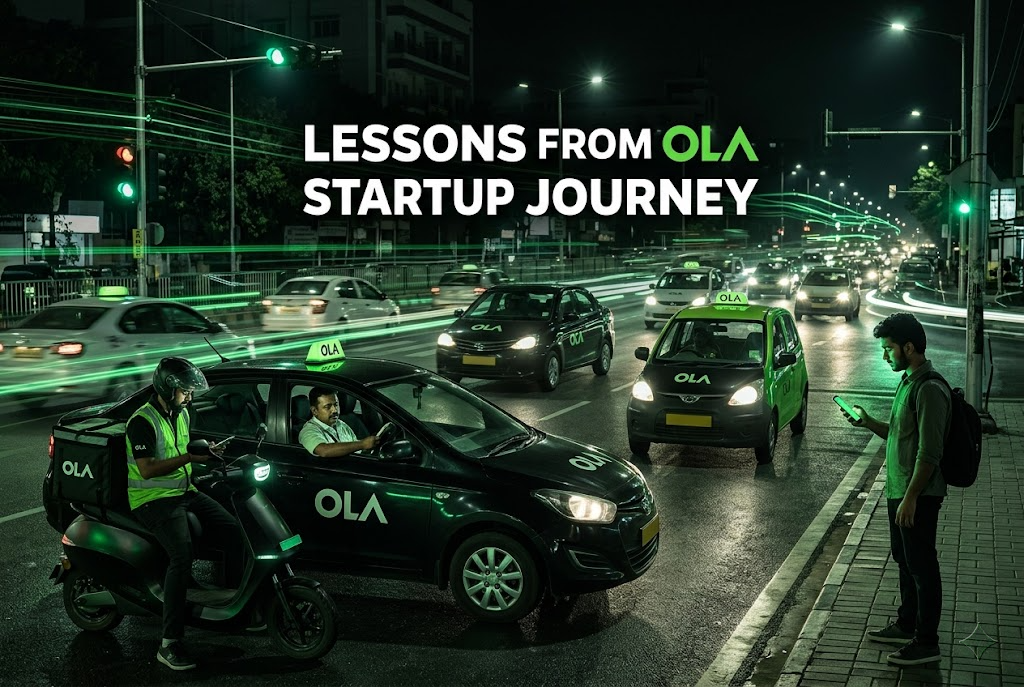
The rise of Ola is one of the most inspiring startup stories in India’s business ecosystem. From a small startup idea to becoming one of the country’s leading mobility platforms, Ola’s journey offers valuable lessons for entrepreneurs, startup founders, and business students.
The company transformed how millions of Indians travel daily. However, Ola’s success did not happen overnight. The startup faced intense competition, operational challenges, customer trust issues, and financial pressure before becoming a recognized brand.
These ola startup journey lessons reveal how persistence, market understanding, innovation, and adaptability can help startups survive and grow in competitive industries.
According to Statista, India’s ride-hailing and mobility sector has experienced massive digital growth over the last decade, creating opportunities for platforms like Ola to scale rapidly.
If you enjoy startup case studies and entrepreneurship insights, visit OneGrasp Startups for more business-related content.
Bhavish Aggarwal and Ankit Bhati founded Ola in 2010 with a simple idea: making transportation more accessible and convenient in India.
The inspiration reportedly came after Bhavish Aggarwal experienced poor service while traveling in a taxi. This real-world problem helped the founders recognize a large gap in the transportation industry.
At that time, booking cabs in India was often unreliable and inconvenient. Therefore, Ola introduced a technology-driven solution where users could book rides easily through mobile applications.
Initially, the startup operated on a small scale. However, the founders focused heavily on customer convenience and driver partnerships.
Ola started in 2010 as a ride-booking platform designed to simplify transportation through technology and mobile-based services.
Understanding Market Problems Deeply
One of the biggest ola startup journey lessons is the importance of solving real customer problems.
Ola succeeded because it addressed everyday transportation frustrations:
Difficulty finding reliable taxis
Lack of transparent pricing
Poor customer experience
Limited booking convenience
Instead of creating technology without purpose, Ola focused on improving existing pain points.
This is an important lesson for startups. Businesses grow faster when they solve genuine customer problems rather than chasing trends blindly.
Moreover, Ola adapted specifically to Indian market conditions. Features like cash payments and auto-rickshaw bookings helped the company connect with local users more effectively.
The Power of Timing in Startup Growth
Timing played a major role in Ola’s success.
During the early 2010s, smartphone usage and internet access were increasing rapidly in India. Consumers were becoming more comfortable using mobile applications for daily services.
Ola entered the market at the right moment and used digital adoption trends effectively.
According to Forbes, many successful startups grow because they identify emerging trends before markets become overcrowded.
This highlights another important startup lesson: even strong ideas require the right market timing to scale successfully.
Ola Startup Journey Lessons in Scaling Operations
Scaling a startup is one of the most difficult phases for entrepreneurs.
As Ola expanded across cities, managing drivers, customer support, pricing systems, and operations became increasingly complex.
Many startups fail during scaling because operational systems cannot handle rapid growth. However, Ola continuously improved technology infrastructure and expanded strategically.
The company also diversified services by introducing:
Auto-rickshaw bookings
Bike taxis
Rental services
Electric mobility initiatives
Diversification helped Ola reduce dependency on one revenue source.
Ola scaled successfully by improving operations, expanding services, and adapting to changing customer needs.
Competition with Uber and Market Pressure
Ola’s journey became even more challenging after Uber entered the Indian market.
Uber brought global experience, strong funding, and aggressive expansion strategies. Many people believed local startups would struggle against international competition.
However, Ola focused on understanding Indian customers better.
For example:
Supporting cash payments
Expanding into smaller cities
Offering local transportation options
This helped Ola remain competitive despite intense market pressure.
The lesson here is important: startups do not always need to beat competitors globally. Sometimes understanding local customer behavior creates stronger advantages.
Real-Life Startup Lesson from Ola
Imagine a startup founder launching a delivery app in a crowded market.
Instead of competing directly only on pricing, the founder studies customer frustrations deeply. Customers complain about late deliveries, poor communication, and unreliable tracking.
The startup then focuses entirely on solving those specific problems better than competitors.
Gradually, customer trust increases, positive reviews grow, and the business gains loyal users.
This approach reflects Ola’s strategy. The company succeeded not only because it built an app, but because it improved customer convenience significantly.
Innovation and Adaptability
One major reason Ola survived intense competition is adaptability.
The company continuously experimented with new business models and services.
For example:
Ola Electric
Subscription models
Fleet partnerships
Driver incentives
In modern startup ecosystems, adaptability matters more than rigid planning.
Technology trends, customer behavior, and market conditions change rapidly. Therefore, businesses that evolve consistently usually survive longer.
According to TechCrunch, startups that innovate continuously often maintain stronger long-term relevance.
Common Mistakes Startups Can Learn from Ola’s Journey
While Ola achieved massive growth, the journey also highlights challenges entrepreneurs should understand.
Expanding Too Fast
Rapid growth can create operational inefficiencies if systems are not ready.
Managing Customer Trust
Ride cancellations, pricing issues, and customer support complaints affected brand perception at times.
Balancing Profitability and Growth
Like many startups, Ola faced pressure between scaling aggressively and maintaining profitability.
Handling Competition
Competing with global companies requires constant innovation and strategic thinking.
These challenges show that startup growth involves continuous problem-solving.
Expert Insight and Analysis
Business experts often describe Ola as an example of localized innovation.
Instead of copying international models exactly, Ola adapted services specifically for Indian consumers. This created stronger market relevance.
Experts also believe Ola’s journey demonstrates the importance of operational execution. Many startups have good ideas, but execution quality determines long-term survival.
Another major insight is that startup founders must remain flexible. Ola’s willingness to expand into electric mobility and new transportation models shows how adaptation supports long-term growth.
The startup ecosystem rewards companies that evolve faster than competitors.
Latest Trends in Mobility Startups
The transportation startup industry is changing rapidly.
Several important trends include:
Electric Vehicles
Electric mobility platforms are growing globally.
AI-Based Route Optimization
Companies now use AI for traffic prediction and route management.
Some platforms now offer monthly ride subscriptions.
Integrated Mobility Apps
Apps are combining taxis, bikes, rentals, and public transport into one ecosystem.
Ola’s investments in electric mobility show how startups are preparing for future transportation trends.
Pros and Cons of Ola’s Startup Strategy
Pros
Cons
Strong local market understanding
High operational complexity
Rapid expansion across India
Intense competition
Service diversification
Customer support challenges
Technology-driven convenience
Profitability pressure
Strong brand recognition
Dependency on large-scale operations
Beginner vs Expert Startup Thinking
Beginner Founder
Experienced Founder
Focuses only on ideas
Focuses on execution
Copies competitors directly
Adapts to local markets
Ignores customer feedback
Studies customer behavior deeply
Expands randomly
Scales strategically
Avoids risks completely
Takes calculated risks
Ola’s founders showed how understanding customers deeply can create competitive advantages.
Tools and Resources Modern Startups Use
Today’s startups rely heavily on technology and analytics tools.
Popular tools include:
Google Analytics for customer insights
Notion for workflow management
HubSpot for CRM
Canva for branding
Trello for project coordination
Using digital tools helps startups scale operations more efficiently.
What Entrepreneurs Should Do Next
If you are building a startup, study customer problems carefully before creating solutions.
Then:
Validate your business idea
Start with a simple product
Collect customer feedback consistently
Improve operations gradually
Adapt quickly to market changes
Most importantly, focus on solving real problems instead of chasing hype.
Many successful startups grow because they improve customer experiences consistently over time.
Quick Startup Lessons Checklist
Solve real customer problems
Understand local markets deeply
Scale operations carefully
Adapt to competition quickly
Focus on customer experience
Build strong operational systems
Diversify revenue streams
Stay flexible and innovative
Conclusion
The journey of Ola is more than just a startup success story. It is a powerful example of how understanding customer problems, adapting quickly, and executing consistently can create long-term business growth.
These ola startup journey lessons show that startups succeed not only through technology but also through deep market understanding and operational discipline.
Ola faced intense competition, scaling difficulties, and market pressure. However, the company continued evolving instead of remaining static.
For entrepreneurs, the biggest takeaway is simple: solve meaningful problems, stay adaptable, and focus relentlessly on customer experience.
In today’s fast-changing business world, those principles remain just as important as innovation itself.
Frequently Asked Questions
Ola was founded by Bhavish Aggarwal and Ankit Bhati in 2010.
Ola succeeded by solving transportation problems and adapting services to Indian customer needs.
Ola faced competition, operational scaling challenges, and profitability pressure.
Startups can learn the importance of customer focus, adaptability, and strategic growth.
Yes, Ola continues expanding into mobility and electric vehicle initiatives.

 May 9, 2026
 8 Min
 No Comment