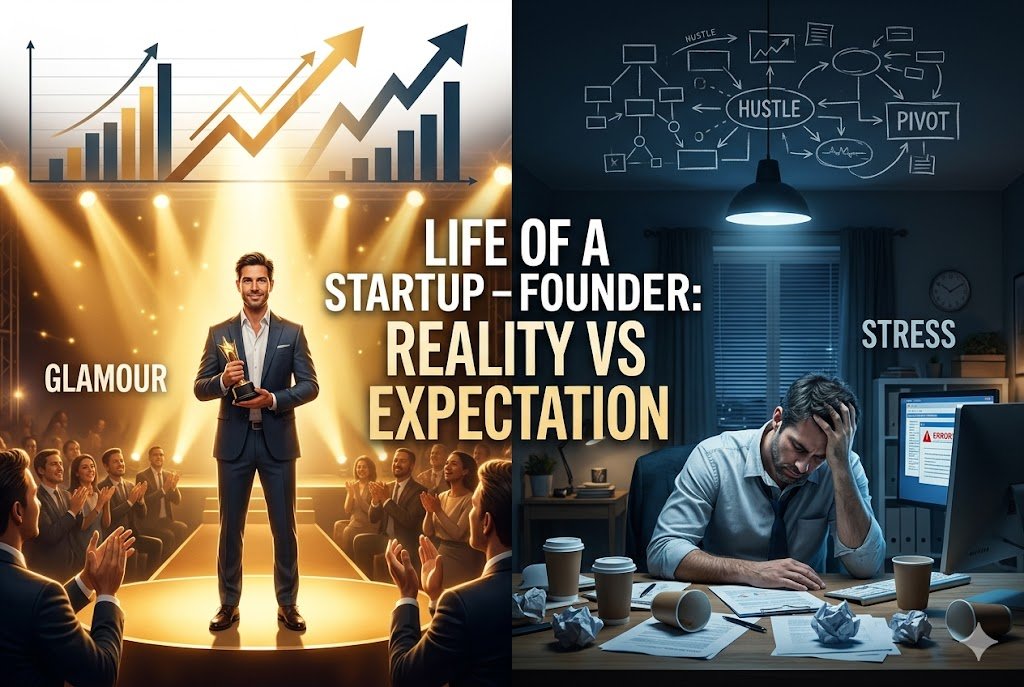
The life of a startup founder is often misunderstood. From the outside, it looks exciting—freedom, innovation, and fast success. But the reality is far more complex, filled with uncertainty, pressure, and constant problem-solving.
In 2026, startups are growing faster than ever, but so are the challenges. Understanding the gap between expectation and reality is important for anyone planning to start a business.
If you’re exploring startup journeys and real business insights, you can also learn more about modern entrepreneurship on https://onegrasp.com/startups/ to understand how founders actually build companies today.
Many people believe the life of a startup founder looks like this:
Flexible working hours
Quick success and funding
Freedom to work anytime, anywhere
Building a billion-dollar idea overnight
Social media often shows only the success stories—funding announcements, product launches, and achievements. This creates a false impression that startups grow quickly and easily.
But reality is very different.
Reality: Constant Pressure and Uncertainty
The real life of a startup founder involves long working hours, high stress, and continuous uncertainty.
Founders often deal with:
Financial pressure
Product failures
Hiring challenges
Customer acquisition struggles
Emotional stress
Most startups do not succeed immediately. Many take years to find product-market fit, and some fail before reaching growth stage.
Daily Life of a Startup Founder
A typical day in the life of a startup founder is unpredictable.
One day may involve:
Meeting users
Fixing product issues
Talking to investors
Another day may include:
Handling team conflicts
Working on marketing strategies
Solving operational problems
There is no fixed schedule. Priorities change constantly based on business needs.
Emotional Challenges in Startup Life
The life of a startup founder is not just about business—it is also emotionally demanding.
Common emotional challenges include:
Fear of failure
Stress from uncertainty
Pressure to deliver results
Loneliness in decision-making
Even successful founders often face burnout if they do not manage stress properly.
Key Responsibilities of a Startup Founder
A founder is responsible for almost everything in the early stage:
Product development
Business strategy
Hiring and team building
Fundraising
Customer experience
Unlike employees, founders do not have a clear job description—they create it as they go.
Reality of Startup Success
Success in startups does not happen overnight. It is usually the result of years of effort, iteration, and learning.
Companies like Airbnb and Uber did not become successful instantly. They faced multiple rejections, product failures, and operational challenges before scaling.
This shows that the life of a startup founder is more about persistence than instant success.
Skills Every Startup Founder Needs
To survive and succeed, founders need more than just an idea:
Problem-solving skills
Leadership ability
Financial understanding
Communication skills
Resilience
Without these skills, managing a startup becomes extremely difficult.
Common Mistakes New Founders Make
Many beginners enter startups with unrealistic expectations. Some common mistakes include:
Expecting quick profits
Ignoring market research
Hiring too fast
Underestimating competition
Giving up too early
These mistakes often lead to early failure.
Strategic Insight
The real difference between expectation and reality lies in execution.
Founders who accept reality early are more likely to succeed.
Conclusion
The life of a startup founder is a mix of excitement, pressure, learning, and resilience. While expectations often focus on success and freedom, reality involves hard work, uncertainty, and continuous problem-solving.
But despite the challenges, it is also one of the most rewarding journeys. Building something from scratch and solving real problems creates long-term impact and fulfillment.
FAQs
No, it is challenging and involves long hours, uncertainty, and responsibility.
In the early stages, very little. Time becomes flexible only after the startup stabilizes.
Uncertainty and lack of guaranteed success.
No, many startups fail before reaching growth.
Because of independence, innovation, and the potential to build impactful businesses.

 May 6, 2026
 4 Min
 No Comment