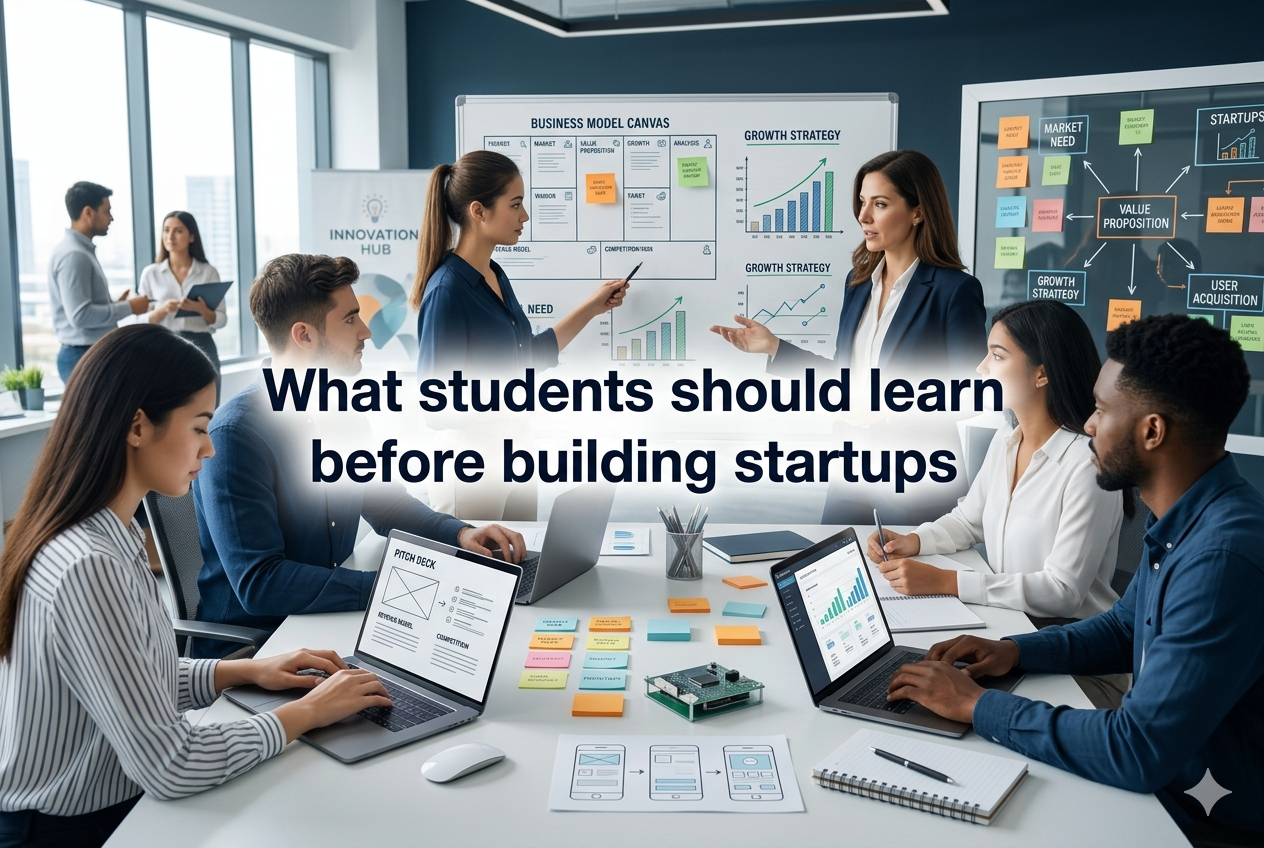
Mastering the startup skills for students is crucial to turning campus ideas into viable businesses before you launch.
Starting a business while still a student sounds exciting—and it is. But behind every successful startup is a strong foundation of skills, discipline, and real-world understanding.
Understanding the right startup skills for students can make the difference between a failed idea and a scalable business.
India has one of the youngest startup ecosystems in the world. Over 50% of startup founders in India are under the age of 35, and many begin their journey during college itself.
However, while enthusiasm is high, many student startups fail within the first two years due to lack of preparation and business knowledge.
Therefore, learning the right skills before starting is critical.
Before launching a startup, students should focus on building these essential skills:
Problem identification and validation
Basic financial literacy
Communication and pitching skills
Market research and analysis
Digital and tech awareness
Moreover, understanding customer needs is more important than just having a unique idea.
A good startup solves a real problem—not just a creative one.
Understanding startup skills for students in real-world context
The most successful entrepreneurs don’t just rely on ideas—they rely on execution skills.
Key real-world startup abilities include:
Building minimum viable products (MVPs)
Understanding user feedback
Managing time and resources
Learning from failure quickly
For example, many successful Indian startups like Flipkart and Zomato started small but scaled because founders focused on solving real customer problems.
In addition, students who learn coding, marketing, or design gain a strong competitive advantage.
Common mistakes students make before starting startups
Many student entrepreneurs struggle due to avoidable mistakes:
Starting without market research
Ignoring financial planning
Copying existing ideas blindly
Focusing only on funding instead of product
Lack of team structure and roles
However, failure is often due to preparation gaps, not idea quality.
Moreover, many students rush into startups without testing their assumptions.
How to prepare yourself before starting a startup
To build strong startup skills for students, follow these steps:
Work on small college projects first
Participate in hackathons and competitions
Take internships in startups
Learn basic business tools (Excel, Canva, CRM tools)
Build small real-world prototypes
A strong foundation reduces failure risk and increases chances of long-term success.
Why preparation matters for startups
Learning before launching a startup helps students:
Reduce early-stage business failure
Build stronger problem-solving skills
Gain investor confidence
Improve leadership abilities
Scale ideas faster and more effectively
Therefore, preparation is not optional—it is the foundation of entrepreneurship success.
Tips to Choose the Right College for entrepreneurship
A startup-friendly college can significantly boost your journey:
Offers entrepreneurship cells or incubation centers
Encourages project-based learning
Provides mentorship from industry experts
Supports innovation competitions
Offers networking opportunities with founders
Such environments help students test and refine ideas early.
Common Mistakes to Avoid
Ignoring skill development before launching
Overestimating idea originality
Not understanding customer needs
Skipping financial planning
Avoiding mentorship or guidance
FAQs
1. Can students really start startups in college? Yes, many successful startups began during college years.
2. What is the most important startup skill? Problem-solving and market understanding are key.
3. Do I need money to start a startup? Not always; many startups begin with low or no investment.
4. How can students learn startup skills? Through internships, workshops, and real projects.
5. What causes student startups to fail? Lack of planning, research, and execution skills.
Conclusion
Building a startup as a student is an exciting journey—but success depends on preparation, not just passion. By learning essential startup skills for students, young entrepreneurs can turn ideas into sustainable businesses.
The key is simple: learn, test, build, and improve continuously.
Frequently Asked Questions
What are the most important startup skills for students?
Key skills include problem identification, basic financial literacy, effective communication, market research, and building MVPs.
How can students gain real-world startup experience?
Participate in hackathons, internships, college projects, and join entrepreneurship cells or incubators to apply skills practically.
Do I need a lot of money to start a student startup?
No, many successful student startups begin with minimal investment by focusing on low‑cost MVPs and leveraging campus resources.
What common mistakes should I avoid as a student entrepreneur?
Avoid skipping market research, ignoring financial planning, copying ideas without validation, and neglecting team roles or mentorship.
Where can I find additional resources to develop startup skills?
OneGrasp offers startup programmes, workshops, FDPs, and events that provide mentorship, tools, and networking opportunities.

 April 22, 2026
  4 Min
4 Min  No Comment