Canada continues to be one of the top destinations for Indian students because of its globally recognized universities, strong job opportunities, multicultural environment, and long-term immigration pathways. However, obtaining a Canadian study permit has become more competitive in 2026 due to stricter immigration scrutiny, updated financial requirements, and new policy changes.
Understanding the Canada student visa requirements carefully is extremely important because even small documentation mistakes can lead to delays or rejections.
According to official Canadian immigration guidelines, international students must receive approval for a study permit before studying in Canada for programs longer than six months. (Canada)
Meanwhile, recent reports show Canada has reduced its overall study permit targets for 2026, increasing competition among applicants. (Collegedunia)
Therefore, Indian students must now focus more strongly on:
Genuine academic intent
Strong financial documentation
Clear career planning
Complete paperwork
Accurate application submissions
Students who prepare strategically and submit well-organized applications generally improve their approval chances significantly.
A Canada study permit is an official document issued by Immigration, Refugees and Citizenship Canada (IRCC) allowing international students to study at designated institutions in Canada.
Without a valid study permit, students cannot legally pursue most full-time academic programs in Canada. (Canada)
It is important to understand that:
A study permit is not the same as a visa
The permit allows studying
A Temporary Resident Visa (TRV) or eTA allows entry into Canada
If the study permit is approved, Canada usually automatically issues the required travel authorization as well. (Canada)
Basic Eligibility Requirements for Indian Students
To apply successfully, students must generally meet these core conditions:
Acceptance from a Designated Learning Institution (DLI)
Students must first secure admission from a recognized Canadian institution.
Examples include:
University of Toronto
University of British Columbia
Seneca College
The institution provides a Letter of Acceptance (LOA), which is mandatory for visa applications.
Proof of Financial Support
Students must demonstrate enough funds to cover:
Tuition fees
Living expenses
Accommodation
Travel costs
Recent guidelines indicate students may need proof of approximately CAD 22,895 or more for living expenses alone, excluding tuition. (Collegedunia)
Clean Academic Background
Students should maintain:
Good academic records
Reasonable study gaps
Genuine career goals
Consistent educational progression
Strong Intent to Study
Visa officers carefully evaluate whether students are genuine temporary residents intending to study seriously.
Strong SOPs and career clarity are increasingly important in 2026.
Important Documents Required
Indian students must carefully prepare all required documents before applying.
Common documents include:
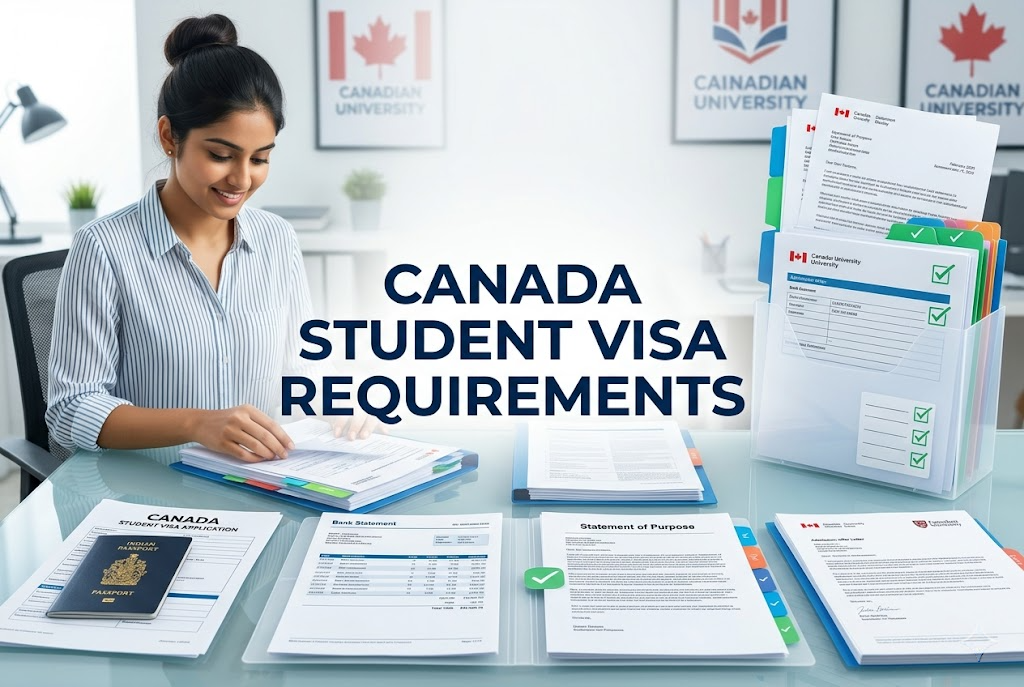
Valid Passport
Your passport should remain valid throughout your study duration.
Letter of Acceptance (LOA)
Official admission letter from a Canadian DLI.
Proof of Funds
Accepted financial proofs may include:
GIC certificates
Bank statements
Education loan approval letters
Sponsor documents
Income tax returns
Passport-Size Photographs
Recent photographs meeting IRCC specifications.
Statement of Purpose (SOP)
The SOP explains:
Why you selected Canada
Why you chose the course
Career goals
Future plans
Medical Examination
Medical tests are usually mandatory for Indian students studying longer than six months. (Collegedunia)
Biometrics
Students aged 14–79 generally must provide:
Fingerprints
Digital photographs
Biometrics are now a mandatory part of the visa process. (Collegedunia)
Understanding the GIC Requirement
A Guaranteed Investment Certificate (GIC) is one of the most important financial requirements for many Indian students.
Students transfer funds into approved Canadian banks before visa submission.
Benefits of GIC:
Strong proof of financial stability
Improves application credibility
Helps demonstrate living expense coverage
According to recent updates, CAD 22,895 is commonly referenced as the minimum living expense requirement in 2026. (Collegedunia)
Popular GIC banks include:
Scotiabank
CIBC
SBI Canada Bank
ICICI Canada
Provincial Attestation Letter (PAL) Requirement
One of the major recent policy changes involves the Provincial Attestation Letter (PAL).
Many undergraduate and diploma students now require a PAL confirming provincial allocation eligibility. (Collegedunia)
However, certain categories may be exempt, including:
Some master’s students
Doctoral students
Existing permit extensions in some situations
Students should verify current institutional requirements carefully because PAL rules continue evolving.
Canada Student Visa Fees in 2026
Typical visa-related costs include:
Expense
Approximate Cost
Study Permit Fee
CAD 150
Biometrics Fee
CAD 85
Medical Examination
CAD 450–600
GIC Amount
CAD 22,895+
Visa Application Centre Fees
Varies
(Collegedunia)
Students should also budget for:
Tuition deposits
Flight tickets
Accommodation
Insurance
Emergency funds
Processing Time for Indian Students
Current study permit processing times from India generally range between:
8–12 weeks
Sometimes longer during peak intake periods
(Collegedunia)
Processing speed depends on:
Application accuracy
Biometrics completion
Medical reports
Seasonal demand
Background verification
Applying early significantly improves preparation flexibility.
Comparison Table: Strong vs Weak Visa Applications
Strong Application
Weak Application
Clear SOP
Generic SOP
Strong financial proof
Unclear finances
Logical academic progression
Random course selection
Genuine career goals
Weak future planning
Complete documentation
Missing documents
DLI-approved institution
Unrecognized institutions
Expert Insight: Visa Officers Focus on Genuine Students
One of the biggest misconceptions among students is believing that admission alone guarantees visa approval.
In reality, visa officers carefully analyze:
Financial credibility
Academic consistency
Course relevance
Immigration intent
Career planning
Recent policy tightening means poorly prepared applications now face much higher rejection risks. (The Times of India)
Experts increasingly recommend:
Writing customized SOPs
Avoiding fake documents
Choosing career-relevant courses
Maintaining transparent finances
Students with clear long-term educational goals usually appear more credible during evaluation.
Latest Trends and Updates in 2026
Canada’s international student system is changing rapidly in 2026. Several major developments are influencing student visa approvals and study permit policies.
Study Permit Caps Have Increased Competition
Canada has reduced overall study permit allocations compared to previous years. (Collegedunia)
As a result:
Approval competition has increased
Documentation scrutiny has become stricter
Financial verification is more detailed
Students now need stronger applications than before.
Financial Proof Requirements Are More Important
Visa officers are increasingly focused on:
Genuine banking records
Stable sponsor income
Proper GIC documentation
Clear financial history
Weak or suspicious financial documents can significantly increase rejection risk.
Graduate Programs Are Receiving More Flexibility
Recent updates suggest some graduate-level applicants may receive exemptions from certain permit cap requirements. (The Economic Times)
This trend is encouraging more students to pursue:
Master’s programs
Research-focused education
Specialized technical programs
Fraud Detection Systems Are Becoming Stricter
Canada has intensified fraud detection and background verification processes. (The Times of India)
Students using:
Fake financial documents
Misleading SOPs
Unverified institutions
face higher rejection risks and possible future immigration complications.
Students Are Becoming More ROI-Focused
Indian students increasingly analyze:
Tuition fees
Salary potential
PR opportunities
Internship access
Job demand
before selecting programs.
Return on investment has become one of the biggest decision-making factors in 2026.
Students interested in entrepreneurship and startup learning can also explore: https://onegrasp.com/
Common Mistakes to Avoid
Many students make avoidable visa mistakes.
Avoid:
Submitting fake documents
Using copied SOP templates
Ignoring financial proof quality
Applying without understanding PAL rules
Selecting unrelated courses
Waiting until deadlines approach
What to Do Next
Before applying for a Canadian study permit, students should:
Research DLI-approved institutions
Prepare strong financial documentation
Create a personalized SOP
Complete medical examinations early
Arrange GIC properly
Verify updated PAL requirements
Apply as early as possible
Strategic preparation can significantly improve approval chances.
Quick Checklist
Secure admission from DLI
Prepare LOA documents
Arrange proof of funds
Open GIC account
Prepare SOP carefully
Complete biometrics
Schedule medical examination
Verify passport validity
Conclusion
Understanding the Canada student visa requirements properly is extremely important for Indian students planning higher education abroad in 2026.
Canadian immigration policies are becoming more competitive, financially strict, and documentation-focused. However, students who prepare transparent applications, maintain genuine academic intent, and organize strong financial proof continue achieving successful outcomes.
The key to approval is not shortcuts or generic applications. Instead, successful students focus on:
Career clarity
Financial transparency
Proper planning
Strong documentation
Genuine educational goals
Students who approach the process strategically usually experience smoother admissions, visa approvals, and long-term success in Canada.
FAQs
Students generally need a Letter of Acceptance, proof of funds, passport, SOP, biometrics, and medical examination.
Students may need proof of approximately CAD 22,895 or more for living expenses, excluding tuition fees. (Collegedunia)
GIC is one of the strongest accepted proofs of funds and is commonly recommended for Indian students.
Current processing times for Indian students are generally around 8–12 weeks. (Collegedunia)
A Provincial Attestation Letter (PAL) confirms provincial allocation approval for certain study permit applicants. (Collegedunia)

 May 13, 2026
 8 Min
 No Comment