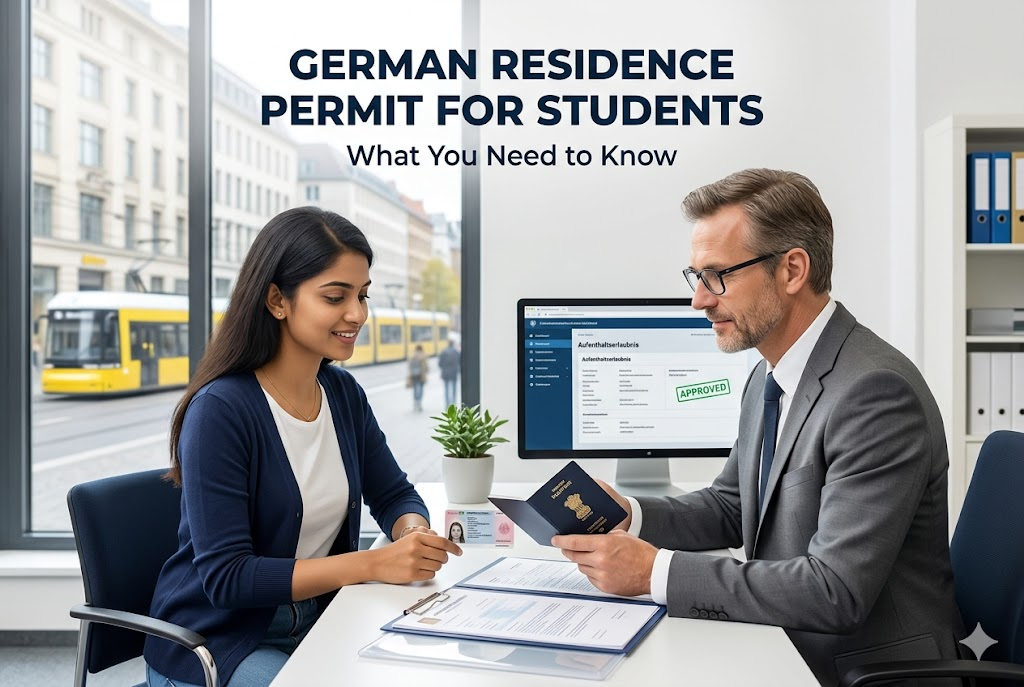
Germany is one of the most popular destinations for international students because of its affordable public universities, strong career opportunities, advanced research ecosystem, and globally respected education system. However, after entering Germany, international students must understand the importance of the German residence permit for students, officially known as the Aufenthaltserlaubnis zum Zweck des Studiums.
Many students confuse the German student visa with the residence permit, but they are different documents. The student visa mainly allows entry into Germany, while the residence permit allows students to legally stay, study, and work part-time during their academic program.
For Indian students and other non-EU students, the residence permit is one of the most important legal requirements after arrival in Germany. It determines:
- Legal stay duration
- Work rights
- University enrollment continuity
- Internship permissions
- Travel flexibility within Schengen countries
- Future PR and job opportunities
According to Germany’s immigration guidance, most non-EU students require a residence permit under Section 16b of the Residence Act for higher education studies. (Handbook Germany)
What Is the German Residence Permit for Students?
The German residence permit for students is a legal authorization allowing non-EU students to stay in Germany for educational purposes.
Official Name
The permit is commonly called:
- Aufenthaltserlaubnis zum Studium
- Student Residence Permit
- Section 16b Residence Permit
Main Purpose
The permit allows students to:
- Live legally in Germany
- Study at recognized universities
- Work part-time under student rules
- Extend stay during academic programs
According to immigration resources, students typically apply for the residence permit after arriving in Germany using a student visa. (Sylum.de)
Difference Between Student Visa and Residence Permit
Many students misunderstand these two terms.
Student Visa
The student visa:
- Is issued before entering Germany
- Allows legal entry into Germany
- Is usually valid for a few months initially
Students apply for it at:
- German embassy or consulate in home country
Residence Permit
The residence permit:
- Is obtained after arrival in Germany
- Allows long-term legal stay
- Is usually issued as a biometric residence card
According to visa guides, students enter Germany using a visa but remain in Germany using the residence permit. (VisaFlow)
Who Needs a German Student Residence Permit?
Most non-EU students studying in Germany for more than 90 days need a residence permit.
Students Who Usually Need It
- Indian students
- Asian students
- African students
- Non-EU international students
EU/EEA Students
EU and EEA citizens generally:
- Do not require a residence permit for studying in Germany
When Should Students Apply?
Students should apply soon after arriving in Germany.
Recommended Timeline
Usually:
- Within the validity period of the entry visa
- Often within the first few weeks after arrival
According to immigration guides, students must register their address and apply through the local Foreigners’ Office (Ausländerbehörde). (Handbook Germany)
Requirements for German Student Residence Permit
Students must meet several requirements.
Valid University Admission
Students need:
- University admission letter
- Enrollment certificate (Immatrikulationsbescheinigung)
Recognized Institutions
The university should be:
- State-recognized
- Accredited in Germany
Financial Proof
Students must prove sufficient financial resources.
Common Financial Method
The most common method is:
- Blocked Account (Sperrkonto)
According to 2026 financial requirements, students generally need approximately:
- €11,904 annually
- €992 monthly access limit. (Handbook Germany)
Health Insurance
Health insurance is mandatory.
Students need:
- Public health insurance
or - Approved private insurance
without valid insurance, residence permits are usually not approved.
Valid Passport
Students must hold:
- Valid passport
- Valid visa if applicable
APS Certificate (For Indian Students)
Indian students generally require:
- APS Certificate
before student visa processing.
Documents Required for Student Residence Permit
Students usually need the following documents.
Main Documents
- Passport
- Student visa
- University admission letter
- Enrollment certificate
- Proof of financial means
- Health insurance proof
- Biometric photographs
- Address registration certificate (Anmeldung)
- Residence permit application form
Additional Documents
Some offices may request:
- Rental agreement
- Academic certificates
- APS certificate
- Proof of fee payment
Requirements can vary by city and immigration office.
Where to Apply for the Residence Permit
Students apply through:
- Local Foreigners’ Office (Ausländerbehörde)
Major Cities
Examples include:
- Berlin
- Munich
- Hamburg
- Frankfurt
Students often book appointments online.
Residence Permit Fees
Students usually pay residence permit processing fees.
Approximate Costs
According to German government resources:
- Around €100 for adults in many cases. (Bundesportal)
Extension fees may also apply later.
Validity of the Student Residence Permit
Residence permits are usually temporary.
Typical Validity
Most permits are issued for:
- 1 to 2 years initially. (Handbook Germany)
Students can extend permits if studies continue.
Extensions
Extensions are generally approved if:
- Students remain enrolled
- Academic progress is satisfactory
- Financial proof remains valid
Work Rights for Students
Germany allows international students to work part-time.
Work Limit Rules
According to updated regulations:
- 140 full days
or - 280 half days annually are allowed. (Handbook Germany)
Benefits of Student Work
Part-time jobs help students:
- Gain experience
- Improve communication skills
- Support living expenses
Internships
Students may also complete:
- Mandatory internships
- Research internships
- Student assistant jobs
depending on university rules.
Can Students Travel with the Residence Permit?
Yes, students can usually travel within:
- Schengen countries
for short periods.
Important Note
Students should:
- Carry passport and residence card during travel
Residence Permit Extension Process
Students who need more study time must extend permits before expiry.
Extension Requirements
Students generally need:
- Updated enrollment certificate
- New financial proof
- Health insurance
- Academic progress evidence
According to extension guides, students should apply early to avoid legal complications. (VisaFlow)
What Happens After Graduation?
Germany offers strong post-study opportunities.
18-Month Job-Seeking Permit
After graduation, students may apply for:
- 18-month post-study job-seeking residence permit. (Bundesportal)
Purpose
This allows graduates to:
- Search for skilled jobs
- Attend interviews
- Transition into work permits
EU Blue Card Opportunities
Graduates securing high-paying skilled jobs may qualify for:
- EU Blue Card Germany
which offers faster PR pathways.
Can Students Get Permanent Residency?
Yes, long-term residence pathways exist.
PR Factors
Germany evaluates:
- Skilled employment
- German language skills
- Pension contributions
- Legal residence duration
Students who transition into skilled jobs often later qualify for PR.
Common Problems Students Face
Delayed Appointments
Large cities often experience:
- Long waiting periods for appointments
Missing Documents
Applications may face delays due to:
- Incomplete paperwork
- Invalid insurance
- Insufficient financial proof
Expired Residence Permit
Students should never allow permits to expire before renewal applications.
Latest Trends in German Student Residence Permits (2026)
Germany Is Attracting More International Students
Germany continues expanding immigration pathways to address skilled worker shortages in engineering, AI, healthcare, and IT sectors. (Sylum.de)
Work Rights Were Expanded
Recent immigration reforms increased student work limits to:
- 140 full days or 280 half days annually. (Handbook Germany)
Digital Appointment Systems Are Expanding
Many cities are introducing:
- Online applications
- Digital uploads
- Faster residence processing systems
to reduce delays.
APS Verification Is Important for Indian Students
APS verification has become a major requirement for Indian applicants before visa and residence procedures. (Reddit)
Germany Is Supporting Skilled Graduate Retention
Germany increasingly encourages international graduates to remain after studies through:
- Job-seeking permits
- EU Blue Cards
- Simplified skilled migration pathways
Housing and Registration Delays Are Increasing
Students in major cities like Berlin and Munich are facing:
- Accommodation shortages
- Delayed address registration appointments
which can affect residence permit timelines.
Expert Insight: Why Residence Permit Planning Matters
Immigration experts recommend students:
- Prepare documents early
- Track permit expiry dates carefully
- Keep financial records updated
- Learn basic German for smoother administration
Students who organize paperwork properly usually experience fewer legal and administrative issues.
Real-Life Example
Aditya from Pune arrived in Germany for his Master’s degree in Mechanical Engineering. Initially, he was confused about the difference between the student visa and residence permit.
After arrival, he:
- Registered his address
- Opened a blocked account
- Purchased health insurance
- Booked an appointment at the Foreigners’ Office
Although appointment waiting times were long, he prepared all documents early and successfully received his residence permit without major issues.
Later, he used the permit to:
- Work part-time
- Complete internships
- Apply for post-study opportunities
Pros and Cons of German Student Residence Permit
| Pros | Cons |
|---|---|
| Legal long-term stay | Bureaucratic paperwork |
| Allows part-time work | Appointment delays |
| Access to internships | Strict documentation rules |
| Pathway to PR and jobs | Financial proof required |
| Schengen travel benefits | Housing registration challenges |
Beginner vs Expert Approach
| Beginner | Expert |
|---|---|
| Applies late | Starts early preparation |
| Ignores appointment waiting times | Books appointments quickly |
| Keeps incomplete documents | Organizes all paperwork carefully |
| Depends only on university guidance | Researches immigration rules independently |
Tools & Resources
- LinkedIn Jobs — https://www.linkedin.com
- Job Bank Canada — https://www.jobbank.gc.ca
- Indeed Canada — https://ca.indeed.com
- Glassdoor Canada — https://www.glassdoor.ca
- Google Trends — https://trends.google.com
- Canva Resume Builder — https://www.canva.com
Official resources:
Students can also explore: https://onegrasp.com/
Common Mistakes to Avoid
- Waiting too long to apply
- Ignoring residence permit expiry dates
- Missing financial proof updates
- Using invalid health insurance
- Delaying city registration (Anmeldung)
- Keeping incomplete document copies
What to Do Next
Before applying for the residence permit:
- Arrange accommodation
- Complete city registration
- Prepare blocked account proof
- Purchase health insurance
- Gather university enrollment documents
- Book immigration appointments early
- Keep digital and physical copies of all documents
Quick Checklist
- Passport valid
- University enrolled
- Address registered
- Health insurance active
- Blocked account proof available
- Appointment booked
- Residence permit fee prepared
Conclusion
The German residence permit for students is one of the most important legal requirements for international students studying in Germany. It allows students to legally stay, work part-time, complete internships, and eventually transition into skilled careers and PR pathways.
Students who carefully manage documentation, financial proof, health insurance, and extension timelines can enjoy a smoother academic and professional journey in Germany while benefiting from one of Europe’s strongest education systems.
FAQs
It is a legal permit allowing non-EU students to stay in Germany for educational purposes. (Handbook Germany)
Yes. The visa allows entry into Germany, while the residence permit allows long-term stay after arrival. (VisaFlow)
Usually 1–2 years initially, with extension options available. (Handbook Germany)
Yes. Students may work up to 140 full days or 280 half days annually. (Handbook Germany)
Yes. Graduates may apply for an 18-month post-study job-seeking residence permit. (Bundesportal)