May 13, 2026
 8 Min
 No Comment
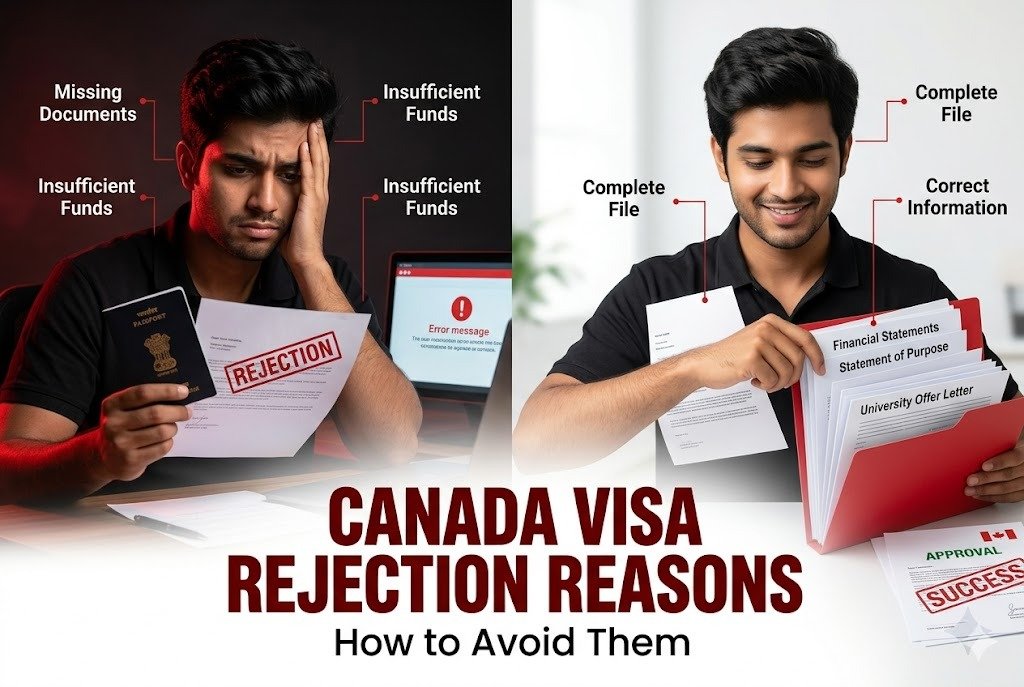
Canada remains one of the most popular destinations for Indian students because of its high-quality education system, career opportunities, multicultural environment, and immigration pathways. However, in 2026, obtaining a Canadian study permit has become more competitive due to stricter immigration checks, updated financial requirements, and increasing global demand.
As a result, understanding the most common Canada visa rejection reasons is extremely important before applying.
Many students mistakenly believe that receiving admission from a Canadian college or university automatically guarantees visa approval. In reality, Canadian visa officers carefully examine:
- Financial stability
- Academic consistency
- Genuine student intent
- Course relevance
- Documentation quality
- Immigration risk factors
According to official immigration guidelines from https://www.canada.ca, visa officers evaluate whether applicants genuinely meet all study permit conditions before granting approval.
Recent reports also suggest that Canada has tightened scrutiny on study permit applications due to concerns involving fraudulent documentation, misuse of student pathways, and increasing application volumes. (timesofindia.indiatimes.com)
The good news is that most visa rejections are avoidable when students prepare strategically and understand the process properly.
Insufficient Proof of Funds
One of the most common rejection reasons is weak financial documentation.
Canadian authorities want assurance that students can genuinely afford:
- Tuition fees
- Living expenses
- Accommodation
- Travel costs
Visa officers carefully analyze:
- Bank statements
- Sponsor income
- Education loans
- GIC certificates
- Financial consistency
Students using unclear, sudden, or suspicious financial transactions often face rejection risks.
According to recent guidelines, students may need proof of CAD 22,895 or more for living expenses alone, excluding tuition. (collegedunia.com)
How to Avoid This Problem
- Maintain transparent banking history
- Avoid large unexplained deposits
- Submit genuine sponsor documents
- Use approved GIC programs
- Include proper income proof
Strong financial clarity significantly improves credibility.
Weak or Generic Statement of Purpose (SOP)
The SOP has become one of the most critical parts of the application process.
Many students still use:
- Copied SOP templates
- AI-generated generic content
- Consultant-written repetitive statements
Visa officers can often identify weak or unrealistic SOPs quickly.
A strong SOP should clearly explain:
- Why you selected Canada
- Why you chose the program
- Career goals
- Future plans after graduation
- How the course aligns with your background
How to Avoid This Problem
- Write personalized SOPs
- Explain career progression logically
- Keep goals realistic and professional
- Avoid exaggerated claims
- Demonstrate genuine academic intent
Students with strong, authentic SOPs often appear more credible.
Choosing an Irrelevant Course
Course mismatch is another major rejection reason.
For example:
- Engineering graduates suddenly applying for unrelated diploma programs
- Students selecting random courses only for visa purposes
- Choosing programs with weak career logic
Visa officers analyze whether the chosen course makes academic and professional sense.
How to Avoid This Problem
Choose programs that align with:
- Previous education
- Career goals
- Industry demand
- Long-term growth plans
Logical academic progression improves approval chances significantly.
Poor Academic Performance
Weak academic records can increase visa concerns.
This does not mean students need perfect marks. However, serious academic inconsistencies without explanation may raise doubts.
Common concerns include:
- Multiple backlogs
- Long unexplained study gaps
- Poor attendance records
- Frequent academic failures
How to Avoid This Problem
- Explain gaps honestly
- Demonstrate improvement
- Include additional certifications
- Show career-focused motivation
Strong SOP explanations can sometimes reduce concerns regarding weaker academics.
Lack of Genuine Temporary Resident Intent
Canadian study permits are temporary resident permits.
Visa officers evaluate whether applicants genuinely intend to:
- Study seriously
- Follow visa rules
- Leave Canada if required
Applications appearing heavily immigration-focused sometimes face additional scrutiny.
How to Avoid This Problem
Students should:
- Focus on educational goals
- Avoid unrealistic immigration language
- Present balanced long-term plans
- Show strong ties to home country
Clear academic purpose remains extremely important.
Incomplete or Incorrect Documentation
Even small documentation errors can create serious problems.
Common mistakes include:
- Missing signatures
- Expired passports
- Incorrect forms
- Unverified documents
- Inconsistent information
How to Avoid This Problem
- Double-check every document
- Follow official IRCC guidelines carefully
- Verify application accuracy
- Maintain document consistency
Well-organized applications create stronger professional impressions.
Comparison Table: Strong vs Weak Visa Applications
| Strong Application | Weak Application |
|---|---|
| Personalized SOP | Generic SOP |
| Clear financial proof | Unclear finances |
| Relevant course selection | Random course choice |
| Logical academic background | Weak academic consistency |
| Complete documentation | Missing paperwork |
| Genuine career goals | Unclear future plans |
Expert Insight: Visa Officers Evaluate Risk and Credibility
One of the biggest misconceptions among students is assuming visa approval depends only on money or admission letters.
In reality, visa officers evaluate overall credibility.
They analyze:
- Academic progression
- Financial transparency
- Communication quality
- Study intentions
- Long-term logic
Students who appear organized, realistic, and professionally prepared usually create stronger applications.
Experts increasingly recommend:
- Independent research
- Transparent finances
- Career-focused course selection
- Personalized documentation
rather than depending entirely on consultants or copied templates.
Latest Trends and Updates in 2026
Canada’s international student system is changing rapidly. Several major trends are influencing study permit approvals and rejection rates in 2026.
Increased Fraud Detection Measures
Canada has strengthened fraud detection systems because of rising concerns regarding:
- Fake bank statements
- Fraudulent admission letters
- Misleading consultants
- Fabricated financial records
As a result, even small inconsistencies now receive greater scrutiny.
Financial Verification Is Much Stricter
Visa officers now examine:
- Sponsor income consistency
- Tax records
- Banking patterns
- GIC authenticity
more carefully than before.
Sudden large deposits or weak sponsor profiles can increase rejection risk significantly.
Students Are Becoming More ROI-Focused
Indian students increasingly evaluate:
- Tuition costs
- Salary potential
- PR opportunities
- Internship access
- Job demand
before selecting programs.
Programs with stronger employability outcomes often appear more credible during visa evaluation.
Graduate Programs Are Receiving Higher Preference
Recent trends suggest that:
- Master’s programs
- Research-focused education
- Specialized technical programs
may experience relatively stronger approval rates compared to generic diploma pathways in some cases. (m.economictimes.com)
SOP Quality Is Becoming More Important
Visa officers increasingly expect:
- Personalized applications
- Clear career logic
- Professional presentation
- Genuine educational planning
Students using copied SOP templates face growing rejection risks.
Real-Life Example: Fixing a Previous Rejection
Aman from Punjab initially received a study permit rejection because:
- His SOP was generic
- His financial documentation lacked clarity
- His chosen program did not align with his academic background
Instead of reapplying immediately with the same documents, he improved:
- Sponsor financial records
- Career explanation
- Program selection
- SOP personalization
He later applied for a Business Analytics program directly connected to his previous commerce degree.
His second application was approved successfully.
His experience demonstrates how strategic corrections can significantly improve outcomes after rejection.
Pros and Cons of Canada’s Strict Visa Screening
| Pros | Cons |
|---|---|
| Reduces fraud | Higher pressure on genuine students |
| Improves system credibility | Longer preparation process |
| Protects academic quality | Increased documentation complexity |
| Encourages serious applicants | Competitive approval environment |
| Strengthens immigration integrity | More financial scrutiny |
Beginner vs Expert Visa Preparation
| Beginner Thinking | Expert Thinking |
|---|---|
| Depends fully on consultants | Researches official IRCC rules |
| Uses copied SOP templates | Writes customized SOP |
| Ignores financial consistency | Builds strong financial profile |
| Selects random courses | Chooses career-aligned programs |
| Applies without planning | Prepares strategically months early |
Useful Tools and Resources
Helpful resources for students planning Canadian education:
- Canva — https://www.canva.com
- Notion — https://www.notion.so
- HubSpot — https://www.hubspot.com
- Trello — https://trello.com
- Google Trends — https://trends.google.com
Official Canadian immigration resources:
Students interested in entrepreneurship and startup learning can also explore: https://onegrasp.com/
Common Mistakes to Avoid
Many students make avoidable visa mistakes.
Avoid:
- Submitting fake financial documents
- Using copied SOPs
- Choosing unrelated programs
- Ignoring financial clarity
- Applying without research
- Waiting until deadlines approach
What to Do Next
Before applying for a Canadian study permit, students should:
- Research official IRCC requirements
- Build strong financial proof
- Select career-relevant programs
- Write personalized SOPs
- Organize documentation carefully
- Apply early
- Prepare long-term educational plans
Strategic preparation significantly improves approval chances.
Quick Checklist
- Verify DLI-approved institution
- Prepare genuine SOP
- Build financial proof
- Arrange GIC properly
- Select relevant course
- Check passport validity
- Complete biometrics
- Review all documents carefully
Conclusion
Understanding the most common Canada visa rejection reasons is extremely important for Indian students planning higher education abroad in 2026.
Most rejections happen not because students lack potential, but because applications contain:
- Weak documentation
- Poor financial clarity
- Generic SOPs
- Course mismatches
- Incomplete planning
The good news is that most of these problems are avoidable.
Students who focus on:
- Transparency
- Strategic preparation
- Career-focused planning
- Genuine educational goals
- Proper financial documentation
usually create much stronger visa applications and improve their chances of approval significantly.
FAQs
Weak financial proof and poor SOP quality are among the most common rejection reasons.
Yes, students can reapply after improving the issues mentioned in the refusal letter.
Yes, but reasonable gaps with proper explanations are often acceptable.
Yes, the SOP is extremely important because it explains academic intent and career goals.
Yes, submitting fraudulent documents can lead to serious immigration consequences and future bans. (canada.ca)
Related Posts: