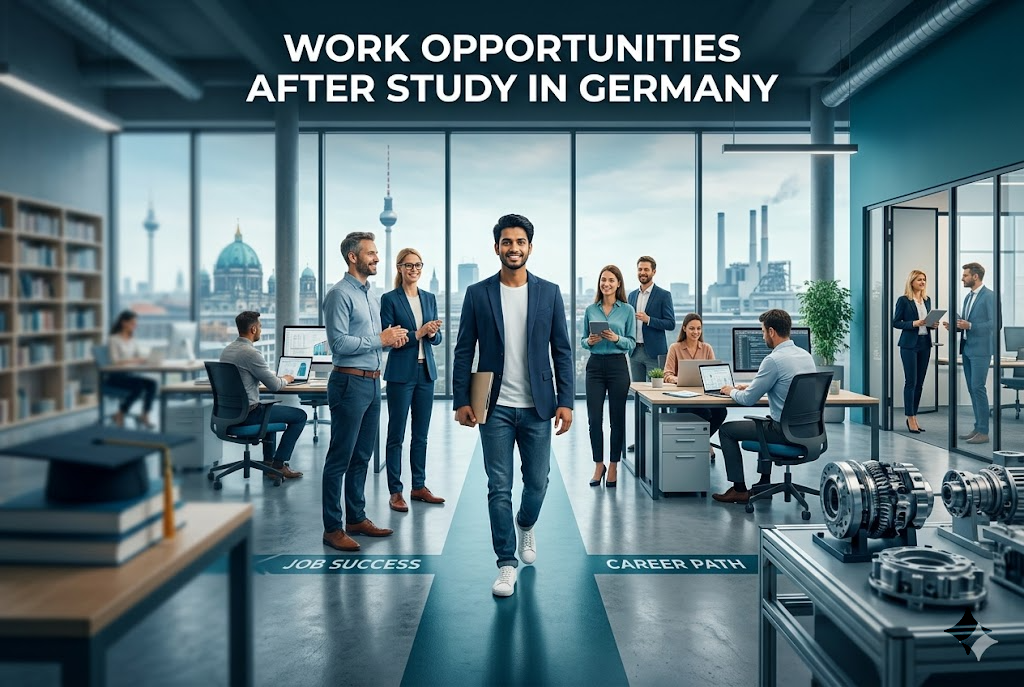
Germany has become one of the most attractive destinations for international students not only because of affordable education, but also because of its strong post-study job opportunities.
For Indian students, one of the biggest questions before choosing Germany is:
Can you stay and work in Germany after graduation?
The answer is yes — and Germany offers one of the most practical post-study work pathways in Europe.
The Germany post study jobs ecosystem is expanding rapidly because the country faces growing skill shortages in:
IT
Artificial intelligence
Engineering
Healthcare
Manufacturing
Renewable energy
According to the Make it in Germany Official Portal, Germany actively encourages qualified international graduates to remain and contribute to the economy after completing their studies.
However, understanding:
Post-study visa rules
Job search timelines
Salary expectations
PR pathways
is extremely important before planning your future.
Can International Students Work in Germany After Graduation?
Yes.
International students graduating from recognized German universities can apply for a post-study residence permit that allows them to stay and search for jobs.
This post-study period gives graduates time to:
Find employment
Attend interviews
Build professional networks
Transition into long-term work permits
Germany’s approach is more career-focused than many countries because it directly connects education with skilled workforce needs.
Germany Post Study Work Visa Explained
After graduation, students can apply for an 18-month post-study residence permit.
Post-study work search period:
18\text{ months post-study job search period}
During this time, graduates can:
Work full-time
Apply for skilled jobs
Attend interviews
Build career experience
This flexibility is one of Germany’s strongest advantages for international students.
Eligibility for Post-Study Work Permit
Students usually need:
Degree completion from recognized German institution
Valid residence permit
Proof of graduation
Financial support documentation (if required)
Once students secure relevant employment, they can transition into:
Skilled worker permit
EU Blue Card
Long-term residence pathways
Top Job Sectors in Germany After Study
Germany offers strong opportunities in several industries.
High-demand sectors include:
Software development
AI and machine learning
Cybersecurity
Mechanical engineering
Automotive engineering
Healthcare and nursing
Data analytics
Renewable energy
Logistics and supply chain
Technical graduates often benefit the most from Germany’s labor shortages.
Average Salary After Graduation
Salaries depend on:
Industry
Experience
City
German language skills
Average graduate salary ranges often start around:
45,000\text{ EUR to }65,000\text{ EUR yearly average graduate salary}
Fields like:
AI
Software engineering
Finance
Data science
may offer even higher starting packages.
Importance of German Language Skills
This is one of the biggest realities students should understand.
Although many companies hire English-speaking professionals, German language skills significantly improve:
Job opportunities
Networking
Workplace integration
Salary growth
Students who learn German during studies usually achieve stronger career outcomes.
Even basic German communication creates advantages in:
Interviews
Daily work culture
Team collaboration
Germany Post Study Jobs: PR and Long-Term Settlement
Germany offers relatively clear long-term pathways for skilled graduates.
After securing qualified employment, graduates may become eligible for:
Germany is rapidly increasing hiring in AI, software development, semiconductor technology, healthcare, and renewable energy sectors due to ongoing labor shortages.

International graduates with technical skills and practical experience are becoming highly valuable in the German job market.

At the same time, employers are increasingly prioritizing communication ability, adaptability, and internship exposure over academic scores alone.

Hybrid work models and English-speaking startup ecosystems are also expanding in major cities like Berlin and Munich.

Germany is continuing immigration reforms to attract more skilled global professionals and simplify long-term employment pathways.
Real-Life Example
Karan completed his master’s degree in data science in Germany.
During studies, he:
Learned intermediate German
Worked part-time as a data analyst intern
Built machine learning projects
Attended networking events
By graduation, he already had industry experience and received a full-time offer within four months.
Meanwhile, several classmates who focused only on academics struggled longer because they lacked practical experience and networking connections.
Pros and Cons of Working in Germany After Study
Pros
Cons
Strong job opportunities
German language can be challenging
18-month job search visa
Competitive hiring in some sectors
Good salary potential
Bureaucratic processes
PR and Blue Card pathways
Slow recruitment timelines
High quality of life
Housing shortages in large cities
Beginner vs Expert Approach
Beginner Thinking
Expert Thinking
Waits until graduation to prepare
Starts career planning early
Focuses only on degree
Builds internships and projects
Ignores networking
Builds professional connections
Avoids German language
Learns gradually during studies
Depends on university reputation
Focuses on employability skills
Quick Checklist for Post-Study Success
Learn German basics
Gain internship experience
Build technical portfolio
Attend networking events
Improve communication skills
Research visa pathways
Apply for jobs early
Conclusion
Germany offers one of the strongest post-study work systems for international students in Europe.
With affordable education, strong industry demand, and clear long-term work pathways, Germany creates excellent career opportunities for graduates who prepare strategically.
However, success depends on much more than simply earning a degree.
Students who:
Build practical skills
Gain internships
Learn German gradually
Network actively
Plan careers early
usually achieve the best long-term outcomes.
In Germany, employability is built during studies — not after graduation.
FAQs
International graduates can usually stay for 18 months to search for jobs.
Yes. Skilled graduates can eventually qualify for permanent residency pathways.
Opportunities are strong in sectors like IT, engineering, AI, and healthcare.
Not always, but German skills significantly improve opportunities and career growth.
Graduate salaries often range between €45,000–€65,000 yearly depending on industry and skills.

 May 20, 2026
 6 Min
 No Comment