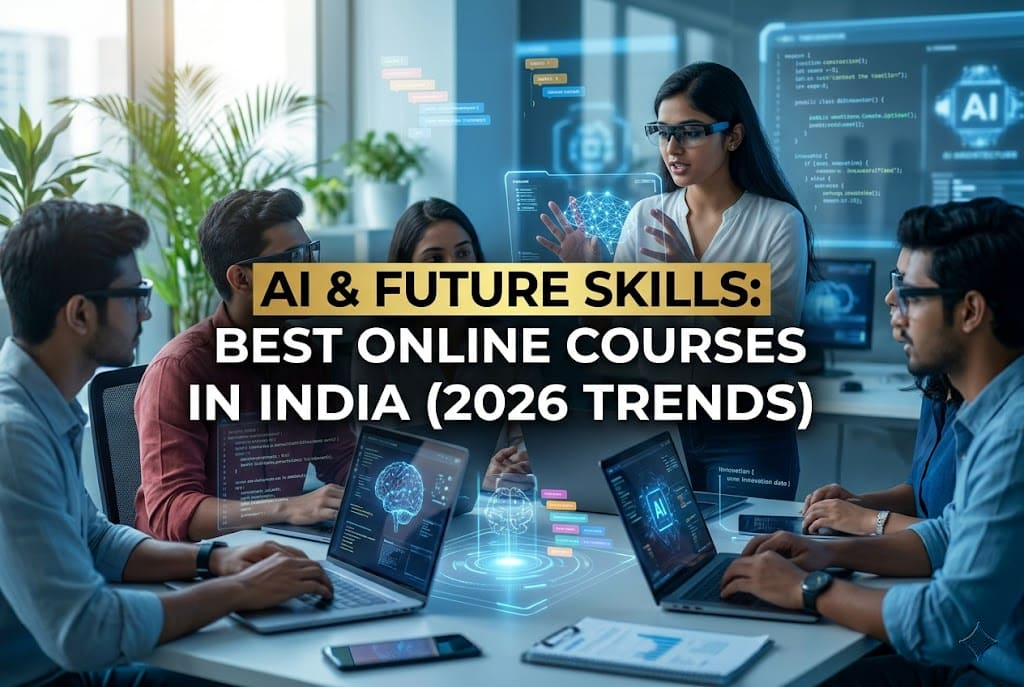
Artificial intelligence is no longer a futuristic concept reserved for tech giants and scientists. It is now transforming how businesses operate, how students learn, and how professionals build careers. From AI-powered chatbots to automated workflows and predictive analytics, the digital economy is evolving faster than ever before. As a result, mastering future-ready skills has become essential for long-term career success.
This AI future skills guide explores the most valuable skills of 2026, the industries changing rapidly because of automation, and the practical steps individuals can take to remain competitive in a technology-driven world.
According to research from McKinsey & Company, AI adoption across industries continues to accelerate globally, especially in areas such as customer service, software development, healthcare, finance, and marketing. Meanwhile, companies increasingly prefer employees who can work alongside AI tools rather than compete against them.
Artificial intelligence is reshaping the employment landscape. While automation may replace repetitive tasks, it is also creating entirely new categories of jobs and business opportunities.
The biggest shift is not simply technological — it is strategic. Companies now seek professionals who can combine creativity, critical thinking, communication, and AI-powered productivity.
For example:
Marketers use AI for content optimization
Developers use AI coding assistants
Designers use generative AI tools
Analysts use machine learning models
Entrepreneurs automate operations with AI software
Therefore, future success depends on adapting quickly instead of resisting technological change.
The Most In-Demand AI and Future Skills in 2026
The modern workforce requires a combination of technical knowledge and human-centered capabilities.
Artificial Intelligence and Machine Learning
AI and machine learning remain among the highest-paying skill areas globally. Professionals who understand data modeling, automation systems, and AI workflows are becoming increasingly valuable.
Even beginners can start learning through affordable online programs and practical projects.
For learners exploring career-focused educational resources and skill development opportunities, OneGrasp’s learning platform offers useful insights into modern education and future-ready careers.
Prompt Engineering
Prompt engineering has emerged as one of the fastest-growing digital skills. Businesses now require professionals who can effectively communicate with AI systems to generate content, automate tasks, and improve productivity.
This skill combines creativity, logic, communication, and problem-solving.
Data Analytics
Data has become the backbone of decision-making. Companies use analytics to predict customer behavior, optimize operations, and improve business strategies.
As a result, data visualization, SQL, Excel analytics, and business intelligence tools remain highly valuable.
Cybersecurity
As digital transformation expands, cyber threats are increasing simultaneously. Cybersecurity experts are essential for protecting sensitive systems, financial data, and cloud infrastructure.
This field continues to offer strong job stability and global demand.
Emotional Intelligence and Communication
Interestingly, human-centered skills are becoming more valuable alongside AI growth.
Leadership, storytelling, negotiation, and emotional intelligence help professionals stand out in environments increasingly dominated by automation.
AI Future Skills Guide for Students and Professionals
The best way to prepare for the future is through continuous learning and adaptability.
Here is a simple comparison between traditional learning approaches and future-focused strategies.
Traditional Career Approach
Future-Ready Career Approach
Degree-focused learning
Skill-focused learning
Static career paths
Flexible career growth
Manual workflows
AI-assisted productivity
Long theoretical training
Micro-learning and certifications
Job dependency
Multiple income streams
This shift explains why short-term certification programs and practical online learning are becoming increasingly popular worldwide.
Industries Being Transformed by AI
Artificial intelligence is impacting almost every major industry.
Industry
AI Impact
Healthcare
AI diagnostics and virtual healthcare
Finance
Fraud detection and automated analysis
Education
Personalized learning platforms
Ecommerce
Recommendation engines and automation
Marketing
AI-generated content and analytics
Manufacturing
Smart robotics and predictive maintenance
According to insights from Forbes Technology Council, organizations investing early in AI adaptation are gaining significant competitive advantages.
Expert Insight: The Real Future Is Human + AI Collaboration
One common misconception is that AI will completely replace humans. In reality, the strongest professionals will be those who learn to collaborate with AI effectively.
For instance, AI can generate content drafts quickly, but human creativity, emotional intelligence, and strategic thinking remain essential for meaningful communication.
Similarly, software developers using AI coding assistants often become more productive rather than obsolete.
The future belongs to professionals who can:
Use AI tools efficiently
Interpret AI-generated insights
Make strategic decisions
Solve complex human problems
Communicate effectively
Therefore, adaptability has become the ultimate career skill.
Latest Trends and Updates
Generative AI tools such as ChatGPT, Gemini, and Claude are rapidly becoming part of daily workflows across industries.

AI-powered automation is reducing repetitive administrative work while increasing demand for strategic and creative roles.

Companies are investing heavily in AI literacy training programs to help employees adapt to evolving technologies.

Remote work and freelancing opportunities are expanding because AI tools allow individuals to operate more efficiently with smaller teams.

Educational institutions and online platforms are increasingly offering micro-certifications focused on AI, cybersecurity, cloud computing, and automation technologies.
Common Mistakes to Avoid While Learning AI Skills
Many learners struggle because they approach AI education incorrectly.
Focusing Only on Theory
Watching tutorials without building projects limits real-world understanding.
Ignoring Soft Skills
Technical knowledge alone is no longer enough in modern workplaces.
Chasing Every Trend
Not every AI trend has long-term value. Focus on foundational skills first.
Fear of Technology
Avoiding AI tools entirely may reduce future career competitiveness.
Real-Life Example: How AI Skills Changed a Career
Priya, a marketing executive from Bengaluru, initially feared AI would replace her role. Instead of resisting change, she learned prompt engineering, AI content optimization, and analytics tools through affordable online certifications.
Within one year, she improved campaign efficiency, reduced manual work, and secured a higher-paying digital strategy position.
Her success came from learning how to work with AI rather than competing against it.
Beginner vs Expert Mindset in the AI Era
Beginner Mindset
Expert Mindset
Fears automation
Uses automation strategically
Learns randomly
Builds structured skill paths
Depends on one income source
Creates multiple opportunities
Avoids AI tools
Experiments continuously
Focuses on certificates only
Focuses on execution and results
Pros and Cons of AI-Driven Careers
Pros
Cons
High salary potential
Rapid technology changes
Flexible remote opportunities
Continuous learning required
Increased productivity
Competitive global market
Strong industry demand
Risk of misinformation
Faster business automation
Ethical concerns in AI usage
What to Do Next (Actionable Steps)
To build future-ready skills effectively:
Learn one AI tool deeply instead of trying everything
Build small practical projects
Develop both technical and communication skills
Follow industry updates consistently
Join online communities and workshops
Create a professional portfolio
Stay adaptable and curious
Most importantly, start early. The AI revolution is already happening, and those who adapt faster will have stronger opportunities in the coming years.
Quick Checklist
Identify future-proof skills
Learn AI fundamentals
Practice with real-world tools
Build portfolio projects
Improve communication abilities
Stay updated with industry trends
Network with professionals
Continue learning consistently
Conclusion
Artificial intelligence is not simply changing technology — it is transforming careers, industries, and the way humans work. The professionals who succeed in 2026 and beyond will not necessarily be the most experienced or the most technically advanced. Instead, they will be the ones who remain adaptable, curious, and willing to evolve continuously.
This AI future skills guide highlights a simple reality: future success depends on combining human creativity with AI-powered efficiency. Those who embrace lifelong learning, practical experimentation, and strategic thinking will unlock the greatest opportunities in the digital economy.
The future is not about humans versus AI. It is about humans empowered by AI.
FAQs
Machine learning, prompt engineering, data analytics, cybersecurity, and AI automation are among the most valuable skills.
AI is automating repetitive tasks, but it is also creating new career opportunities requiring human creativity and strategy.
Yes, many beginner-friendly AI tools and platforms now allow non-technical users to work with AI effectively.
AI certifications can improve credibility when combined with practical projects and hands-on experience.
Healthcare, finance, marketing, education, ecommerce, software development, and cybersecurity are actively hiring AI-skilled professionals.

 May 20, 2026
 7 Min
 No Comment