May 25, 2026
 8 Min
 No Comment
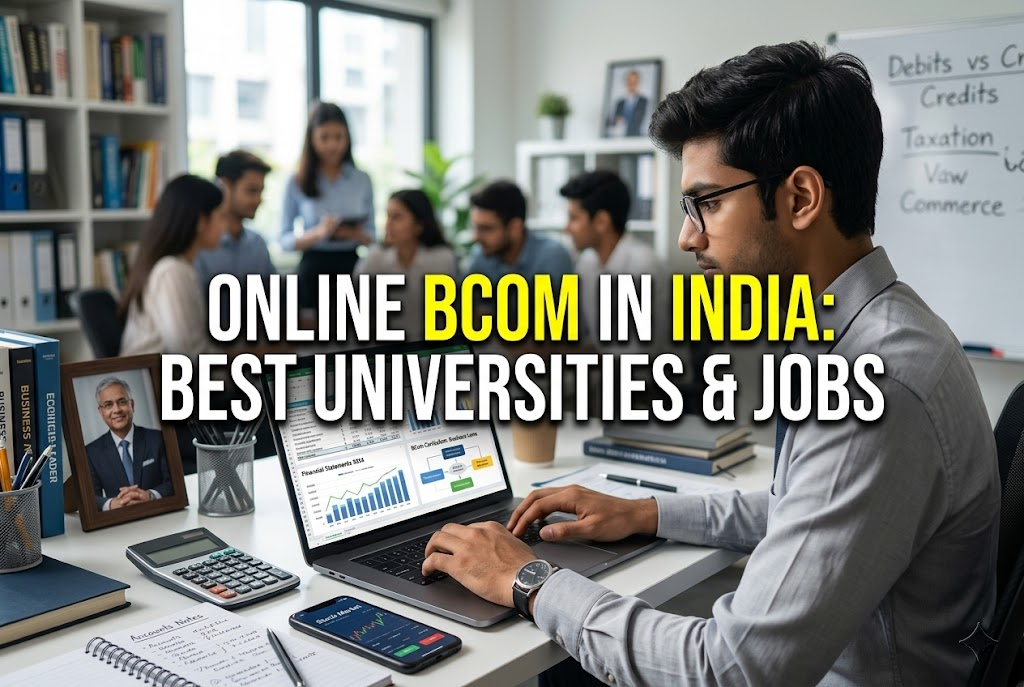
Commerce education in India is evolving faster than ever before. Students no longer need to relocate to major cities or attend fixed classroom sessions to earn a recognized commerce degree. Today, the rise of digital learning platforms and university-backed virtual classrooms has made the online BCom in India ecosystem one of the fastest-growing segments in higher education.
For many students, an online Bachelor of Commerce degree offers more than convenience. It creates opportunities to prepare for CA, CS, CMA, banking exams, and corporate careers while maintaining flexibility. Working professionals, entrepreneurs, and even students pursuing professional certifications are increasingly choosing online BCom programs to balance education with other commitments.
The perception of online education has also changed significantly. With UGC-approved universities, AI-enabled learning systems, recorded lectures, and online examinations becoming mainstream, digital commerce education is gaining stronger industry acceptance.
As India’s online education market expands rapidly, understanding how online BCom programs work can help students make smarter academic and career decisions.
What Is an Online BCom Degree?
An online Bachelor of Commerce degree is a three-year undergraduate commerce program delivered entirely through digital platforms.
Students typically study subjects such as:
- Financial Accounting
- Business Law
- Economics
- Taxation
- Banking
- Auditing
- Business Management
Unlike traditional classroom programs, online BCom courses allow students to learn remotely through live classes, recorded lectures, digital assignments, and online assessments.
According to the University Grants Commission, UGC-approved online degrees from recognized institutions are valid for higher education and many employment opportunities.
Students can also explore educational guidance and admission resources through OneGrasp Education Resources for better academic planning.
Why Online BCom Programs Are Growing Rapidly
The demand for online commerce degrees has increased sharply in recent years.
Several factors are driving this growth:
| Traditional BCom | Online BCom |
|---|---|
| Fixed classroom schedule | Flexible learning |
| Daily commuting required | Learn from anywhere |
| Higher living expenses | More affordable |
| Limited accessibility | Nationwide enrollment |
| Manual learning methods | Digital learning tools |
According to India’s Ministry of Education Digital Learning Initiatives, digital higher education adoption accelerated significantly after 2020 due to internet expansion and EdTech growth.
In addition, many commerce students preparing for CA, ACCA, CMA, and banking exams prefer online BCom programs because they provide academic flexibility alongside professional preparation.
Industry reports also show that recognized online commerce degrees are becoming increasingly accepted in banking, finance, operations, and business administration roles. (CollegeFunda)
Online BCom in India: Eligibility and Admission Process
Eligibility Criteria
Most universities require students to:
- Complete 10+2 from a recognized board
- Meet minimum qualifying marks
- Submit identity and academic documents
Some universities accept students from all streams, while others prefer commerce backgrounds.
Admission Process
The online admission process usually includes:
- Online registration
- Document upload
- Fee payment
- Verification process
- Admission confirmation
Many universities now complete the entire admission process digitally without requiring campus visits.
Students should always verify whether the university is UGC-DEB approved before enrolling. (The Times of India)
Top Universities Offering Online BCom Programs
Several reputed institutions now offer online BCom programs in India.
Popular names include:
- Sikkim Manipal University
- Amity University
- NMIMS
- Jamia Hamdard
- Manipal University Jaipur
Many of these institutions now provide:
- Live and recorded classes
- AI-proctored examinations
- Placement assistance
- EMI payment options
- Career mentorship
According to recent university data, fee ranges typically vary from ₹35,000 to ₹2 lakh depending on institution reputation and specialization. (CollegeFunda)
Career Opportunities After Online BCom
A BCom degree continues to remain one of the most versatile undergraduate qualifications in India.
Graduates can pursue careers in:
| Industry | Potential Roles |
|---|---|
| Banking | Banking Associate, Clerk |
| Finance | Financial Analyst |
| Accounting | Accountant, Auditor |
| Corporate Sector | Operations Executive |
| Taxation | Tax Consultant |
| Digital Business | E-commerce Associate |
Many students also pursue:
- CA
- CS
- CMA
- MBA
- Banking exams
- Government jobs
Interestingly, community discussions on Reddit show that many students combine online BCom programs with professional certifications for greater flexibility and career growth. (Reddit)
Online BCom in India: Common Challenges Students Face
Despite growing popularity, online commerce education still comes with challenges.
One major issue is self-discipline. Since students learn remotely, maintaining consistency becomes difficult for some learners.
Another challenge is choosing the right university. Some students unknowingly enroll in institutions without proper approval or industry credibility.
Technical issues such as internet connectivity and digital platform problems can also affect learning experiences.
Moreover, some employers still prioritize practical skills and internships over the degree format itself. Therefore, students should focus on skill-building alongside academics.
Recent discussions on Reddit also highlight student concerns regarding placement quality, degree perception, and practical exposure in online commerce programs. (Reddit)
Expert Insight: The Future of Online Commerce Education
The future of online commerce education in India looks highly promising.
Universities are increasingly integrating:
- AI-based learning systems
- Interactive finance simulations
- Industry case studies
- Virtual mentorship programs
- Skill-based certifications
Meanwhile, employers now value practical business skills such as:
- Financial analysis
- Communication
- Excel proficiency
- Digital marketing
- Business analytics
Experts believe hybrid learning models combining online education with internships and workshops will dominate future commerce education.
Additionally, new job-oriented online programs are expanding rapidly across universities. Recent reports indicate that institutions like the University of Madras are also expanding online commerce offerings for wider accessibility. (The Times of India)
Common Mistakes to Avoid Before Enrolling
Students often make avoidable mistakes while selecting online BCom programs.
| Mistake | Consequence |
|---|---|
| Ignoring UGC approval | Degree validity concerns |
| Choosing based only on low fees | Poor educational quality |
| Ignoring placement support | Limited career guidance |
| Weak time management | Poor academic performance |
| Avoiding skill development | Lower employability |
Students should always research accreditation, faculty quality, curriculum structure, and student support systems carefully.
Latest Trends and Updates
Artificial intelligence tools are increasingly being integrated into online BCom programs to personalize learning experiences and improve student engagement.

Several Indian universities now offer AI-proctored examinations, reducing the need for physical exam centers while maintaining academic integrity.

Skill-based commerce education is also expanding rapidly, with universities combining finance, taxation, analytics, and digital business certifications alongside traditional BCom curriculum.

Mobile-first learning platforms are helping students attend classes, access recorded lectures, and submit assignments directly through smartphone apps.

Meanwhile, universities are introducing industry-oriented modules in fintech, e-commerce, and business analytics to align commerce education with evolving job market demands.
Real-Life Example: Combining CA Preparation with Online BCom
Consider the example of Rahul, a commerce student from Hyderabad preparing for Chartered Accountancy exams.
Instead of attending a full-time college with rigid schedules, he enrolled in a UGC-approved online BCom program. This allowed him to dedicate additional hours to CA coaching while continuing graduation simultaneously.
He attended recorded lectures during weekends, completed assignments digitally, and balanced both academic tracks effectively.
His experience reflects why many commerce students now prefer online BCom programs alongside professional certifications.
Beginner vs Expert Approach to Online Commerce Education
| Beginner Approach | Expert Approach |
|---|---|
| Focuses only on degree | Builds practical business skills |
| Chooses cheapest university | Verifies accreditation carefully |
| Studies irregularly | Maintains structured routine |
| Ignores internships | Gains real-world exposure |
| Avoids networking | Builds professional connections |
Successful students usually combine academic learning with certifications, internships, and digital skills.
Pros and Cons of Online BCom Programs
| Pros | Cons |
|---|---|
| Flexible schedule | Requires self-discipline |
| Affordable education | Limited campus exposure |
| Suitable for CA/CS aspirants | Internet dependency |
| Learn from anywhere | Reduced physical networking |
| Digital learning access | Placement quality may vary |
What Students Should Do Next
Students considering online BCom programs should take a strategic approach before enrolling.
Practical next steps include:
- Verify UGC-DEB approval
- Compare fee structures carefully
- Research placement support
- Analyze curriculum relevance
- Build finance and digital skills
- Prepare a consistent study schedule
- Explore internships alongside studies
Students should also verify accreditation through official bodies like National Assessment and Accreditation Council (NAAC) before confirming admissions.
Quick Checklist
- Verify university recognition
- Compare curriculum quality
- Check placement assistance
- Review fee transparency
- Build complementary skills
- Create study schedule
- Research career opportunities
Conclusion
The growth of digital education has transformed commerce learning opportunities across India, and the modern online BCom in India ecosystem is becoming more flexible, career-focused, and industry-relevant than ever before.
For students seeking affordability, convenience, and academic flexibility, online BCom programs offer a practical pathway toward higher education and professional growth. However, success depends heavily on choosing a recognized university, maintaining discipline, and building real-world business skills alongside academics.
As AI-powered education, digital learning platforms, and hybrid commerce training continue evolving, online BCom degrees are likely to gain even stronger acceptance in India’s employment landscape.
For aspiring commerce students, the smartest strategy is simple: choose wisely, stay consistent, and treat the degree as a foundation for long-term career development rather than just a qualification.
FAQs
Yes, online BCom degrees from UGC-approved universities are generally valid for jobs, higher studies, and competitive exams.
Yes, many CA aspirants choose online BCom programs because of flexible schedules and reduced classroom commitments.
Most online BCom programs in India have a duration of three years.
Yes, online BCom programs are usually more affordable than traditional on-campus commerce degrees. (CollegeFunda)
Popular options include Amity University, NMIMS, Sikkim Manipal University, and Jamia Hamdard.