May 25, 2026
 7 Min
 No Comment
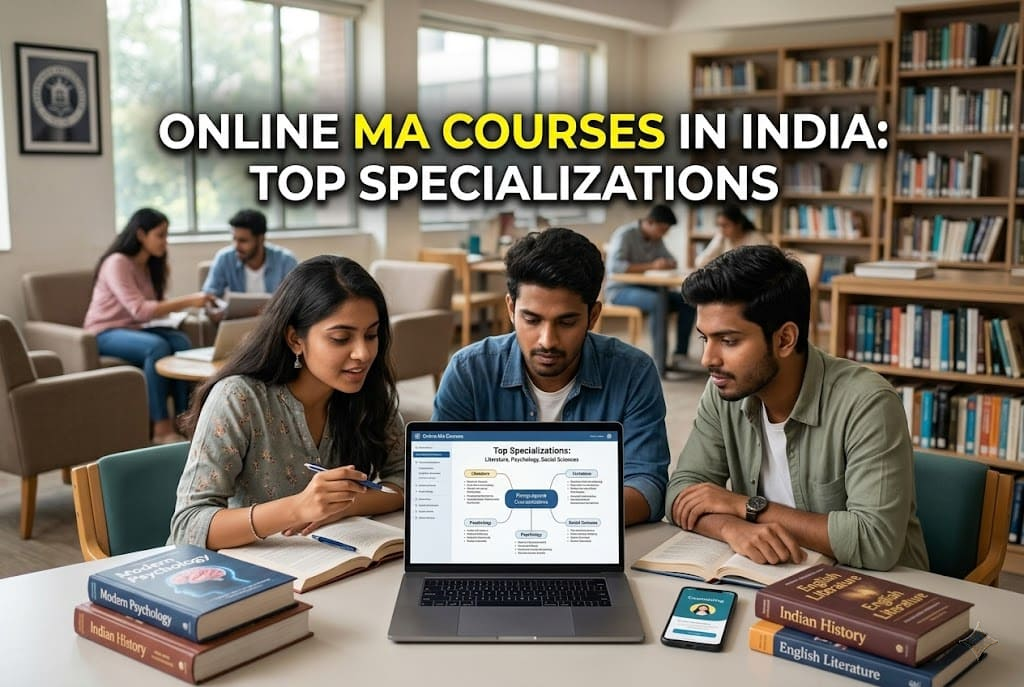
The demand for flexible higher education in India has grown rapidly over the past few years. Students and working professionals no longer want education systems that force them to choose between career responsibilities and academic growth. This shift has made online MA courses India learners can pursue from home increasingly popular across the country.
Today, online Master of Arts programs are helping graduates continue higher education without relocating, leaving jobs, or attending traditional classrooms daily. Whether someone wants to prepare for government exams, improve career opportunities, enter academia, or simply deepen subject expertise, online MA degrees provide a more accessible pathway.
The rise of digital learning platforms, virtual classrooms, AI-powered education tools, and UGC-approved online universities has further strengthened the credibility of online postgraduate education in India.
At the same time, employers are becoming more comfortable with recognized online qualifications, especially when candidates demonstrate communication skills, practical understanding, and adaptability.
Understanding how online MA programs work, their career value, and how to choose the right university is essential before enrolling.
What Are Online MA Courses?
Online MA courses are postgraduate degree programs delivered digitally through virtual learning platforms.
Students usually attend:
- Live online lectures
- Recorded video sessions
- Virtual discussions
- Online assignments
- Digital examinations
Most online MA programs in India have a duration of two years.
Popular MA specializations include:
- English
- Political Science
- History
- Sociology
- Economics
- Journalism
- Psychology
- Public Administration
According to the University Grants Commission, recognized universities can offer approved online postgraduate programs under specific guidelines.
Students can also explore educational guidance and digital learning resources through OneGrasp Education Resources for better academic planning.
Why Online MA Courses Are Growing in India
The rapid expansion of online education has significantly increased interest in postgraduate online learning.
| Traditional MA Programs | Online MA Programs |
|---|---|
| Fixed classroom schedule | Flexible learning |
| Relocation often required | Learn from anywhere |
| Daily commuting | Fully digital access |
| Limited flexibility for professionals | Suitable for working learners |
| Higher living expenses | More affordable overall |
Several factors are contributing to this growth:
- Increasing internet accessibility
- Growth of digital universities
- Working professionals seeking qualifications
- Competitive exam preparation flexibility
- Rising acceptance of online education
According to India’s Ministry of Education Digital Learning Initiatives, digital higher education adoption continues growing across universities and learners in India.
Popular Online MA Specializations
Online MA in English
This specialization focuses on:
- Literature
- Communication
- Writing
- Linguistics
- Critical analysis
It is useful for careers in teaching, content, publishing, and media.
Online MA in Political Science
Students study:
- Political systems
- Public policy
- International relations
- Governance
This specialization is popular among UPSC and government exam aspirants.
Online MA in Psychology
Psychology programs cover:
- Human behavior
- Counseling concepts
- Mental health theories
- Social psychology
Interest in psychology education has increased significantly in recent years.
Online MA in Journalism and Mass Communication
These programs teach:
- Media studies
- Journalism ethics
- Digital communication
- Content production
This field aligns well with growing digital media industries.
Eligibility Criteria for Online MA Courses
Admission requirements are generally straightforward.
Common Eligibility Requirements
Students usually need:
- Bachelor’s degree from recognized university
- Minimum qualifying marks
- Basic document verification
Some universities may also require:
- Identity proof
- Passport-size photographs
- Digital application forms
Most admissions are completed fully online.
Are Online MA Degrees Valid in India?
This is one of the most important concerns for students.
UGC-approved online MA degrees from recognized universities are generally valid for:
- Higher education
- Competitive examinations
- Private sector employment
- Many academic opportunities
However, students should always verify:
- University recognition
- Accreditation status
- Online program approval
Recognition matters more than the learning mode itself.
Career Opportunities After Online MA Courses
Online MA graduates can pursue opportunities across multiple industries.
| MA Specialization | Career Opportunities |
|---|---|
| English | Teaching, Content Writing |
| Political Science | Civil Services, Research |
| Journalism | Media, Communication |
| Psychology | Counseling Support Roles |
| Sociology | Social Research, NGOs |
Many students also combine postgraduate education with digital certifications to improve employability.
Expert Insight: Why Humanities and Social Sciences Are Evolving
The modern job market is increasingly valuing communication, analytical thinking, creativity, and adaptability.
As AI automates repetitive technical tasks, human-centered skills such as:
- Critical thinking
- Communication
- Research ability
- Emotional intelligence
- Public understanding
are becoming more valuable.
Experts believe postgraduate humanities and social science education will remain highly relevant when combined with practical digital skills.
For example:
- Journalism students learning SEO
- Psychology students learning digital counseling tools
- Political science students understanding data analysis
This hybrid learning model improves long-term career adaptability.
Common Mistakes Students Should Avoid
Many learners make avoidable errors while selecting online MA programs.
| Mistake | Consequence |
|---|---|
| Ignoring university recognition | Degree validity issues |
| Choosing only based on fees | Poor educational quality |
| Weak study discipline | Incomplete learning |
| Ignoring career planning | Limited opportunities |
| Avoiding practical skills | Reduced employability |
Students should evaluate both academic and career outcomes carefully.
Latest Trends and Updates
Artificial intelligence and digital learning systems are increasingly transforming postgraduate education across India.

Several universities now offer AI-supported learning dashboards, virtual mentoring, recorded lectures, and interactive online classrooms for MA students.

Hybrid education models combining online learning with workshops, internships, and research-based practical exposure are also becoming more common.

Digital communication, content creation, policy analysis, and behavioral research are creating new interdisciplinary opportunities for humanities and social science graduates.

Meanwhile, employers increasingly value candidates who combine academic depth with digital literacy, communication skills, and practical adaptability.
Real-Life Example: Continuing Education While Working
Consider the example of Priya, a working professional from Hyderabad employed in customer support services.
She wanted to pursue higher education but could not leave her job for a full-time campus program. Instead, she enrolled in an online MA in English through a recognized university.
She attended evening lectures, completed assignments digitally, and improved her communication and analytical skills alongside work.
After graduation, she transitioned into content and communication-related roles with stronger career growth opportunities.
Her experience reflects why online postgraduate education is becoming increasingly popular among working professionals.
Beginner vs Expert Learning Approach
| Beginner Approach | Expert Approach |
|---|---|
| Studies only for exams | Focuses on practical application |
| Chooses random specialization | Aligns degree with career goals |
| Learns inconsistently | Maintains structured study routine |
| Ignores networking | Builds professional connections |
| Relies only on degree | Develops complementary skills |
Experienced learners treat postgraduate education strategically rather than passively.
Pros and Cons of Online MA Courses
| Pros | Cons |
|---|---|
| Flexible learning schedule | Requires self-discipline |
| Suitable for working professionals | Reduced campus interaction |
| More affordable than regular programs | Internet dependency |
| Learn from anywhere | Practical exposure may vary |
| Wide specialization options | Quality differs by university |
What Students Should Do Next
Students considering online MA programs should approach the decision strategically.
Practical next steps include:
- Verify university recognition
- Compare specialization relevance
- Research curriculum quality
- Build communication skills
- Combine academics with digital skills
- Develop practical projects
- Maintain consistent study routines
Students should also verify accreditation through official bodies like National Assessment and Accreditation Council (NAAC) before confirming admissions.
Quick Checklist
- Verify UGC approval
- Choose career-aligned specialization
- Compare universities carefully
- Build practical communication skills
- Maintain study consistency
- Explore internships or projects
- Track industry trends
Conclusion
The growth of online MA courses India students and professionals now pursue reflects the broader transformation happening across higher education. Flexible learning, digital classrooms, and recognized online universities are making postgraduate education more accessible than ever before.
For working professionals, government exam aspirants, and graduates seeking advanced academic qualifications, online MA programs offer opportunities to continue education without disrupting personal or professional responsibilities.
However, long-term success depends on more than earning a degree alone. Students who combine postgraduate education with practical digital skills, communication ability, and continuous learning habits are likely to remain more competitive in modern industries.
As online education systems continue evolving with AI-powered learning and hybrid education models, online MA programs are expected to become even more accepted and career-oriented across India.
FAQs
Yes, UGC-approved online MA programs from recognized universities are generally valid for higher education and many employment opportunities.
Yes, online MA programs are highly suitable for working professionals because of flexible schedules.
The best specialization depends on career goals, but English, Political Science, Psychology, and Journalism are highly popular.
Most online MA programs are more affordable than traditional campus-based postgraduate programs.
Students should verify university accreditation and approval through official UGC and NAAC websites.