Microsoft AI Strategy Faces Internal Backlash as Employees Question Workplace Culture, Job Security and Ethical Responsibilities
Microsoft is facing growing internal criticism over its aggressive push into artificial intelligence (AI), with a group of current and former employees circulating an open letter expressing concerns about workplace culture, employee well-being, environmental commitments and the company’s approach to AI development.
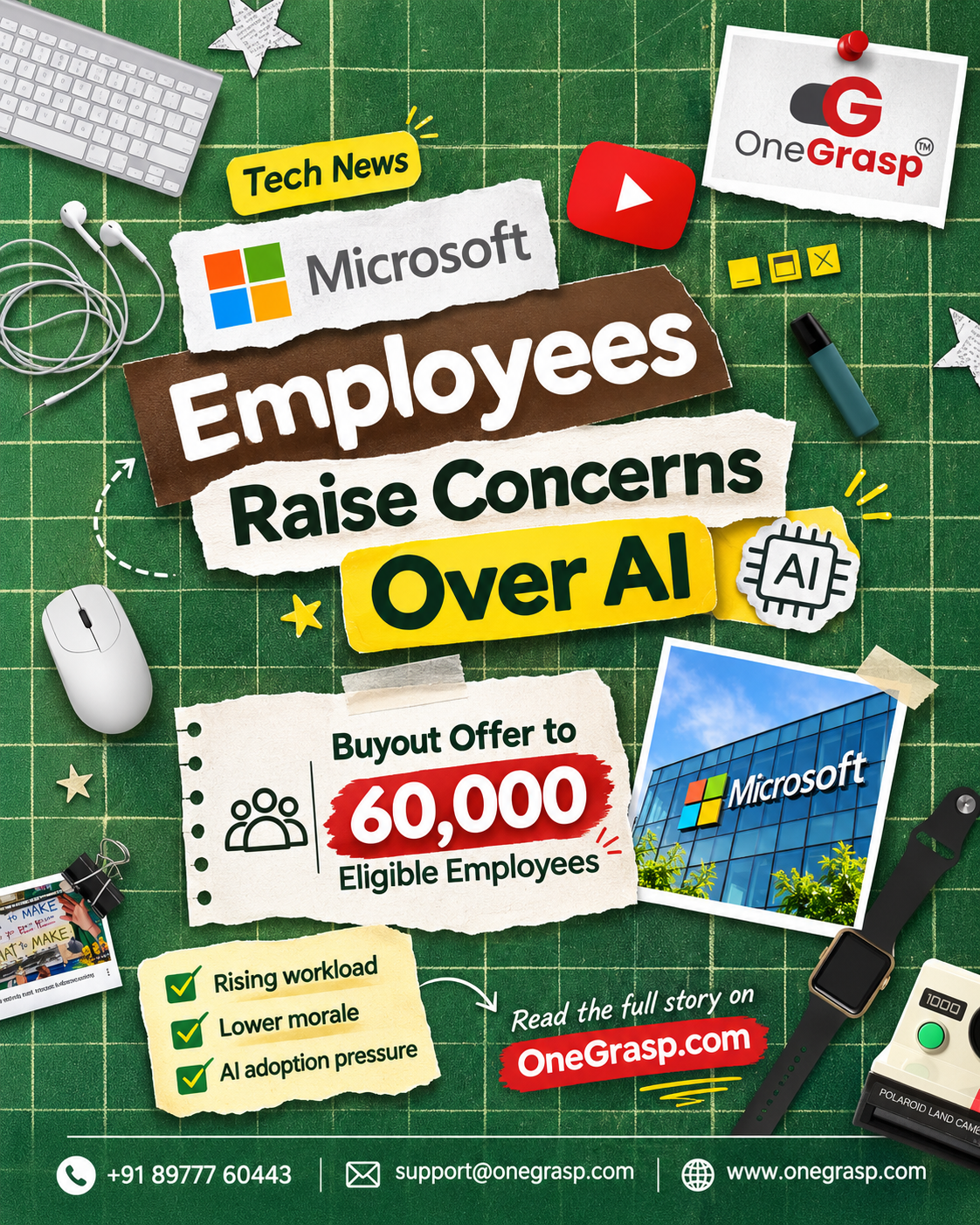
The concerns have emerged at a significant moment for the technology giant, following its voluntary buyout offer to approximately 60,000 eligible employees across several countries. The move has sparked discussions about the future of employment in the technology industry, particularly as companies increasingly integrate AI into their operations.
According to reports, the open letter, signed by a group identifying themselves as “Concerned Microsoft Workers,” argues that the company’s rapid AI expansion has created additional pressure on employees while changing the nature of their work.
Microsoft Employees Question the Impact of AI on Workplace Culture
The open letter describes a decline in employee morale, with workers expressing concerns about increasing workloads, frequent organisational restructuring and uncertainty about the future of their positions.
Employees reportedly believe that Microsoft’s growing emphasis on AI adoption has contributed to a more demanding workplace environment.
One of the central concerns is the expectation that employees should increasingly use AI tools in their everyday responsibilities. According to the letter, workers are being encouraged or required to integrate AI into their workflows, sometimes without adequate training or clear explanations of how these tools improve productivity.
Employees also highlight the additional work involved in reviewing AI-generated content, correcting inaccuracies and addressing problems created by poorly implemented features.
This raises an important question for technology companies: Does introducing AI genuinely reduce workloads, or does it sometimes create additional responsibilities for employees?
Microsoft’s AI Push and the Growing Debate Over Job Security
Artificial intelligence is rapidly transforming the global employment landscape. Companies are investing heavily in AI-powered systems to automate repetitive tasks, improve operational efficiency and accelerate product development.
However, the transition is creating uncertainty among employees across multiple industries.
At Microsoft, some workers have reportedly expressed concerns that AI adoption could increase expectations around productivity while reducing the need for certain roles.
The employees behind the open letter are calling for greater involvement in decisions concerning AI development and workplace implementation. They believe employees should have a meaningful voice in determining how AI systems are introduced and how their performance is evaluated.
Their concerns reflect a broader debate across the technology sector: How can organisations benefit from AI innovation without compromising employee security, professional development and workplace satisfaction?
Microsoft Offers Voluntary Buyouts to Eligible Employees Across Four Countries
The workplace concerns have attracted additional attention following Microsoft’s Voluntary Exit Offer, which was extended to eligible employees at level 70 and below in participating teams across the United States, India, the United Kingdom and Canada.
The programme reportedly provides eligible employees with an opportunity to leave the company voluntarily with financial support.
Under the reported terms:
Eligible employees can receive a minimum of eight weeks of base pay.
The final compensation may increase depending on employee level and tenure.
Employees have until December 9, 2026, to make their decision.
Employees accepting the offer are expected to leave by December 31, 2026.
Certain sales and engineering teams are excluded from the programme.
Microsoft reportedly expects fewer than 5% of eligible employees to accept the offer.
It is important to distinguish between voluntary buyouts and compulsory layoffs. The programme provides eligible employees with a choice to leave under specified financial arrangements rather than representing an immediate termination of all affected positions.
Nevertheless, the announcement has intensified discussions about workforce restructuring and the changing requirements of technology jobs.
Record AI Investments Amid Employee Compensation Concerns
Another issue highlighted by employees is the difference between Microsoft’s financial performance and the rewards received by its workforce.
According to the financial figures cited in the report, Microsoft recorded quarterly profits of approximately $36.6 billion, representing a 32% increase. Revenue reached approximately $92.3 billion during the reported quarter.
At the same time, the company’s capital expenditure increased significantly, driven largely by investments in data centres and AI infrastructure.
Microsoft’s reported capital spending reached approximately $45.2 billion, while its projected spending for the calendar year was around $170 billion.
Some employees reportedly expressed dissatisfaction with relatively modest merit-based salary increases, with certain increases falling below 1%.
This has raised questions about how large technology companies balance investments in emerging technologies with employee compensation, professional development and workplace satisfaction.
For many employees, the concern is not simply about AI replacing jobs. It is also about whether the benefits of AI-driven growth are being distributed fairly across the organisation.
Employees Raise Concerns About AI Ethics and Environmental Commitments
The open letter also addresses concerns that extend beyond internal workplace practices.
The employees reportedly questioned Microsoft’s involvement in certain government and military contracts, its approach to AI-related data collection and the broader social implications of artificial intelligence.
They also expressed concerns about the environmental impact of expanding data centre infrastructure.
AI systems require substantial computing resources, and large-scale data centres consume significant amounts of electricity and water. As demand for AI services increases, technology companies face growing pressure to manage their environmental footprint responsibly.
The employees have called on Microsoft to reaffirm its environmental commitments, including its stated goals of becoming carbon negative, water positive and achieving zero waste by 2030.
Their demands broadly focus on three areas:
Employee protection: Greater employee participation in AI decisions, appropriate training and safeguards against negative workplace consequences.
Community protection: Responsible AI development that considers its broader social impact.
Environmental responsibility: Maintaining sustainability commitments while expanding AI infrastructure.
These concerns highlight the importance of responsible AI development, particularly as artificial intelligence becomes increasingly integrated into essential services and everyday business operations.
What Does This Mean for the Future of the Technology Industry?
Microsoft’s situation reflects a much larger transformation taking place across the global technology sector.
Companies such as Microsoft and other major technology organisations are investing billions of dollars in AI infrastructure, automation and intelligent software systems.
While these investments create opportunities for innovation, they also introduce challenges involving employment, workplace expectations, data privacy, accountability and environmental sustainability.
The Microsoft developments offer several important lessons for businesses and professionals.
1. AI Skills Are Becoming Increasingly Important
Professionals across industries will need to understand how AI tools work and how to use them effectively. Technical expertise alone may not be sufficient as AI becomes integrated into everyday workflows.
2. Continuous Learning Is Essential
Employees must continuously update their skills to remain relevant. Organisations also have a responsibility to provide appropriate training when introducing new technologies.
3. Human Oversight Remains Important
AI-generated results are not always accurate. Human judgement, verification and accountability remain essential, particularly in high-impact decisions.
4. Productivity Should Not Come at the Cost of Employee Well-Being
Businesses need to evaluate whether AI implementation genuinely improves working conditions rather than simply increasing productivity expectations.
5. Responsible AI Must Include Environmental Considerations
The expansion of AI infrastructure should be accompanied by responsible energy consumption, water management and sustainability practices.
Conclusion: The Future of AI Depends on More Than Technology
Microsoft’s employee concerns and voluntary buyout programme highlight the complex relationship between artificial intelligence, business growth and workforce transformation.
AI has the potential to improve productivity, accelerate research and create entirely new career opportunities. However, successful AI adoption requires more than advanced technology and substantial financial investment.
Companies must also consider their employees, customers, communities and environmental responsibilities.
For students, professionals and organisations, the message is clear: understanding AI and developing relevant skills will become increasingly important. However, critical thinking, creativity, adaptability, ethical judgement and human collaboration will remain valuable capabilities in an AI-driven economy.
The future of work will not be determined by AI technology alone. It will also depend on how responsibly organisations choose to develop, implement and manage it.
Microsoft’s AI Revolution Comes With a Workplace Challenge.
Microsoft is facing internal criticism as employees raise concerns about AI adoption, increasing workloads and workplace culture.
The technology giant has reportedly offered voluntary buyouts to approximately 60,000 eligible employees across India, the US, UK and Canada.
The bigger question is no longer just whether AI can replace human tasks.
Are organisations prepared to manage the human impact of AI transformation?

 November 9, 2026
 7 Min
 No Comment