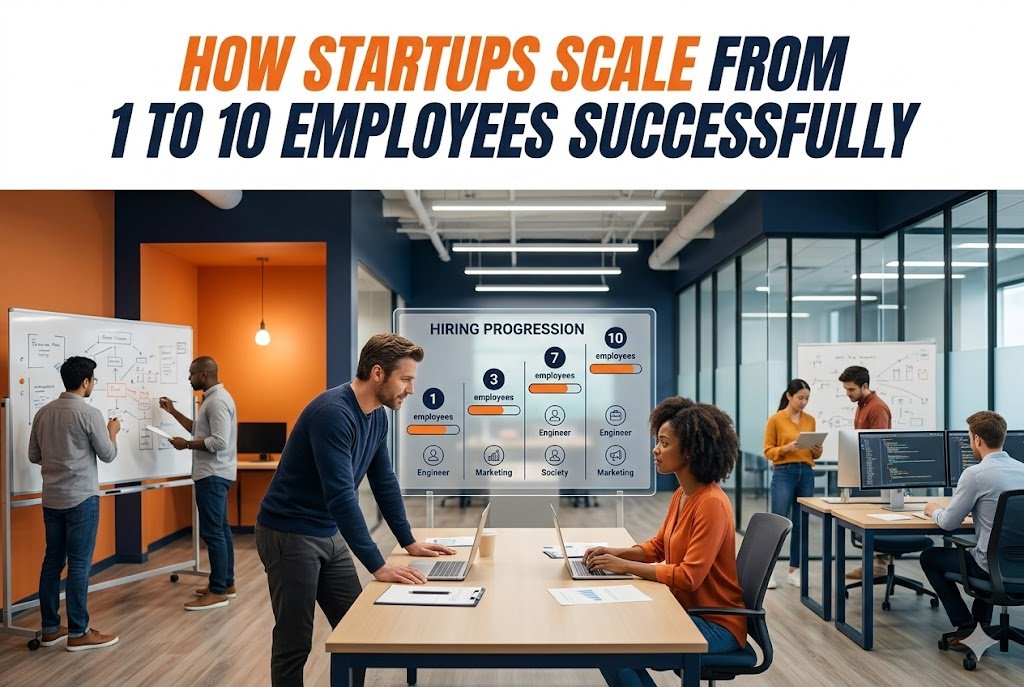
Understanding how startups scale from 1 to 10 employees is one of the most important stages in building a successful company. The transition from solo founder to a small operational team changes everything inside a startup.
At the beginning, founders usually handle:
Product development
Customer support
Sales
Marketing
Operations
But eventually, growth becomes impossible without building a team.
The first 10 employees shape the startup’s culture, speed, communication style, and long-term operational structure. Hiring too quickly can create chaos, while hiring too slowly can slow down growth.
In 2026, startups are scaling faster than ever, but early-stage hiring remains one of the biggest challenges founders face.
If you’re exploring startup operations, growth systems, and founder strategies, you can also explore more startup-focused insights on https://onegrasp.com/startups/ to understand how modern startups scale effectively.
The first few employees are not just workers—they become the foundation of the company.
The stage where how startups scale from 1 to 10 employees becomes critical because:
Every hire has massive impact
Team culture develops early
Communication systems are formed
Operational workflows are created
A bad hire in a 5-person startup affects the entire company. In larger organizations, mistakes can be absorbed more easily.
According to startup leadership research from https://www.forbes.com/, early hiring decisions strongly influence long-term company culture and scalability.
Stage 1: Founder Doing Everything
Most startups begin with a single founder or small founding team.
At this stage:
Speed matters more than perfection
Validation matters more than scaling
Learning matters more than structure
The founder handles almost everything manually.
The main goal is:
Validate demand
Build early traction
Understand customer problems
Improve the product quickly
Many founders make the mistake of hiring too early before validating the business model.
Stage 2: Hiring the First Employee
The first hire is usually made when workload becomes impossible to manage alone.
Most startups hire for:
Technical support
Operations
Marketing
Customer service
The smartest founders usually hire people who solve immediate bottlenecks.
For example:
Technical founders often hire marketers
Business-focused founders often hire engineers
The first employee should increase execution speed significantly.
Stage 3: Building a Small Core Team
As the startup grows to 3–5 employees, team structure becomes more important.
These systems reduce operational confusion as teams expand.
If you’re also exploring startup productivity and operational systems, you can discover more startup growth insights on https://onegrasp.com/startups/.
Stage 4: Defining Roles Clearly
One major challenge in how startups scale from 1 to 10 employees is role confusion.
In small startups, everyone does multiple tasks. But as the company grows:
Startup culture forms much earlier than many founders realize.
The first employees influence:
Communication style
Work ethic
Team energy
Company values
Strong startup cultures often prioritize:
Speed
Ownership
Adaptability
Problem-solving
According to startup leadership discussions on Reddit, many founders believe early culture issues become harder to fix later as teams grow. (reddit.com)
Stage 6: Hiring for Adaptability, Not Just Skills
Early-stage startups change constantly.
This means startups often prefer employees who:
Learn quickly
Handle uncertainty
Solve problems independently
Adapt to changing priorities
In small startups, rigid specialization can slow execution.
The best early hires are usually highly adaptable generalists.
Stage 7: Improving Communication Systems
As startups grow toward 10 employees, communication complexity increases rapidly.
Founders must improve:
Meeting systems
Task tracking
Documentation
Team coordination
Without structure, teams lose alignment quickly.
This is why many startups implement:
Weekly planning meetings
Documentation systems
Transparent workflows
Strong communication reduces operational chaos.
Stage 8: Avoiding Overhiring
One of the biggest startup mistakes is hiring too fast.
Overhiring creates:
Financial pressure
Management complexity
Reduced efficiency
Startups should hire based on:
Real workload
Business growth
Operational bottlenecks
Not based on “looking bigger.”
According to startup scaling research from https://www.mckinsey.com/, sustainable hiring growth is often more effective than aggressive early expansion.
Stage 9: Leadership Evolution for Founders
As teams grow, founders must evolve from “builders” into leaders.
This means:
Delegating tasks
Managing people
Setting direction
Building systems
Many founders struggle because they try to control everything even after hiring.
The transition from operator to leader becomes critical during this stage.
Stage 10: Preparing for Future Scaling
Once startups reach around 10 employees, operations become more structured.
The company begins preparing for:
Department-level organization
Hiring systems
Performance tracking
Scalable workflows
This stage lays the foundation for future growth beyond 10 employees.
Common Mistakes Startups Make
While learning how startups scale from 1 to 10 employees, many founders:
Hire too quickly
Ignore culture fit
Avoid delegation
Fail to document processes
Create unclear responsibilities
Most scaling problems come from operational confusion rather than lack of talent.
Strategic Insight
The process of how startups scale from 1 to 10 employees is less about “growing headcount” and more about building operational systems.
According to leadership analysis from https://hbr.org/, early-stage startups that focus on communication clarity, culture, and operational structure often scale more sustainably.
In 2026, startups move quickly, but the companies that survive long term are usually the ones that build strong internal systems early.
If you’re also exploring startup operations, hiring systems, and scaling strategies, you can discover more startup-focused resources on https://onegrasp.com/startups/.
Conclusion
Understanding how startups scale from 1 to 10 employees helps founders avoid many early-stage operational mistakes.
The first hires shape culture, workflows, communication, and company direction. Startups that scale successfully usually focus on:
Smart hiring
Clear communication
Operational simplicity
Strong culture
Adaptable teams
Scaling is not just about adding people—it is about building systems that allow growth without creating chaos.
FAQs
They shape company culture, operational systems, and long-term growth direction.
Usually when workload becomes too large for the founder to manage alone.
Adaptable problem-solvers who can handle multiple responsibilities.
Why do startups struggle while scaling teams?Common reasons include unclear roles, poor communication, and overhiring.
By building strong systems, hiring carefully, and improving communication early.

 May 7, 2026
 6 Min
 No Comment