Launching a startup without validating the product idea is one of the biggest mistakes founders make. Many startups spend months building complex features only to discover that customers do not actually need the product.
This is why building a Minimum Viable Product (MVP) is critical for modern startups.
An MVP helps founders test business ideas quickly using a basic version of the product with only essential features. Instead of building everything at once, startups launch smaller versions to gather feedback, validate demand, and improve gradually.
Understanding how to build a startup MVP helps entrepreneurs reduce risk, save money, and improve product-market fit.
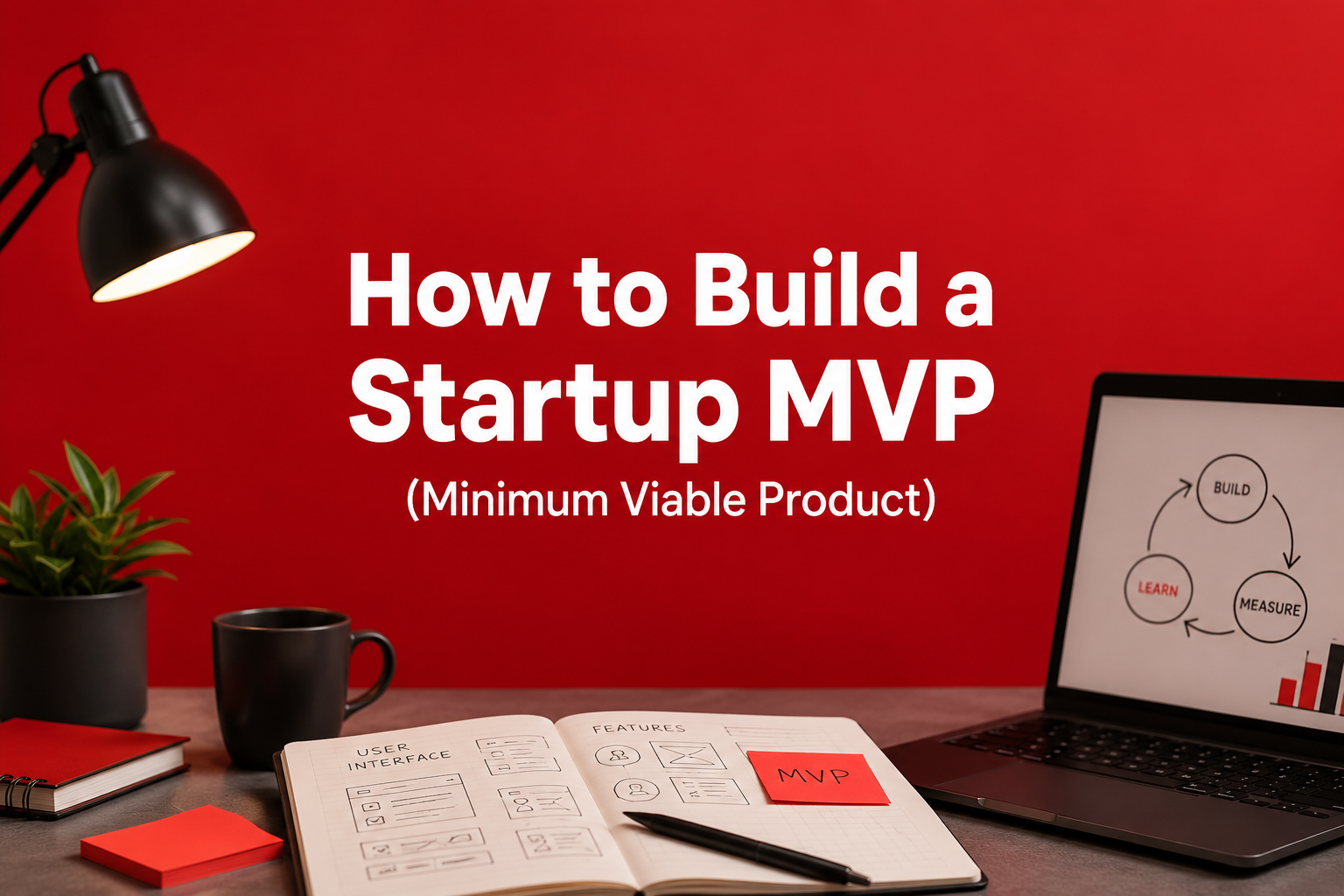
A Minimum Viable Product is the simplest version of a product that solves a core problem for users.
An MVP typically includes:
Essential functionality
Basic user experience
Core problem-solving features
The goal is not perfection. Instead, the goal is learning from real users as early as possible.
Startups use MVPs to:
Validate demand
Test assumptions
Reduce development costs
Improve products faster
Collect user feedback
Many successful companies initially launched with simple MVP versions before scaling globally.
Why MVPs Matter for Startups
Building full-scale products immediately can be risky and expensive.
MVPs help startups:
Launch faster
Avoid unnecessary development
Test market interest
Improve based on feedback
Reduce financial risk
Moreover, MVPs allow startups to adapt quickly when customer behavior changes.
In competitive markets, speed and learning often matter more than perfection.
Step 1: Identify the Core Problem
Every successful MVP begins with solving a clear problem.
Founders should ask:
What pain point exists?
Who experiences this problem?
Why is current solving inadequate?
How can the product simplify the solution?
Many startups fail because they build products without understanding customer frustrations deeply.
Therefore, user research is essential before development begins.
Step 2: Define Essential Features Only
One of the biggest MVP mistakes is adding too many features.
Instead, startups should focus only on:
Core functionality
Basic usability
Main customer value
For example:
A food delivery MVP may only need:
Restaurant listings
Ordering system
Payment integration
Advanced features like loyalty systems or AI recommendations can come later.
Simplifying the product helps startups launch faster and learn earlier.
Step 3: Choose the Right Development Approach
Modern startups can build MVPs using multiple approaches.
No-Code Tools
Platforms like:
Bubble
Webflow
Glide
allow founders to create products without coding.
Custom Development
Technical startups often build custom MVPs for scalability and flexibility.
Hybrid Development
Some startups combine no-code systems with lightweight coding solutions.
The best approach depends on:
Budget
Technical skills
Product complexity
Scalability needs
Step 4: Launch Quickly and Gather Feedback
An MVP should reach users as early as possible.
Many founders delay launches because they want perfect products. However, early feedback is more valuable than internal assumptions.
After launching, startups should track:
User behavior
Retention rates
Customer feedback
Feature usage
Pain points
Real-world insights help improve products more effectively.
Step 5: Improve and Scale Gradually
Successful MVPs evolve continuously.
Startups should improve products based on actual customer needs rather than random assumptions.
Gradual iteration helps businesses:
Improve retention
Increase conversions
Build loyalty
Achieve product-market fit
Over time, MVPs can develop into scalable full-featured platforms.
Expert Insight and Analysis
Startup experts believe MVPs are primarily learning tools rather than incomplete products.
Many founders mistakenly focus too heavily on visual perfection while ignoring customer validation.
Experts recommend prioritizing:
Speed
User feedback
Simplicity
Problem-solving ability
Adaptability
The most successful startups often launch imperfect products but improve rapidly through continuous iteration.
Experts also emphasize that startups should validate demand before investing heavily in scaling.
Latest MVP Trends in 2026
The way startups build and validate Minimum Viable Products (MVPs) has completely evolved. In 2026, speed, experimentation, and user feedback are more important than perfection. Startups are focusing on launching faster, learning earlier, and iterating continuously based on real-world data.
AI-Powered MVP Development
Artificial Intelligence is transforming how MVPs are designed, built, and tested. Startups no longer need large development teams to get started.
AI is helping founders to:
Generate product ideas and feature sets
Build landing pages and UI mockups instantly
Write basic backend logic and code
Create prototypes in hours instead of weeks
Analyze early user feedback and behavior
This acceleration allows startups to validate ideas much faster and reduce time-to-market significantly. In many cases, AI acts as a “co-founder” for early-stage product development.
No-Code Startup Growth
No-code platforms have become a major force in the startup ecosystem. Founders without technical backgrounds can now build fully functional products without writing traditional code.
Popular use cases include:
Building MVP web applications
Creating SaaS dashboards
Designing landing pages and funnels
Automating workflows and integrations
This shift has dramatically lowered the barrier to entry for entrepreneurship. Startups can now test ideas quickly, pivot faster, and avoid heavy upfront development costs.
Lean Product Teams
Modern startups are increasingly adopting lean product development structures. Instead of large engineering teams, they rely on small, highly efficient cross-functional teams.
These teams typically include:
A product thinker or founder
A developer or no-code builder
A designer (often freelance or part-time)
A growth/marketing specialist
This lean structure allows startups to move faster, reduce overhead costs, and make quicker decisions. It also reduces complexity, making it easier to experiment and iterate.
Community-Based Product Validation
Before building full products, startups are now validating ideas directly with their target audience through online communities.
Validation methods include:
Polls and discussions on social platforms
Feedback from Discord, Reddit, or WhatsApp groups
Landing page waitlists
Early access beta testing groups
This approach ensures that startups only build products that solve real problems. It reduces the risk of failure and increases the chances of product-market fit.
Faster Iteration Cycles
In 2026, successful startups follow rapid iteration cycles instead of long development phases. Products are launched early and improved continuously based on real user data.
Key practices include:
Weekly or even daily product updates
A/B testing for features and designs
Real-time analytics-driven decisions
Continuous user feedback integration
This agile mindset ensures that startups evolve based on actual market demand rather than assumptions.
These trends show startups are prioritizing speed, flexibility, and customer feedback.
Common MVP Mistakes Startups Should Avoid
Building too many features early
Delaying launch unnecessarily
Ignoring customer feedback
Spending excessively before validation
Focusing more on design than functionality
What Startup Founders Should Do Next
Research customer pain points deeply
Define essential MVP features clearly
Launch products quickly for validation
Gather user feedback consistently
Improve products through continuous iteration
Conclusion
Understanding how to build a startup MVP helps founders launch products faster while reducing financial and operational risks.
Instead of building large complex systems immediately, startups should focus on solving core customer problems through simple and scalable products.
Modern MVP strategies emphasize speed, feedback, experimentation, and continuous improvement.
In today’s startup ecosystem, businesses that validate ideas early and adapt quickly are more likely to achieve long-term success.
FAQs
MVP stands for Minimum Viable Product, the simplest version of a product solving a core problem.
MVPs help startups validate ideas while reducing development risk and costs.
Simple MVPs can sometimes be built within weeks depending on complexity.
No-code platforms are useful for many early-stage startup MVPs.
Adding unnecessary features before validating customer demand is a common mistake.

 May 11, 2026
 7 Min
 No Comment