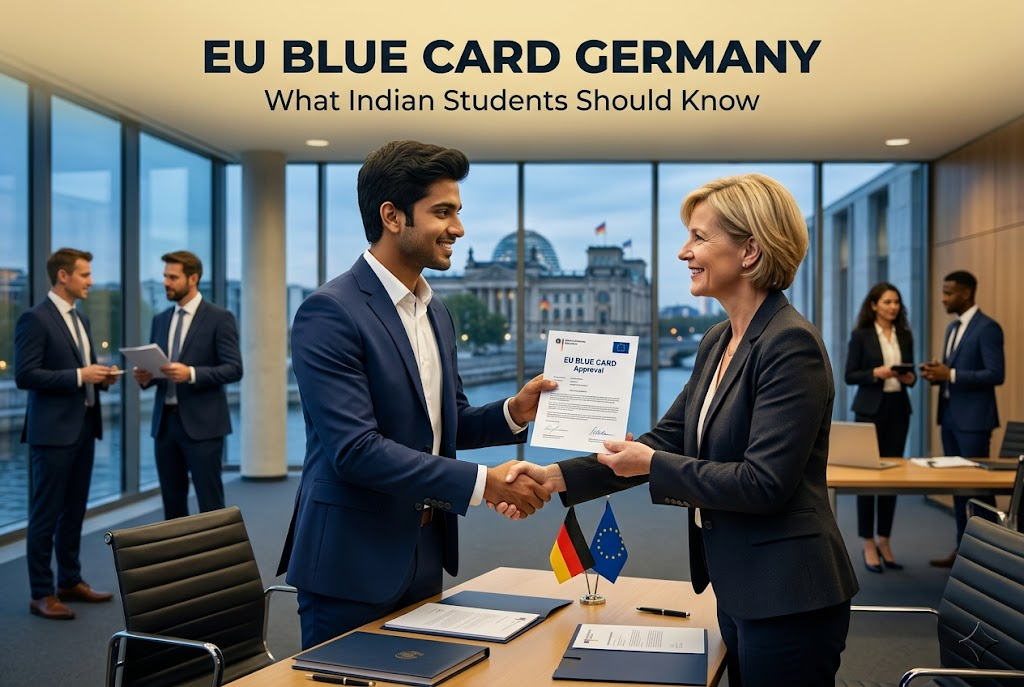
Germany has become one of the most attractive destinations for Indian students because of its affordable education system, strong economy, and excellent career opportunities. One of the biggest advantages for international graduates in Germany is the possibility of obtaining the EU Blue Card Germany, a special residence permit designed for highly skilled professionals.
For Indian students studying in Germany, the EU Blue Card is extremely important because it offers:
Long-term work opportunities
Faster permanent residency pathways
Better career stability
Easier family reunification benefits
Access to Europe’s strongest job market
Germany currently faces shortages of skilled workers in sectors such as:
Information Technology
Engineering
Artificial Intelligence
Healthcare
Data Science
Manufacturing
Renewable Energy
As a result, international graduates with strong qualifications and job offers are increasingly encouraged to stay and work in Germany through the EU Blue Card system.
According to Germany’s official immigration portal, the EU Blue Card is specifically designed for qualified professionals with recognized degrees and a valid job offer in Germany.
Healthcare remains one of the strongest long-term sectors.
Data Science & Artificial Intelligence
Students specializing in:
Machine Learning
AI systems
Analytics
Big Data
have strong Blue Card opportunities.
Renewable Energy Engineering
Germany’s green transition is increasing demand for:
Energy Engineers
Sustainability specialists
Smart grid experts
How Indian Students Can Get an EU Blue Card
The process usually begins after graduation.
Step 1: Complete Your Degree
Students first complete:
Bachelor’s degree
Master’s degree
Technical qualification
from recognized institutions.
Step 2: Find a Qualified Job
Students must secure:
Full-time skilled employment
Job related to qualifications
Salary meeting Blue Card requirements
Internships and networking often help students secure jobs faster.
Step 3: Verify Qualification Recognition
Degrees must be:
German degrees or
Recognized foreign degrees
Germany uses systems such as ANABIN for qualification recognition.
Step 4: Apply for the Blue Card
Applications are submitted through:
Local Foreigners’ Office (Ausländerbehörde)
German embassy in some cases
Required documents usually include:
Passport
Degree certificates
Employment contract
Health insurance
Residence documents
Step 5: Receive Residence Permit
Once approved, students receive:
EU Blue Card residence permit
Work authorization
This allows long-term professional employment in Germany.
Benefits of the EU Blue Card Germany
The Blue Card offers several major advantages.
Faster Permanent Residency
Blue Card holders may receive permanent residency faster than many other visa categories.
According to German immigration resources:
27 months with A1 German
21 months with B1 German skills
Easier Family Reunification
Family members can:
Join Blue Card holders in Germany
Access work opportunities
High Job Flexibility
Blue Card holders can:
Change jobs under certain conditions
Build long-term careers
Stronger Long-Term Security
The Blue Card provides:
Residence stability
Better immigration pathways
Access to Europe’s labor market
Can Students Get PR Through the Blue Card?
Yes, many Indian students eventually obtain:
Permanent Residence (PR)
Long-term settlement permits
through the Blue Card pathway.
Germany considers:
Stable employment
Pension contributions
Language skills
Financial stability
during PR applications.
Is German Language Necessary?
English-speaking jobs are increasing, especially in:
IT
AI
Engineering
Data Science
However, German language skills significantly improve:
Job opportunities
Networking
PR prospects
Workplace integration
Students with B1 or higher German proficiency often progress faster.
Average Salaries for Blue Card Jobs
Approximate annual salary ranges:
Profession
Approximate Salary
Software Engineer
€55,000 – €85,000
Data Scientist
€60,000 – €90,000
Mechanical Engineer
€55,000 – €80,000
AI Engineer
€65,000 – €100,000
Healthcare Specialist
€50,000 – €85,000
Salaries vary based on:
Experience
Location
Industry
Language skills
Challenges Indian Students May Face
Competitive Job Market
Top roles often require:
Strong technical skills
Internship experience
Practical projects
German Language Expectations
Even English-speaking companies may prefer:
Basic German communication skills
Documentation Complexity
Students must manage:
Residence permits
Insurance
Contracts
Registration systems
Housing Pressure
Cities like Munich and Berlin face:
Accommodation shortages
High rental costs
Latest Trends in EU Blue Card Germany (2026)
Germany Is Expanding Skilled Immigration
Germany is actively reforming immigration policies to attract highly skilled workers in engineering, AI, healthcare, and IT sectors because of labor shortages.
Salary Thresholds Continue Updating
Blue Card salary limits are adjusted annually, with lower thresholds available for shortage occupations such as engineering and IT.
IT Professionals Without Degrees Have More Opportunities
Recent reforms allow certain IT professionals to qualify through work experience even without traditional university degrees.
AI and Technology Roles Are Growing Rapidly
Germany’s investments in:
Artificial Intelligence
Automation
Semiconductor manufacturing
Digital transformation
are increasing Blue Card opportunities for international graduates.
International Student Retention Is Increasing
Germany is encouraging more international graduates to remain in the country after completing studies to support the economy and skilled workforce demand.
Faster PR Pathways Are Attracting Students
Many international students now choose Germany specifically because the Blue Card offers one of Europe’s fastest pathways toward long-term residence and settlement.
Expert Insight: Is the EU Blue Card Worth It?
Immigration experts consider the EU Blue Card one of Europe’s strongest work-residence pathways for skilled graduates.
Experts recommend students:
Focus on high-demand fields
Build strong technical skills
Complete internships
Learn German gradually
Network actively during studies
Students who combine technical expertise with practical experience and communication skills usually secure stronger opportunities.
Real-Life Example
Arjun from Bengaluru completed his Master’s degree in Data Science in Germany. During his studies, he participated in AI projects and completed internships with a Berlin technology startup.
After graduation, he secured a full-time Data Scientist role with a salary above the Blue Card threshold. He later applied for the EU Blue Card and began planning for permanent residency.
The EU Blue Card Germany has become one of the most valuable opportunities for Indian students seeking long-term careers and settlement in Europe. Germany’s growing demand for skilled professionals, affordable education system, strong salaries, and fast PR pathways make the Blue Card extremely attractive for international graduates.
Students who strategically combine technical skills, internships, networking, and gradual German language learning can build highly successful careers and long-term futures in Germany through the EU Blue Card pathway.
FAQs
The EU Blue Card is a residence permit for highly skilled non-EU professionals working in qualified jobs in Germany.
Yes, Indian students can apply after securing a qualified job meeting salary requirements.
The 2026 threshold is approximately €48,300–€50,700 annually, with lower thresholds for shortage occupations.
Not always, especially in IT and engineering, but German significantly improves long-term opportunities.
Yes, many Blue Card holders qualify for permanent residency after 21–27 months depending on German language proficiency.

 May 16, 2026
 9 Min
 No Comment