Germany has become one of the most talked-about study abroad destinations for Indian students over the past decade. Affordable education, globally respected universities, and strong job opportunities have made the country increasingly attractive for students seeking international careers.
However, despite the growing hype, studying in Germany is not perfect for everyone.
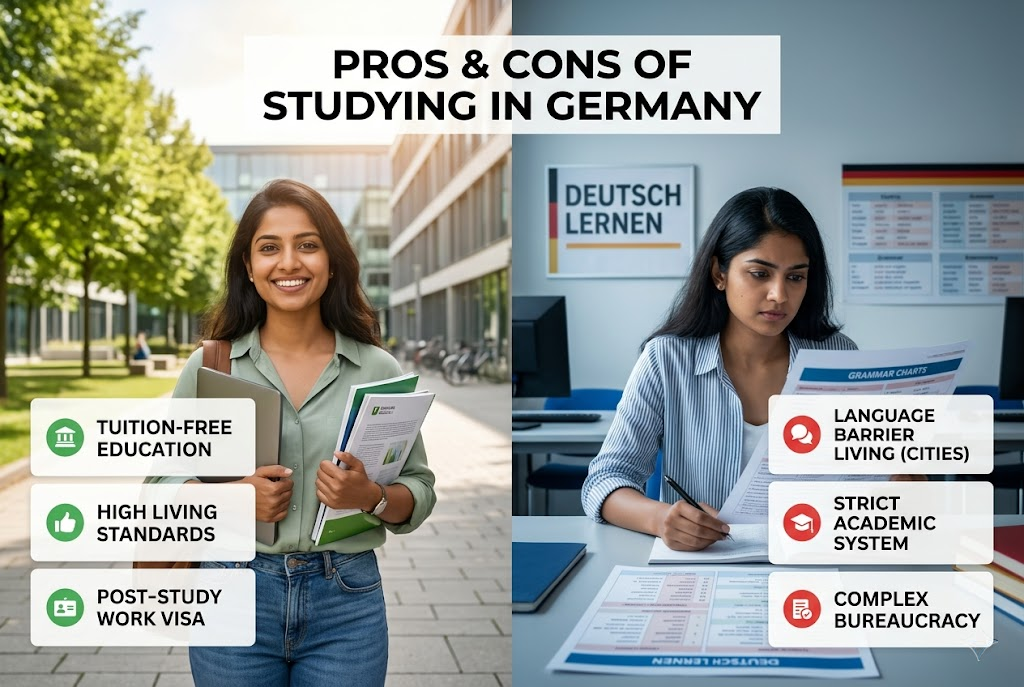
The Germany study pros cons discussion is important because many students only hear success stories online without understanding the real challenges involved in adapting to German education, culture, finances, and career expectations.
Germany offers incredible opportunities — but it also demands independence, planning, and adaptability.
According to the DAAD Germany Official Website, Germany continues attracting hundreds of thousands of international students because of its strong academic reputation and research-focused education system.
Still, before making a life-changing decision, students should realistically understand both:
Advantages
Limitations
This balanced perspective helps students prepare better for long-term success.
Why Germany Became So Popular Among International Students
Germany’s rise as a study abroad destination happened because it solved several problems students faced in other countries.
Compared to nations like:
USA
UK
Australia
Germany offered:
Lower tuition fees
Strong engineering education
Better work-life balance
Affordable public universities
Access to Europe’s job market
At the same time, Germany’s economy remained highly stable and industrially powerful.
This combination created strong interest among students pursuing:
Engineering
AI
Data science
Healthcare
Renewable energy
Business analytics
However, popularity alone does not guarantee the right fit for every student.
Major Advantages of Studying in Germany
Germany offers several powerful long-term benefits for international students.
Affordable Education
One of Germany’s biggest strengths is affordability.
Many public universities charge:
Very low tuition fees
Only semester contributions
Typical semester fees:
150\text{ EUR to }350\text{ EUR per semester}
This dramatically reduces financial pressure compared to countries where tuition alone may cost tens of lakhs.
For many Indian students, Germany provides one of the best global education ROI opportunities.
Strong Global Reputation
Germany is internationally respected for:
Engineering
Manufacturing
Scientific research
Automotive technology
Industrial innovation
Universities like:
Technical University of Munich
RWTH Aachen
Heidelberg University
have strong global recognition.
Degrees from German universities often carry excellent credibility internationally.
Excellent Job Opportunities
Germany faces major shortages in:
IT
AI
Cybersecurity
Engineering
Healthcare
Logistics
This creates strong opportunities for skilled graduates.
According to the Make it in Germany Official Portal, Germany actively encourages skilled international graduates to remain and work after studies.
Students can also access:
Working student roles
Internships
Part-time jobs
EU Blue Card pathways
High Quality of Life
Germany consistently ranks highly in:
Public infrastructure
Transportation
Healthcare
Safety
Environmental quality
Students benefit from:
Reliable public transport
Clean cities
Organized systems
Strong work-life balance
For many international students, daily life feels structured and stable.
Access to Europe
Germany’s location provides access to:
France
Netherlands
Switzerland
Austria
Belgium
Students often travel across Europe during semester breaks at relatively affordable costs.
This international exposure becomes a major life experience advantage.
Major Disadvantages of Studying in Germany
Despite its strengths, Germany also presents serious challenges.
German Language Barriers
This is one of the biggest realities students underestimate.
Although many master’s programs are taught in English, daily life often requires German.
Students may struggle with:
Government paperwork
Housing
Customer service
Local communication
Networking
Meanwhile, many jobs outside international startups still prefer German-speaking candidates.
Students who ignore language learning often face:
Limited job opportunities
Social isolation
Slower integration
Housing Shortages
Finding accommodation in Germany can be surprisingly difficult.
Cities like:
Munich
Berlin
Frankfurt
Hamburg
face intense housing competition.
Students often spend weeks searching for affordable housing after arrival.
According to the StudierendenWERK Germany, demand for student accommodation continues increasing across major university cities.
Early accommodation planning becomes extremely important.
Bureaucratic Processes
Germany’s systems are organized — but often slow.
Students may find processes frustrating involving:
Visa documentation
City registration
Residence permits
Banking
Insurance
Appointments can take weeks or months in some cities.
Patience becomes essential.
Academic Pressure and Independence
German universities often expect:
Independent learning
Self-discipline
Research-based study
Unlike some education systems with continuous supervision, German academics may feel less guided initially.
This surprises many students during their first semester.
Students who struggle with:
Time management
Independent study
Academic pressure
may initially find adjustment difficult.
Weather and Cultural Adjustment
Germany’s climate can feel challenging for students from warmer countries like India.
Long winters, limited sunlight, and cultural differences may affect:
Mental adjustment
Motivation
Social comfort
Meanwhile, German communication styles may initially feel more direct and formal compared to Indian culture.
Adaptation takes time.
Germany Study Pros Cons: Is Germany Really Worth It?
For many students — yes.
But success in Germany depends heavily on:
Preparation
Adaptability
Career planning
Language learning
Financial management
Germany rewards students who:
Build practical skills
Gain internships
Learn German gradually
Network professionally
Prepare independently
Students expecting easy shortcuts or guaranteed outcomes may struggle more.
Public vs Reality: Common Myths About Germany
Many online discussions exaggerate Germany unrealistically.
Common myths include:
“Germany is completely free”
“Everyone gets jobs easily”
“German language is unnecessary”
“Admission guarantees success”
In reality:
Living costs still matter
Jobs remain competitive
Language skills help significantly
Practical experience is critical
Students should approach Germany realistically instead of emotionally.
Expert Insight: Germany Is Best for Self-Motivated Students
Germany’s education system works especially well for students who:
Prefer independence
Enjoy technical learning
Think long-term
Adapt quickly
Manage finances responsibly
Meanwhile, students expecting:
Constant guidance
Simplified bureaucracy
Guaranteed placements
may struggle initially.
Germany rewards maturity, consistency, and self-management more than aggressive marketing expectations.
Latest Trends and Updates
Germany continues expanding opportunities in AI, automation, renewable energy, semiconductor manufacturing, and digital infrastructure, creating strong long-term demand for international graduates.

English-taught programs are increasing rapidly across public universities, especially in technology and engineering fields.

At the same time, housing shortages in major cities are becoming one of the biggest practical challenges for incoming students.

German employers are also increasingly prioritizing practical experience, internships, and communication skills alongside academic qualifications.

Meanwhile, international students are becoming more focused on ROI, employability, and long-term residency opportunities rather than university rankings alone.
Real-Life Example: Two Different Student Experiences
Arjun moved to Germany for mechanical engineering and prepared carefully before arrival.
He:
Learned basic German
Researched accommodation early
Budgeted carefully
Applied for internships early
Within two years, he secured a working student role and later transitioned into full-time employment.
Meanwhile, another student from his batch focused only on admission and ignored:
Language preparation
Networking
Practical experience
Although both studied at similar universities, their outcomes became very different.
Germany offers one of the strongest combinations of affordable education, global career opportunities, and long-term professional growth available today.
However, studying in Germany is not simply about getting admission into a university.
Students who:
Prepare financially
Learn German gradually
Build practical experience
Adapt independently
Think strategically
usually achieve the best outcomes.
Germany is highly rewarding — but it rewards preparation, discipline, and long-term thinking more than shortcuts.

 May 19, 2026
 7 Min
 No Comment