Many people choose careers based on short-term trends, salary pressure, family expectations, or random opportunities. While this may work temporarily, it often leads to confusion, stagnation, or burnout later in life. Learning how to plan long term career growth properly can help individuals build stability, financial progress, and long-term satisfaction.
In today’s rapidly changing economy, career planning has become more important than ever. Artificial intelligence, automation, digital transformation, and global competition are reshaping industries faster than previous generations experienced. Jobs that seem secure today may evolve significantly over the next decade.
At the same time, entirely new career opportunities are emerging across technology, healthcare, digital business, renewable energy, analytics, and creator-driven industries.
According to workforce research by World Economic Forum, millions of jobs will transform significantly because of technology and changing business models in the coming years.
Students and professionals exploring future-ready career guidance can also stay updated through OneGrasp Career Insights.
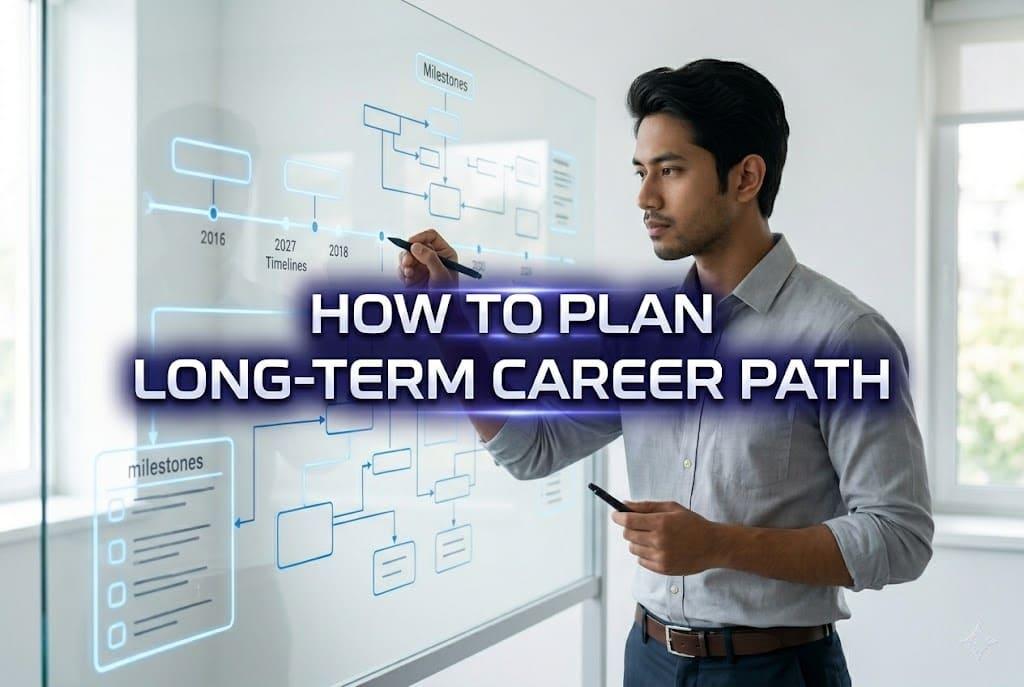
A career roadmap acts like a long-term navigation system.
It helps individuals visualize:
Current position
Target role
Required skills
Experience gaps
Learning milestones
Example Career Roadmap
Career Stage
Focus Area
Beginner
Skill building and internships
Mid-Level
Specialization and leadership
Senior Level
Strategy and management
Advanced Stage
Mentorship or entrepreneurship
Roadmaps provide structure and improve long-term consistency.
Networking Is More Important Than Many Realize
Career growth is not based only on technical skills.
Professional relationships also matter significantly.
Networking helps individuals:
Discover opportunities
Learn industry trends
Gain mentorship
Build reputation
Access hidden job markets
Platforms like LinkedIn, professional communities, internships, and industry events can accelerate career development significantly.
Financial Planning Supports Career Flexibility
Long-term career planning should also include financial awareness.
Without financial planning, professionals may feel trapped in unsuitable jobs due to economic pressure.
Important financial habits include:
Emergency savings
Skill investment budgets
Smart debt management
Income diversification
Financial stability creates freedom to pursue better opportunities later.
Expert Insight / Analysis
One of the biggest shifts in modern careers is that stability now depends more on adaptability than permanence.
Earlier generations often worked in one industry or company for decades. Today, professionals may experience multiple career transitions due to technological and economic changes.
Experts increasingly recommend “career resilience” instead of rigid career dependency.
This means building:
Transferable skills
Continuous learning habits
Strong communication ability
Digital adaptability
Professional networks
Another important trend is hybrid expertise.
Professionals who combine multiple capabilities — such as technology + business or healthcare + analytics — often enjoy stronger long-term opportunities.
Common Mistakes People Make
Many professionals struggle because they make avoidable planning mistakes.
Common issues include:
Following salary trends blindly
Ignoring future industry changes
Avoiding skill upgrades
Depending only on degrees
Neglecting networking
Lack of long-term vision
Another major mistake is expecting instant success.
Strong careers are usually built gradually through consistent improvement over many years.
Latest Trends / Updates
Artificial intelligence is reshaping long-term career planning across nearly every major industry.

Hybrid careers combining technology, communication, and business skills are becoming increasingly valuable.

Remote work is expanding global job opportunities for Indian professionals beyond traditional city-based careers.

Companies are prioritizing adaptability and continuous learning more than static qualifications.

Portfolio-based hiring and practical skill assessment are growing faster than degree-only evaluation models.

Professionals are increasingly building multiple income streams through freelancing, consulting, and digital businesses.
Real-Life Example / Mini Case Study
Consider the example of Rahul, an engineering graduate from Bengaluru.
Initially, he planned only for a traditional software job. However, after researching long-term industry trends, he realized cloud computing and cybersecurity offered stronger future demand.
Instead of staying limited to coding alone, he gradually learned cloud infrastructure, security fundamentals, and project management while working full-time.
Over several years, this strategic skill stacking helped him transition into a senior cloud architect role with significantly better salary growth and international opportunities.
His journey demonstrates how long-term planning and adaptability can accelerate career success.
Pros and Cons of Long-Term Career Planning
Pros
Cons
Better career clarity
Requires patience
Stronger financial growth
Plans may need adjustments
Reduced career confusion
Continuous learning required
Improved adaptability
Initial uncertainty is common
Higher long-term satisfaction
Market changes can disrupt plans
Beginner vs Expert Career Planning
Beginner Mindset
Expert Mindset
Focuses only on immediate salary
Focuses on long-term growth
Avoids difficult skills
Invests in future-ready learning
Depends entirely on degrees
Builds practical expertise
Waits for opportunities
Creates opportunities actively
Resists change
Adapts continuously
How Students and Professionals Can Start Today
Planning a long-term career path becomes easier through consistent action.
Practical starting steps include:
Identify strengths and interests.
Research future industry trends.
Build one high-value skill deeply.
Gain practical experience early.
Create a long-term career roadmap.
Develop communication and networking abilities.
Continue learning every year.
Small improvements compound significantly over time.
Quick Checklist
Identify personal strengths
Study future industry demand
Learn adaptable skills
Build practical experience
Improve networking
Create financial stability
Stay flexible and curious
Conclusion
Planning a long-term career path is no longer optional in today’s fast-changing world. Professionals who think strategically about skills, industry trends, adaptability, and personal growth usually build stronger and more sustainable careers over time.
The goal is not predicting the future perfectly. Instead, it is creating flexibility, resilience, and continuous learning habits that allow long-term growth despite changing industries and technologies.
Whether you are a student starting your journey or a working professional considering future opportunities, investing time in career planning today can create enormous advantages tomorrow. Platforms like OneGrasp can also support learners with career insights, future-ready skills, and professional growth guidance in India.
FAQs
It helps individuals make smarter decisions about skills, education, finances, and professional growth.
Most experts recommend having a 5–10 year flexible career vision while adapting to changing opportunities.
Yes. Modern careers are increasingly flexible, and many professionals successfully transition industries.
Adaptability, communication, digital literacy, problem-solving, and continuous learning are highly valuable.
Passion helps, but sustainable careers usually combine interest, strengths, market demand, and practical skills.

 May 23, 2026
 7 Min
 No Comment