May 25, 2026
 7 Min
 No Comment
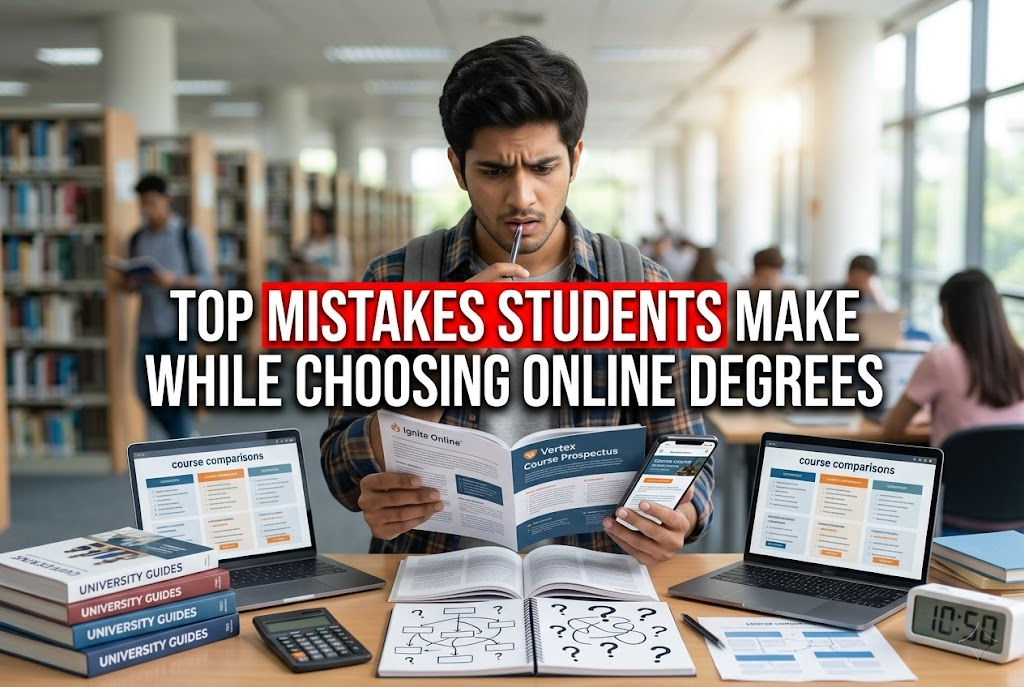
Online education in India has grown rapidly over the last few years. Students now have access to hundreds of digital degree programs across management, commerce, technology, arts, healthcare, and professional certification fields. Flexible schedules, affordable learning, and remote accessibility have made online education attractive for students and working professionals alike.
However, the rapid expansion of digital education has also created confusion. Many students make critical decisions without proper research, often selecting programs based on advertisements, social media hype, or low fees alone.
These online degree choosing mistakes can lead to poor career outcomes, wasted money, weak skill development, and even degree validity issues.
Some students realize too late that their chosen university lacks recognition. Others struggle because the curriculum is outdated or the learning model does not match their learning style.
Choosing the right online degree is not only about getting a certificate. It is about selecting a pathway that aligns with long-term career goals, industry demand, personal strengths, and future employability.
Understanding the most common mistakes students make can help avoid expensive educational decisions and improve long-term career growth.
Ignoring University Recognition and Accreditation
One of the biggest mistakes students make is enrolling in unrecognized institutions.
Many learners focus heavily on marketing claims while ignoring official approvals and accreditation status.
Students should always verify:
- UGC approval
- NAAC accreditation
- AICTE approval where applicable
- Institutional credibility
According to the University Grants Commission, students should verify whether universities are officially approved to offer online degree programs.
Without proper recognition, students may face problems related to:
- Job eligibility
- Higher education admissions
- Government examinations
- Degree acceptance
Students can also explore educational planning guidance through OneGrasp Education Resources before selecting online programs.
Choosing Degrees Only Based on Low Fees
Affordable education is important, but choosing programs only because they are cheap often becomes a costly long-term mistake.
Low-cost programs may sometimes lack:
- Updated curriculum
- Faculty quality
- Career support
- Practical exposure
- Industry relevance
Why Value Matters More Than Price
Students should evaluate:
| Low-Fee Focus Only | Smart Value Evaluation |
|---|---|
| Cheapest option | Career-oriented learning |
| Minimal research | Accreditation verification |
| No skill analysis | Industry relevance check |
| Short-term thinking | Long-term ROI focus |
The cheapest program is not always the best investment.
Ignoring Career Goals
Many students choose degrees based on trends rather than personal career alignment.
For example:
- Choosing MBA because friends selected it
- Selecting coding programs without technical interest
- Pursuing psychology without understanding career paths
Why Career Alignment Matters
Educational decisions should connect with:
- Personal interests
- Industry demand
- Strengths and abilities
- Long-term goals
Students who ignore career planning often lose motivation midway through programs.
Not Researching the Curriculum Properly
A degree title alone does not reveal what students will actually learn.
Two universities offering the same degree may have completely different curriculum quality.
Students should evaluate:
- Subject depth
- Industry-focused learning
- Practical assignments
- Technology integration
- Updated course content
Modern employers increasingly prioritize practical skills over degree labels alone.
According to World Economic Forum Future of Jobs Report, digital adaptability and practical technological skills are becoming increasingly important in future job markets.
Ignoring Learning Style Compatibility
Online learning requires self-discipline and digital comfort.
Some students assume online education is automatically easier than traditional classroom education.
In reality, many learners struggle because they are not prepared for:
- Independent learning
- Time management
- Self-motivation
- Digital learning systems
Questions Students Should Ask
Before enrolling, students should ask:
- Can I study consistently without supervision?
- Am I comfortable with digital learning tools?
- Do I prefer live interaction or self-paced learning?
Choosing the wrong learning format can affect academic performance significantly.
Falling for Aggressive Marketing and Social Media Hype
Modern education marketing has become highly aggressive.
Students frequently encounter:
- Influencer promotions
- Paid reviews
- Unrealistic salary claims
- “Guaranteed placement” promises
Red Flags Students Should Notice
| Warning Sign | Possible Risk |
|---|---|
| Unrealistic salary guarantees | Misleading marketing |
| No accreditation clarity | Recognition problems |
| Excessive urgency tactics | Low-quality admissions strategy |
| Weak curriculum details | Poor academic quality |
Students should always rely on verified institutional information instead of social media hype alone.
Ignoring Skill Development Beyond the Degree
A major mistake many students make is believing the degree itself guarantees employment.
Modern employers increasingly prioritize:
- Practical skills
- Communication ability
- Digital literacy
- Problem-solving
- Portfolio work
Why Additional Skills Matter
Students pursuing online degrees should simultaneously build:
- Internships
- Certifications
- Real-world projects
- Communication skills
- Networking ability
Degrees alone are no longer enough in many industries.
Expert Insight: Why Smart Educational Decisions Matter More Today
India’s education ecosystem is becoming increasingly competitive and technology-driven.
Experts believe future employability will depend on a combination of:
- Academic qualifications
- Technical skills
- Adaptability
- Continuous learning
- Communication ability
Meanwhile, AI and automation are changing job structures rapidly. Therefore, students who make thoughtful educational decisions and continuously upgrade skills may perform better than those who simply chase trending degrees.
The quality of learning is becoming more important than the popularity of the degree title itself.
Common Mistakes Students Continue Repeating
| Mistake | Long-Term Impact |
|---|---|
| Ignoring accreditation | Degree validity issues |
| Following trends blindly | Career dissatisfaction |
| Choosing only by fees | Weak educational quality |
| Avoiding practical skills | Low employability |
| Not researching university reputation | Poor career outcomes |
Awareness is the first step toward making better educational decisions.
Latest Trends and Updates
Artificial intelligence and digital transformation are rapidly changing how online education systems operate across India.

Modern universities are increasingly integrating AI-powered learning dashboards, virtual classrooms, digital assessments, and personalized learning systems into online degree programs.

At the same time, employers are focusing more on skills, portfolios, practical projects, and adaptability rather than relying only on academic degrees.

Students are also increasingly combining online degrees with micro-certifications, internships, coding bootcamps, and industry-specific training programs.

Meanwhile, accreditation awareness is growing as learners become more careful about verifying university legitimacy and long-term career value before enrollment.
Real-Life Example: A Costly Online Degree Mistake
Consider the example of Arun, a student from Andhra Pradesh who enrolled in a low-cost online business degree after seeing aggressive social media advertisements.
Initially, the program appeared attractive because of low fees and fast admission processes. However, he later discovered:
- Limited faculty interaction
- Outdated curriculum
- Weak placement support
- Recognition concerns
After struggling with career opportunities, he eventually pursued additional certifications and skill-based learning separately.
His experience highlights why students should evaluate educational quality carefully rather than focusing only on convenience or marketing.
Beginner vs Expert Educational Decision-Making
| Beginner Approach | Expert Approach |
|---|---|
| Follows trends | Researches deeply |
| Chooses based on ads | Verifies accreditation |
| Focuses only on degree title | Evaluates curriculum quality |
| Ignores practical skills | Builds portfolio alongside degree |
| Chooses quickly | Compares long-term ROI |
Experienced learners approach education strategically rather than emotionally.
Pros and Cons of Online Degrees
| Pros | Cons |
|---|---|
| Flexible learning | Requires self-discipline |
| Accessible from anywhere | Quality varies widely |
| Affordable compared to regular college | Reduced campus interaction |
| Suitable for working professionals | Practical exposure may vary |
| Wide course availability | Digital distractions possible |
What Students Should Do Next
Students planning online education should approach the decision carefully.
Practical next steps include:
- Verify accreditation officially
- Compare curriculum quality
- Align degree with career goals
- Build practical skills simultaneously
- Research university reputation
- Evaluate learning flexibility
- Avoid rushed admissions decisions
Students should also verify accreditation through official bodies like National Assessment and Accreditation Council (NAAC) before enrolling.
Quick Checklist
- Verify UGC recognition
- Compare curriculum quality
- Research university reputation
- Align with career goals
- Build practical skills
- Avoid marketing hype
- Study long-term ROI carefully
Conclusion
The rapid growth of online education has created excellent opportunities for flexible and affordable learning across India. However, it has also increased the risk of poor educational decisions caused by lack of research, social pressure, or misleading marketing.
The most common online degree choosing mistakes students make usually involve ignoring accreditation, following trends blindly, focusing only on low fees, and underestimating the importance of practical skill-building.
In today’s competitive and technology-driven job market, educational success depends not only on earning a degree but also on selecting the right learning environment, developing industry-relevant skills, and maintaining continuous adaptability.
Students who research carefully, think strategically, and prioritize long-term career value over short-term convenience are more likely to build strong and sustainable professional futures.
FAQs
Ignoring accreditation and university recognition is one of the most common and serious mistakes.
No, students should verify whether the university and program are officially approved and recognized.
No, curriculum quality, accreditation, and career value are more important than low fees alone.
No, practical skills, communication ability, and industry readiness also play major roles in employability.
Students should verify UGC approval, NAAC accreditation, curriculum quality, and institutional reputation before enrolling.