Published: November 24, 2026 Category: Astronomy | Space Science | Astrophysics
What if a star system existed that astronomers believed should not be possible?
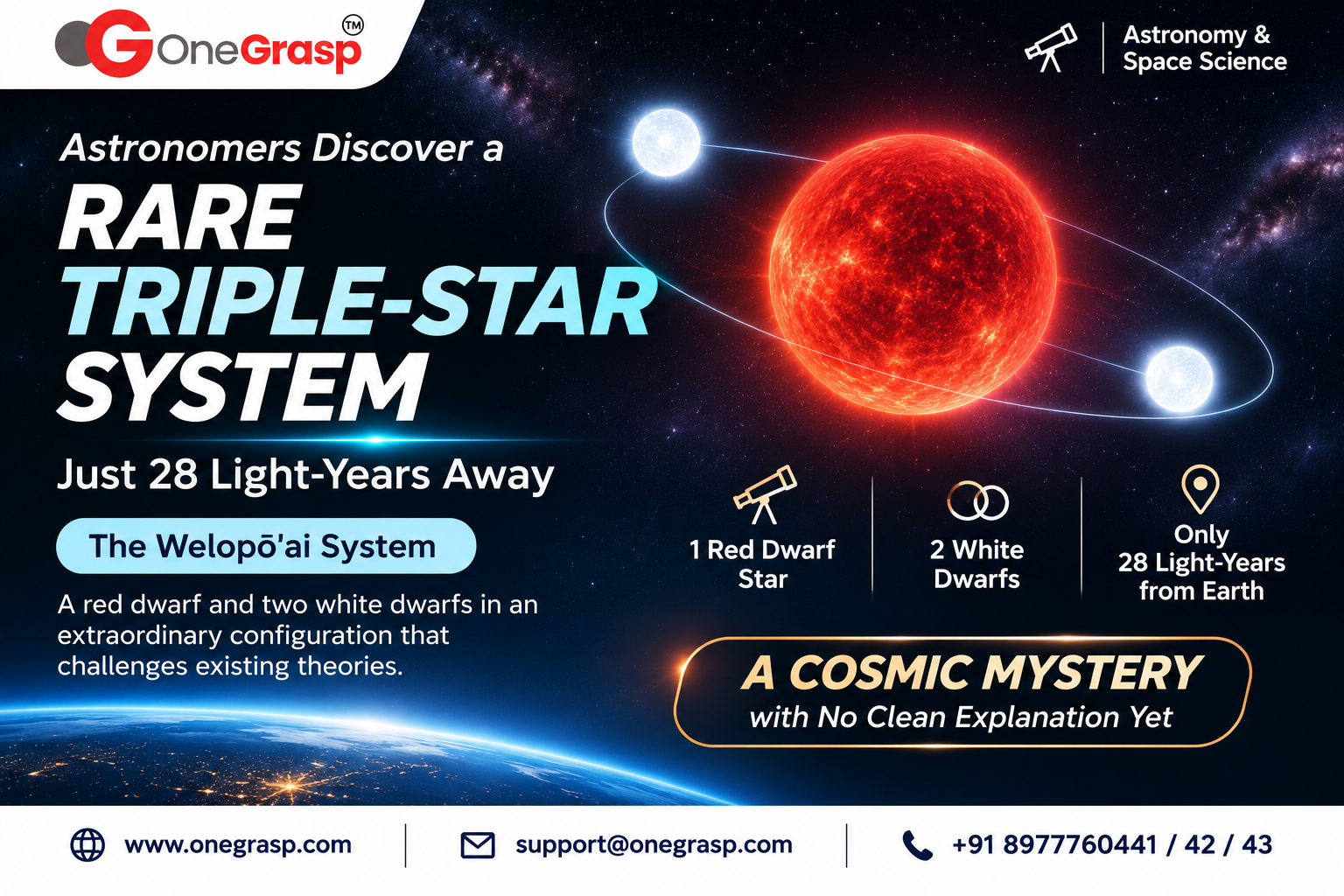
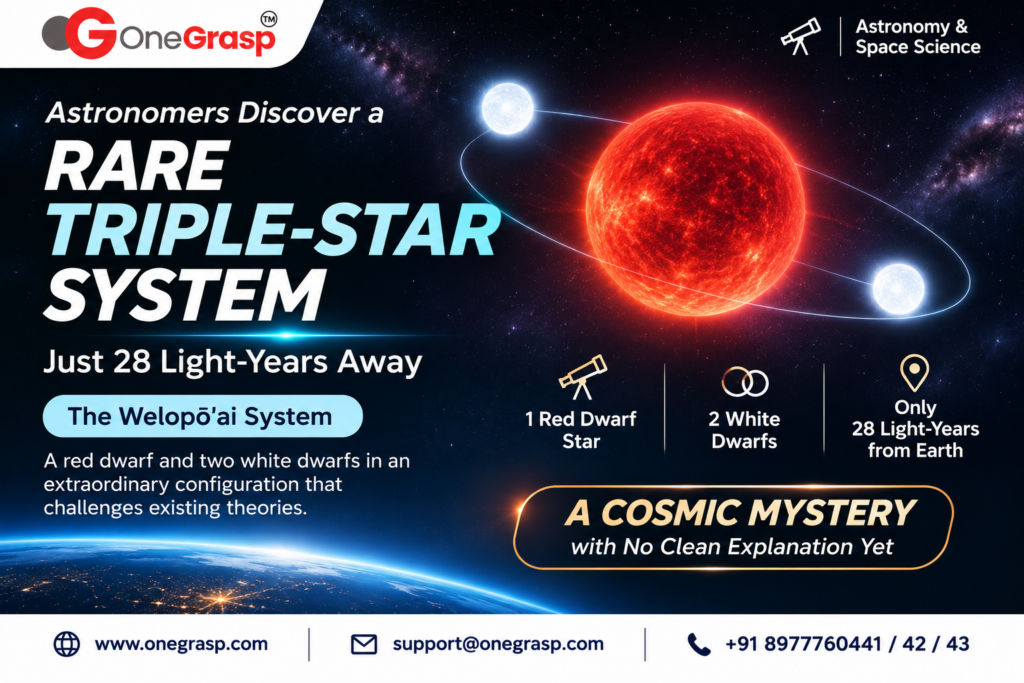
In a remarkable astronomical discovery, researchers have identified an unusual triple-star system located just 28 light-years from Earth. The system, named Welopō’ai, contains one red dwarf star and two white dwarfs, creating an extraordinary configuration that has left scientists searching for an explanation.
What makes this discovery particularly fascinating is that astronomers were not initially looking for such a system. Their original objective was to search for planets. Instead, their observations revealed something far more unexpected.
The discovery offers a new opportunity to understand stellar evolution, gravitational interactions and the mysterious life cycles of stars.
Welopō’ai is an unusual stellar system consisting of three objects:
One red dwarf star.
One white dwarf orbiting relatively close to the red dwarf.
A second white dwarf orbiting the inner pair from a much greater distance.
The system is approximately 28 light-years away from Earth.
Its name combines two Hawaiian words associated with a path of family traits.
According to the research team, the arrangement is particularly unusual because the evolutionary history of the stars should have significantly disturbed the system’s orbital configuration.
Scientists are now investigating how the three stars reached their present positions.
How Was This Extraordinary Discovery Made?
The discovery was led by Étienne Artigau of the Trottier Institute for Research on Exoplanets at the Université de Montréal.
The research team was using the SPIRou instrument on the Canada–France–Hawaii Telescope to search for planets orbiting the red dwarf.
Astronomers use a technique called the radial velocity method to identify planets.
When a planet orbits a star, its gravitational influence causes the star to move slightly around the system’s centre of mass. This movement produces detectable changes in the star’s light, known as Doppler shifts.
However, the researchers detected an unusually large radial velocity signal of approximately 16 kilometres per second.
Such a signal was far too large to be explained by an ordinary planet.
Further observations using the Gemini North telescope helped identify the hidden companion as a white dwarf — the dense remnant of a star that has reached the end of its normal life cycle.
What Are White Dwarfs and How Do They Form?
White dwarfs represent one of the final evolutionary stages of stars similar in mass to our Sun.
As a star gradually exhausts the hydrogen available for nuclear fusion in its core, its internal structure begins to change.
The star expands into a red giant, eventually shedding its outer layers into space. Its remaining core contracts into a dense stellar remnant known as a white dwarf.
Despite having a mass comparable to a substantial fraction of the Sun, a white dwarf is approximately Earth-sized.
Unlike ordinary stars, white dwarfs no longer generate energy through sustained nuclear fusion in their cores.
Their structure is supported by a quantum mechanical phenomenon called electron degeneracy pressure, which prevents further gravitational compression under ordinary white dwarf conditions.
Understanding these objects helps astronomers investigate the final stages of stellar evolution.
What Makes This Triple-Star System So Unusual?
The most intriguing aspect of Welopō’ai is its orbital configuration.
The newly identified white dwarf is separated from the red dwarf by approximately 4.6 astronomical units, making it closer to the red dwarf than Jupiter is to our Sun.
The two objects have the following estimated masses:
Stellar object
Estimated mass
Red dwarf
42% of the Sun’s mass
Newly identified white dwarf
62% of the Sun’s mass
The newly identified white dwarf is believed to have originated from a star that was approximately 40% more massive than our Sun.
The second white dwarf is located much farther away. It orbits the inner pair at approximately 129.3 astronomical units, with an orbital period of around 1,000 years.
These measurements make the system particularly valuable for studying how stars evolve and interact over long periods.
Why Do Scientists Say This System Should Not Exist?
The central mystery concerns the transformation of the original stars.
Astronomers believe the system once contained two Sun-like stars and one red dwarf.
As the two larger stars evolved into red giants, their expanding outer layers should have disturbed the gravitational environment of the system.
This process could have destabilised the red dwarf’s orbit or potentially caused it to interact with one of the expanding stars.
Yet the red dwarf remains in a relatively stable orbit.
How did it survive this evolutionary process?
Researchers do not yet have a definitive explanation.
Further observations of the gravitational interactions between the three objects may help reconstruct their evolutionary history.
Why Is This Discovery Important for Astronomy and Astrophysics?
Welopō’ai is more than an unusual astronomical observation. It offers scientists an opportunity to test existing models of stellar evolution.
Some important research possibilities include:
1. Understanding Stellar Evolution
The system provides an opportunity to examine how stars transform from ordinary stars into white dwarfs.
2. Testing Gravitational Models
Studying the orbital relationships between the three objects could help researchers understand how complex stellar systems remain stable.
3. Investigating White Dwarf Physics
Accurate measurements of white dwarf masses can help scientists investigate the extreme physical conditions inside these dense stellar remnants.
4. Improving Astronomical Observation Techniques
The discovery demonstrates how instruments originally designed to identify exoplanets can reveal entirely different astronomical objects.
5. Understanding the History of Multiple-Star Systems
Further research could help explain how stellar companions survive major evolutionary changes within their systems.
What Can Young Researchers Learn From This Discovery?
One of the most important lessons from Welopō’ai is that scientific discoveries do not always happen according to the original research plan.
The astronomers were searching for planets but discovered an unexpected stellar configuration.
This demonstrates the importance of scientific curiosity, advanced observation techniques, interdisciplinary knowledge and the willingness to investigate unexpected results.
Students and aspiring researchers interested in astronomy can explore several emerging research areas:
Astrophysics and Stellar Evolution
Observational Astronomy
Exoplanet Research
Gravitational Dynamics
Computational Astrophysics
Space Science and Instrumentation
Quantum Physics and Dense Matter
Data Science in Astronomy
These areas offer opportunities for academic research, scientific collaboration and future technological innovation.
The Universe Still Has Surprises Waiting to Be Discovered
The discovery of Welopō’ai reminds us that even our relatively nearby cosmic neighbourhood contains mysteries that existing scientific models cannot fully explain.
Located just 28 light-years away, this unusual triple-star system provides researchers with an exceptional opportunity to investigate stellar evolution, gravitational interactions and the physics of white dwarfs.
Further observations may eventually reveal how the red dwarf survived the dramatic transformation of its stellar companions.
Until then, Welopō’ai remains a fascinating reminder that scientific progress begins with asking questions that existing explanations cannot answer.
Sometimes, the most important discovery is not what scientists set out to find, but what they were curious enough to investigate.
About OneGrasp
OneGrasp is a global academic and research platform connecting students, research scholars, scientists, educators and industry professionals with international academic opportunities.
Through international scientific conferences, research initiatives, academic workshops and professional development programmes, OneGrasp encourages knowledge exchange and interdisciplinary collaboration.
Explore research. Discover opportunities. Connect with the global scientific community.

 November 24, 2026
 6 Min
 No Comment