April 24, 2026
 4 Min
 No Comment
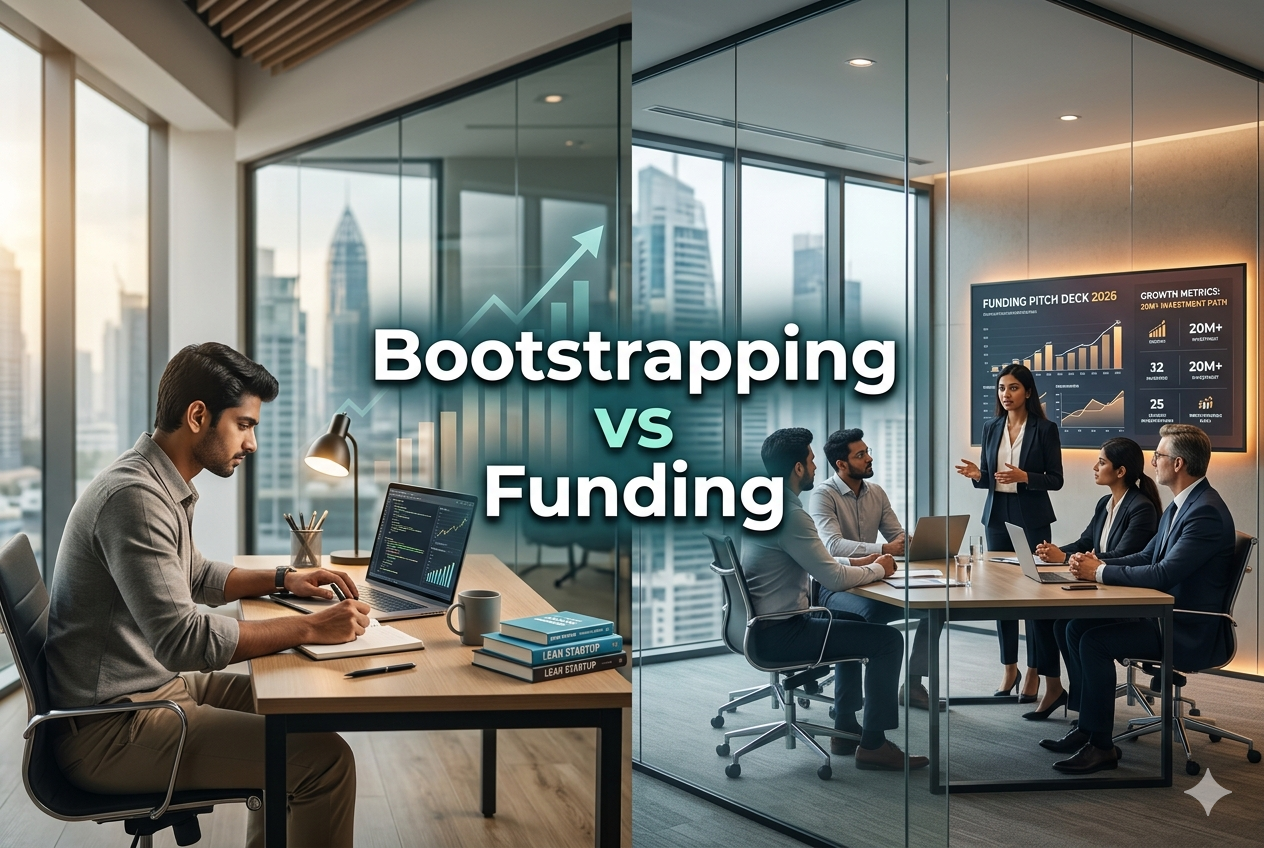
bootstrapping vs funding is the pivotal decision that determines whether Indian founders retain control or accelerate growth through external capital.
Every founder eventually faces one big question: should you grow your startup with your own money or raise external funding?
If you are searching for bootstrapping vs funding, you are likely stuck between independence and rapid scaling.
There is no universal right answer—but there is a right strategy for your situation. The decision you make can define how fast your startup grows, how much control you retain, and even whether you survive the first 3 years.
Let’s break it down in a practical, real-world way.
Understanding Bootstrapping vs Funding in Startups
Bootstrapping means building your startup using personal savings or internal revenue.
Funding means raising capital from investors such as angel investors, venture capital firms, or institutions.
In India, nearly 60–70% of early-stage startups begin as bootstrapped ventures, according to industry insights.
Platforms like https://onegrasp.com/startups/ also show increasing interest among founders exploring funding options at later stages.
Both paths are valid—but they serve different goals.
Bootstrapping: Full Control, Slow Growth
Bootstrapping is popular among first-time founders because it gives complete ownership.
Advantages:
- Full control over decisions
- No investor pressure
- Profits belong entirely to founders
- Strong discipline in spending
Disadvantages:
- Limited resources
- Slower growth
- High personal financial risk
However, bootstrapped startups often build stronger business fundamentals because they must be profitable early.
Funding: Fast Growth, Shared Control
Funding helps startups scale quickly by injecting external capital.
Advantages:
- Faster expansion
- Access to networks and mentors
- Ability to hire and scale quickly
- Strong brand credibility
Disadvantages:
- Equity dilution
- Investor pressure for returns
- Less decision-making freedom
According to Startup India, funded startups scale significantly faster but face higher accountability.
Bootstrapping vs Funding: Key Comparison
Here’s a simple breakdown:
- Bootstrapping: Slow but stable growth
- Funding: Fast but high-pressure growth
Bootstrapping works best for:
- Service businesses
- Freelancers
- Low-capital startups
Funding works best for:
- Tech startups
- High-scale businesses
- Market-disrupting ideas
Common Mistakes Founders Make
Many startups fail not because of the model—but because of poor execution.
Mistakes include:
- Raising funding too early
- Ignoring cash flow in bootstrapping
- Overvaluing startups without traction
- Scaling too fast without product-market fit
Moreover, emotional decision-making often leads to financial mistakes.
Benefits of Choosing the Right Strategy
Selecting the right path gives you:
- Financial stability
- Better decision clarity
- Higher survival chances
- Stronger long-term positioning
Therefore, the right choice depends on your business model—not trends.
Tips to Choose the Right Startup Approach
Before deciding:
- Understand your cash runway
- Validate your idea first
- Study competitor funding models
- Define your growth speed expectations
👉 Explore startup guidance here: https://onegrasp.com/startups/
Government & Institutional Support
India’s startup ecosystem is growing rapidly with support from Ministry of Commerce and Industry.
Support includes:
- Seed funding programs
- Tax benefits
- Incubation support
- Startup India recognition
These initiatives reduce dependency on external investors at early stages.
Career Impact of Your Choice
Your funding strategy impacts your entrepreneurial journey:
- Bootstrapping builds discipline and ownership mindset
- Funding builds scale and leadership exposure
However, both paths require consistency, resilience, and execution power.
Conclusion
The debate of bootstrapping vs funding is not about which is better universally—but which is better for your startup stage.
If you want control and slow growth, bootstrapping is ideal. If you want rapid scaling and external support, funding is the way forward.
The smartest founders often start bootstrapped and move to funding later.
👉 Start your entrepreneurial journey today with expert guidance and choose the path that matches your vision.
❓ FAQs
1. What is bootstrapping in startups?
It means funding your startup using personal money or revenue.
2. Is funding better than bootstrapping?
It depends on your business goals and growth speed.
3. Can I switch from bootstrapping to funding?
Yes, many startups do it after achieving traction.
4. What percentage of startups are bootstrapped?
Around 60–70% in India start as bootstrapped businesses.
5. Does funding guarantee startup success?
No, execution matters more than funding.
Frequently Asked Questions
What is bootstrapping in the context of Indian startups?
Bootstrapping means building your startup using personal savings, revenue, or internal cash flow without external investor money.
When is funding more suitable than bootstrapping?
Funding is ideal when you need rapid scaling, hiring, or network access that personal resources cannot support.
Can a startup switch from bootstrapping to funding later?
Yes, many founders start bootstrapped to prove traction and then raise capital to accelerate growth.
What percentage of Indian startups begin as bootstrapped ventures?
Industry data shows roughly 60‑70% of early‑stage Indian startups start bootstrapped.
Does securing funding guarantee startup success?
No, success depends more on execution, product‑market fit, and disciplined management than on funding alone.
Related Posts: