May 5, 2026
 5 Min
 No Comment
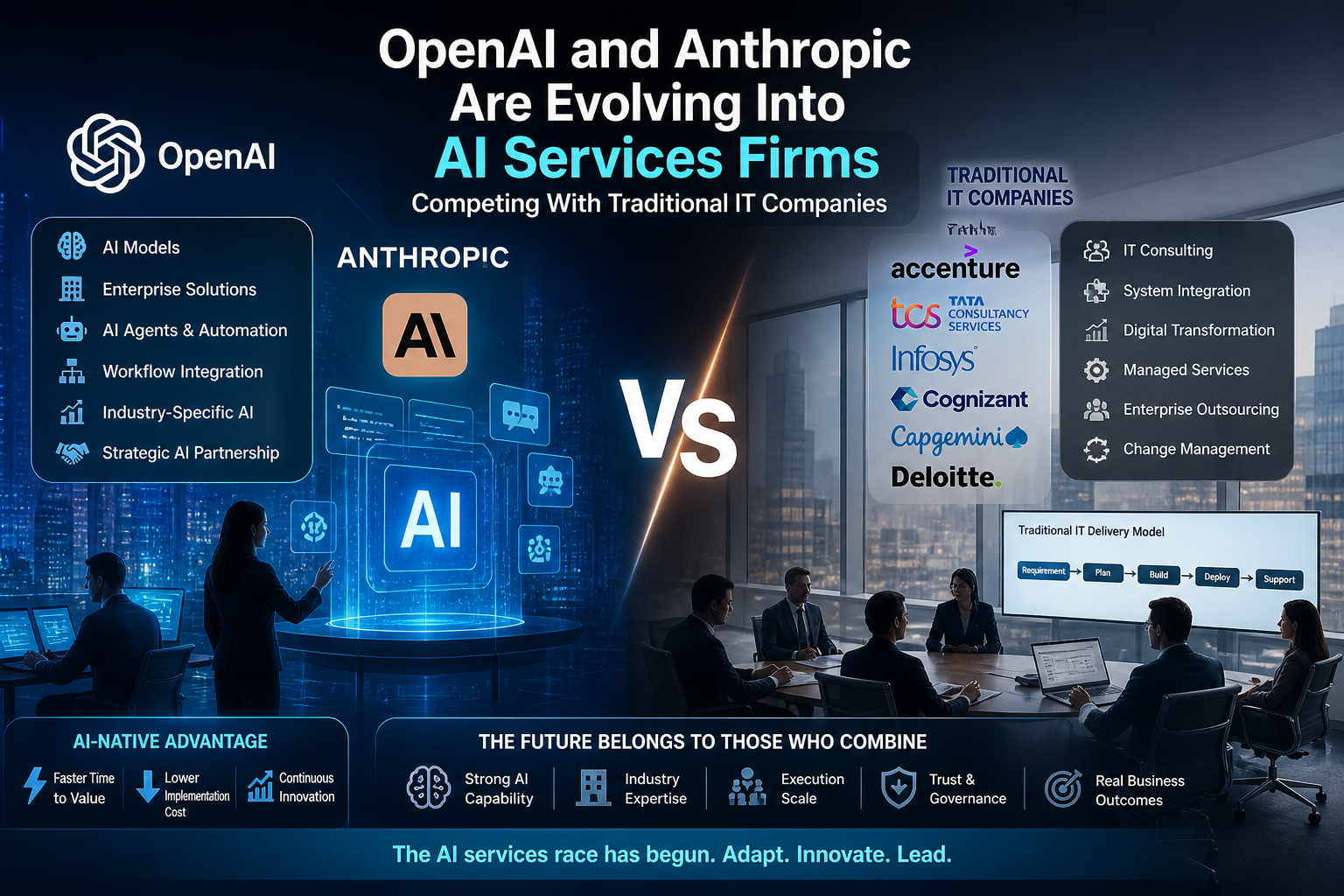
AI services firms like OpenAI and Anthropic are rapidly expanding beyond model licensing to offer enterprise consulting and workflow automation.
For years, OpenAI and Anthropic were seen primarily as AI model companies building powerful language models.
That perception is rapidly changing. In 2026, both firms are increasingly moving toward enterprise execution, consulting, workflow automation, and business transformation — areas historically dominated by traditional IT services companies.
This shift means AI leaders are no longer just technology providers. They are becoming direct competitors to firms like Accenture, TCS, Infosys, Cognizant, Capgemini, and Deloitte.
OpenAI and Anthropic Are Becoming AI Services Firms
The first phase of the AI boom was about building foundational models.
The second phase is about helping enterprises actually use AI to improve operations, reduce costs, automate workflows, and generate revenue.
That is where OpenAI and Anthropic are now expanding.
Instead of only selling API access or subscriptions, these companies are increasingly focused on:
- Enterprise deployments
- Custom AI integrations
- Workflow automation
- AI agents for business processes
- Industry-specific AI solutions
- Strategic AI transformation partnerships
This moves them closer to the traditional IT services model.
Explore more information: Startups
Why This Threatens Traditional IT Firms
For decades, IT services giants earned revenue from:
- Digital transformation projects
- Software implementation
- Process automation
- Managed services
- Consulting engagements
- Large enterprise outsourcing deals
Now AI-native companies can deliver many of these outcomes faster and with fewer people.
That changes the economics of the industry.
What Makes OpenAI and Anthropic Different
1. Product + Services Combination
Traditional firms often rely on external software vendors.
OpenAI and Anthropic own the core AI technology itself, allowing them to bundle:
- Models
- Platforms
- Deployment
- Support
- Optimization
This can be more attractive for enterprises.
2. Faster Time to Value
Instead of 12-month transformation programs, AI tools can sometimes deliver results in weeks.
Businesses increasingly want speed, measurable ROI, and lower implementation risk.
3. Executive-Level Demand
CEOs now view AI as a boardroom priority.
That means OpenAI and Anthropic can enter organizations directly through strategic AI mandates rather than waiting through slower IT procurement cycles.
How Traditional IT Companies May Respond
The major IT firms still have significant advantages:
- Existing enterprise relationships
- Global delivery teams
- Compliance expertise
- Industry knowledge
- Change management experience
- Large-scale implementation capacity
Their likely response will include:
- Partnering with AI labs
- Building proprietary AI tools
- Reskilling employees
- Outcome-based pricing models
- AI managed services offerings
Winners in the New Market
The future likely belongs to firms that combine:
- Strong AI capability
- Industry expertise
- Execution scale
- Trust and governance
- Real business outcomes
This means both AI-native firms and legacy IT players can win — but only if they adapt quickly.
What This Means for Professionals
For engineers, consultants, and IT employees, this shift is significant.
The most valuable skills in the next 5 years may be:
- AI implementation
- Prompt engineering
- Workflow redesign
- Data governance
- AI risk management
- Domain expertise + AI usage
Pure traditional outsourcing skills may face pressure.
Strategic Insight
OpenAI and Anthropic are not merely software vendors anymore. They are evolving into AI transformation partners.
That puts them on a collision course with traditional IT services companies whose business models depend on selling large-scale technology change programs.
Common Mistakes in Understanding This Shift
- Assuming AI firms only sell chatbots
- Believing IT services firms will disappear overnight
- Ignoring enterprise trust and compliance needs
- Underestimating speed of AI adoption
Reality is more nuanced: this is a market reshaping, not instant disruption.
Businesses and professionals who adapt early to AI-led services will benefit the most.
- Learn AI transformation skills
- Understand enterprise AI demand
- Build domain + AI capability
The next wave of competition is not model vs model — it is AI firms vs legacy service firms
FAQ SECTION
Are OpenAI and Anthropic becoming consulting firms?
Not traditional consulting firms, but they are expanding into enterprise transformation and implementation services.
Will AI replace IT services companies?
Not entirely. It is more likely to reshape pricing, staffing, and delivery models.
Which IT firms are most exposed?
Firms heavily dependent on labor-based digital transformation and repetitive outsourcing work may face pressure.
Can traditional IT firms still win?
Yes, especially those combining enterprise trust, domain expertise, and AI capability.
What skills should professionals learn now?
AI implementation, automation, governance, and industry-specific AI use cases.
Frequently Asked Questions
Are OpenAI and Anthropic becoming consulting firms?
They are not traditional consulting firms, but they are adding enterprise transformation and implementation services to their portfolios.
Will AI services firms replace traditional IT services companies?
They will not replace them entirely; instead, they will reshape pricing, staffing, and delivery models, creating new competitive dynamics.
Which IT firms are most exposed to AI services competition?
Companies heavily reliant on labor‑intensive digital transformation and repetitive outsourcing work, such as some divisions of Accenture, TCS, and Cognizant, face the greatest pressure.
What skills should professionals develop to stay relevant?
Focus on AI implementation, prompt engineering, workflow redesign, data governance, AI risk management, and combining domain expertise with AI usage.
How can traditional IT firms respond to AI services firms?
They can partner with AI labs, build proprietary AI tools, reskill employees, adopt outcome‑based pricing, and launch AI‑managed services offerings.